Related Articles

Introduction: A Prayer That Does Not End Where We Think It Does
There are moments in Holy Mass that we repeat so often that we risk no longer asking ourselves what they mean. One of them occurs when the priest invites the faithful to pray the Our Father. The entire congregation then joins in the prayer that Jesus Christ Himself taught His disciples. We ask the Father that His name may be hallowed, that His Kingdom may come, that His will may be done, that He may give us our daily bread, forgive our sins, and deliver us from evil.
However, when we pray the Our Father during the celebration of the Eucharist, something happens that may attract our attention, especially if we are accustomed to praying it at home, during the Rosary, or as part of other devotions: we do not say “Amen” when its words come to an end.
Why does this happen? Is it a liturgical omission? Is it a peculiarity of the Roman Rite? Why, after asking the Father to deliver us from evil, does the priest continue with words that are not part of the Our Father as it appears in the Gospel?
The answer is found in an ancient tradition of Christian liturgy: the embolism.
This word, which is unfamiliar to many Catholics, refers to a prayer that expands and develops the final petition of the Our Father. During Holy Mass, the priest takes up the supplication “deliver us from evil” and extends it through a prayer asking the Lord to free us from sin, protect us from disturbance, and grant us peace as we await the glorious coming of Jesus Christ.
The embolism is therefore neither an unimportant addition nor a formula recited simply because the ceremonial prescribes it. It is an expression of the Church’s faith, a prayer deeply connected with Christian hope, the struggle against sin, the peace that comes from God, and the expectation of the Lord’s return in glory.
Understanding it will help us participate in the Eucharist more consciously, rediscover the richness of traditional liturgy, and understand that the words of the Mass are not arranged arbitrarily: they form an organic prayer in which every gesture, silence, and formula has its proper place and meaning.
1. What Exactly Is the Embolism?
The word embolism comes from the Greek embolismós, a term associated with the idea of inserting, interposing, or introducing something. In liturgical language, it refers to a prayer inserted to develop or expand a preceding prayer.
In the Roman Rite Mass, the term is used especially for the prayer that immediately follows the Our Father.
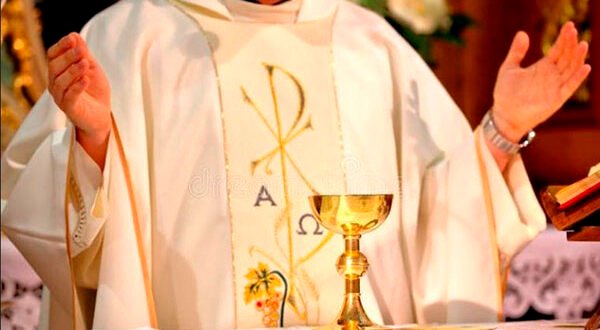
In the current Roman Rite liturgy, after the people have finished the Our Father, the priest says these words:
“Deliver us, Lord, we pray, from every evil, graciously grant peace in our days, that, by the help of your mercy, we may be always free from sin and safe from all distress, as we await the blessed hope and the coming of our Savior, Jesus Christ.”
The congregation responds:
“For the kingdom, the power and the glory are yours now and for ever.”
The exact wording may vary among approved liturgical translations, but the fundamental structure remains the same: the Our Father ends without the people saying “Amen”; the priest develops the final petition through the embolism; and the congregation responds with an acclamation proclaiming the Kingdom, power, and glory of God.
It is important to distinguish three elements:
- The Our Father: the prayer taught by Jesus Christ, which the whole Church addresses to the Father.
- The embolism: the presidential prayer that develops the final petition of the Our Father.
- The concluding acclamation: the people’s response proclaiming the sovereignty of God.
These are not three independent prayers artificially joined together. They form a coherent liturgical sequence.
The embolism is understood precisely in relation to the petition from which it arises: “Deliver us from evil.” The priest does not abandon the content of Christ’s prayer but unfolds it and applies it to the life of the Church.
This distinction also helps us avoid a misunderstanding: the embolism is not a new version of the Our Father, a modification of the Gospel words, or a private prayer introduced by the priest on his own initiative. It is a liturgical formula proper to the celebration of the Eucharist.
2. Why Do We Not Say “Amen” at the End of the Our Father During Mass?
This is the central question.
When we pray the Our Father outside Mass, we usually conclude with the word “Amen.” This is what happens during the Rosary, in personal prayer, and in many devotional practices. It is also customary in other Christian traditions.
In the Roman Rite, however, the Our Father is integrated into a broader sequence. Its final petition does not immediately receive the customary conclusion but is followed by the embolism.
The principal reason is liturgical: the Our Father and the embolism form a single unit of prayer, and the conclusion of that sequence comes after its development.
“Amen” essentially means “so be it,” “it is true,” or “we believe it.” It is a word of assent and adherence to what has been proclaimed or requested. There is no general prohibition against saying it after the Our Father. Indeed, the faithful say it when praying this prayer outside the Roman Eucharistic sequence.
During Mass, however, liturgical tradition has established a different structure. The congregation does not insert “Amen” between Christ’s prayer and the prayer that develops it. Instead, the congregation continues with the embolism and then participates in the acclamation.
This does not mean that the Our Father is theologically incomplete or that Jesus Christ’s prayer needs to be corrected. It means that the Church has established a particular liturgical form for proclaiming it within the Eucharistic celebration.
An Important Clarification
We must not claim that “Amen” is intrinsically incompatible with the Our Father or that saying it outside Mass is less correct. Nor would it be accurate to maintain that all Christians of every age and rite have followed a single practice.
The matter is both simpler and more profound: in the Roman Rite, the absence of “Amen” at that point reflects the received structure of liturgical prayer.
The liturgy is not a collection of independent prayers that each person may rearrange according to personal preference. It is the public prayer of the Church, received and transmitted through the centuries. For this reason, the way its prayers are connected has significance of its own.
The faithful who understand this structure no longer interpret the absence of “Amen” as an accidental omission. Instead, they begin to discover a continuity between Christ’s supplication, the priest’s prayer, and the people’s acclamation.
3. The Biblical Foundation: “Deliver Us from Evil”
To understand the embolism, we must return to the Gospel.
Saint Matthew records the teaching of Jesus Christ on prayer in the Sermon on the Mount:
“You are to pray like this: Our Father, who art in heaven…” (cf. Matthew 6:9–13).
The prayer concludes, in the customary form of the Our Father, with these words:
“And lead us not into temptation, but deliver us from evil” (Matthew 6:13, according to the traditional wording found in many English translations).
This final petition contains extraordinary spiritual depth.
Jesus does not teach His disciples to regard themselves as invulnerable. Nor does He promise them a life free from suffering, temptation, persecution, or difficulties. He teaches them to recognize their need for God and to ask for the grace to remain faithful amid trials.
The expression “deliver us from evil” can be understood broadly as a plea against evil in all its dimensions: sin, temptation, injustice, suffering, and the activity of the Evil One. In Christian tradition, the petition also has a personal and spiritual dimension: we ask to be protected from the Evil One, the enemy of God and of human salvation.
The Church does not, therefore, reduce evil to an abstract concept or identify it exclusively with material problems. Evil has a moral and spiritual dimension that affects our relationship with God, with ourselves, and with our neighbor.
The embolism develops precisely this supplication.
When the priest asks that we may live free from sin, he deepens the petition to be preserved from moral evil. When he asks for protection from all distress, he expresses the desire that nothing may draw us away from fidelity to God. When he implores peace, he asks for a gift that cannot be reduced to the absence of external conflicts. And when he refers to the glorious coming of Jesus Christ, he places the entire supplication within the ultimate horizon of history: the definitive manifestation of the Lord.
Thus, the prayer that begins with the request to be delivered from evil ends by directing our gaze toward Christ’s definitive victory.
“Lead Us Not into Temptation”
This petition also deserves special attention.
The Christian does not simply ask never to experience temptation. Temptations are part of the human condition in a world wounded by sin, although their presence does not in itself constitute personal sin.
Above all, we ask not to succumb to them; not to abandon our trust in God; and not to deliberately consent to anything that separates us from His will.
Saint Paul offers a word of consolation and hope:
“God is faithful, and he will not let you be tempted beyond your strength, but with the temptation will also provide the way of escape, that you may be able to endure it” (cf. 1 Corinthians 10:13).
This passage does not mean that human beings can overcome every trial exclusively through their natural abilities, nor that every suffering is easy to endure. It means that God remains faithful and that His grace does not abandon those who turn to Him.
The embolism invites us to remember this truth every time we participate in Mass: we need divine mercy to persevere, combat sin, and walk toward holiness.
4. Why Does the Embolism Mention Peace?
One of the most striking features of the embolism is the connection between deliverance from evil and the petition for peace.
At first glance, these might appear to be two different matters. From a Christian perspective, however, they are intimately related.
Peace does not consist solely in the disappearance of wars, social tensions, or family conflicts. All these things matter and should be the subject of our prayers and commitment. But Christian peace also has an interior, moral, and supernatural dimension.
Sin breaks the harmony between human beings and God. It can destroy family concord, foster resentment, justify injustice, and harden the heart. Conversion, by contrast, opens the way to a deeper reconciliation.
For this reason, asking God to deliver us from evil and grant us peace means asking Him to transform our lives through His grace.
This is not merely psychological peace, nor is it tranquility obtained at any cost. Christian peace does not require us to silence the truth, tolerate injustice, or renounce what is good to avoid every disagreement.
Christ is the Prince of Peace, but His peace is not indifference toward sin. Authentic peace requires truth, justice, charity, and reconciliation.
The embolism also reminds us that peace is a gift we must receive and, at the same time, a task we must undertake. Christians cannot limit themselves to asking for peace while nurturing hatred, slander, envy, or division.
Liturgical prayer commits us to action.
When we ask for peace during Mass, we should ask ourselves whether we are willing to work for it in our families, workplaces, personal relationships, and society.
Do we forgive when it is appropriate to do so? Do we avoid spreading rumors? Do we treat those who think differently with charity? Do we defend the truth without resorting to personal contempt? Do we seek reconciliation when we have offended someone?
The embolism does not allow us to separate prayer from life. The peace we ask God to grant us must begin to bear fruit in our behavior.
5. “Free from Sin”: True Christian Freedom
The embolism asks that, with the help of God’s mercy, we may always live free from sin.
This expression should not be interpreted as a promise that Christians will cease to experience every temptation or automatically attain absolute sinlessness simply by attending Mass.
The Church teaches that the Christian life is a journey of conversion in which we continually need God’s grace. Participation in the Eucharist strengthens us, unites us to Christ, and urges us to live according to the Gospel. However, it does not eliminate the need to repent of our sins or to approach the Sacrament of Penance when necessary.
Christian freedom does not mean doing whatever we desire, either. We are not freer simply because we accept fewer limits; we are freer when we become more capable of choosing what is good.
A person enslaved by lies, anger, impurity, greed, or pride may retain many external freedoms and yet experience profound inner slavery.
Jesus expresses this clearly:
“Every one who commits sin is a slave to sin” (John 8:34).
And He adds:
“If the Son makes you free, you will be free indeed” (cf. John 8:36).
Christian freedom is born from an encounter with Christ and develops through grace, prayer, the sacraments, the practice of virtue, and the daily struggle against sin.
Therefore, when we hear the embolism, we should not think only of external dangers. We should also ask God to free us from whatever chains us inwardly.
It may be resentment that we refuse to abandon, a habit that weakens our spiritual life, a lack of charity that we constantly justify, or a spiritual lukewarmness that prevents us from responding generously to God’s call.
The petition is demanding, but it is also full of hope: we are not alone in the spiritual struggle. Divine mercy goes before us, sustains us, and invites us to begin again.
6. The Glorious Coming of Jesus Christ: The Eschatological Horizon of the Embolism
The embolism does not end by looking only at the difficulties of the present. It concludes by directing our attention toward “the glorious coming of our Savior Jesus Christ.”
This expression is fundamental to understanding the spirituality of the liturgy.
Christianity is not simply a moral doctrine that helps us behave better, nor is it a collection of religious practices intended to comfort us. It is faith in Jesus Christ, who died and rose again, conquered sin and death, and will return in glory at the end of time.
The Church lives between two great events: Christ’s first coming in the humility of the Incarnation and His glorious return, when His victory will be fully revealed.
In the meantime, Christians journey as pilgrims in hope.
We do not know the moment of the Second Coming. Nor should we interpret every political crisis, war, catastrophe, or cultural change as an unmistakable sign that the end of the world is imminent. Jesus Christ Himself exhorted us to vigilance, not reckless speculation about dates.
Christian hope consists in living prepared, persevering in faith, charity, and holiness.
The embolism connects this expectation with deliverance from evil. We ask to be preserved from sin and all distress while awaiting Christ’s definitive triumph.
This is a profoundly realistic perspective. The Church does not claim that all human problems will immediately disappear after we pray. She recognizes that we live in a history marked by suffering, sin, and spiritual struggle. But she also proclaims that evil will not have the final word.
The Book of Revelation expresses this hope through a promise of definitive renewal:
“He will wipe away every tear from their eyes, and death shall be no more” (cf. Revelation 21:4).
This is the ultimate goal of Christian hope: not merely a temporary improvement in our circumstances, but the consummation of the Kingdom of God.
The embolism therefore teaches us to live in the present without despair and to face the future without superstitious fear. It calls us to work for what is good, combat sin, and persevere in prayer, knowing that our history is moving toward our definitive encounter with Jesus Christ.
7. The People’s Acclamation: “For the Kingdom, the Power and the Glory Are Yours”
After the embolism, in the ordinary form of the Roman Rite, the people respond:
“For the kingdom, the power and the glory are yours now and for ever.”
This acclamation should not be confused with the original words of the Our Father as found in every manuscript of Matthew’s Gospel. It is a doxology, that is, a formula of praise and glorification of God, linked to biblical and liturgical tradition.
The acclamation expresses three fundamental affirmations.
The Kingdom belongs to God. Christians recognize that history does not ultimately belong to any human power. No state, ideology, economic system, or leader can take God’s place. Every human authority is subject to a moral order and must be judged in the light of truth and goodness.
The power belongs to God. Our hope does not rest exclusively on human abilities. The forces of evil can cause real suffering, but they are not omnipotent. God’s power is creative, providential, and salvific.
The glory belongs to God. The purpose of the Christian life is not to make ourselves the center of everything, but to live for the glory of God. This does not destroy human dignity; it illuminates it. Human beings attain their fulfillment when they acknowledge their Creator and learn to love according to the truth.
The expression “now and for ever” emphasizes the permanence of God’s lordship. In the face of fashions, empires, crises, and cultural transformations, the Church proclaims that God does not lose His sovereignty.
The acclamation therefore has spiritual significance and a public dimension. Christians do not ultimately belong to the powers of this world. Their consciences must be formed by the Gospel, and their hope must rest in the Lord.
When they respond in this way, the faithful are not merely completing a formula. They proclaim their faith in a society that often measures success by power, wealth, influence, or visibility.
The liturgy reminds us that the Kingdom, power, and glory are not the property of human beings. They belong to God.
8. The History of the Embolism: A Prayer That Has Endured Through the Centuries
To understand the embolism fully, we must place it within the history of Christian liturgy.
From the earliest centuries, Christians did not limit themselves to praying the Our Father individually. This prayer gradually acquired a privileged place in community life, catechesis, and the celebration of the sacred mysteries.
The Church received this prayer from Jesus Christ as a treasure. From it, the different liturgical traditions developed ways of concluding it, expanding it, or connecting it with other prayers.
The Roman embolism belongs to this history of liturgical development. Its purpose has been to express the final petition of the Our Father more fully by imploring deliverance from evil and peace for the Christian people.
The First Centuries of Christianity
One of the most important early testimonies concerning Christian prayer is the Didache, also called the Teaching of the Twelve Apostles, a Christian writing from the late first or early second century, depending on the proposed dating.
This document recommends praying the Our Father three times a day and transmits a concluding formula of praise that includes the words “for yours is the power and the glory for ever.”
This testimony is particularly relevant because it shows that the concluding doxology of the Our Father was present in an ancient Christian tradition. However, we must not confuse that formula with the Roman embolism itself: they are related elements, but they are different.
The Catechism of the Catholic Church recalls that liturgical usage very early added a doxology to the end of the Our Father. It also explains that the Roman tradition developed the final petition in the light of Christian hope and the Second Coming of the Lord. <Cite refs={[“turn268025search0″,”turn268025search4”]}/>
From those early centuries onward, we can therefore identify a constant concern: the prayer taught by Jesus was to lead to the praise of God and express the Christian community’s hope for the Lord’s return.
The Development of Western Liturgies
Over time, the different Western liturgical traditions developed their own formulas for expanding the petition to be delivered from evil.
In the Roman tradition, the prayer Libera nos—“Deliver us”—came to occupy a distinctive place after the Our Father, within the rites preparing the faithful for Communion.
Ancient liturgical books show that various formulations and variants existed during the Middle Ages. We cannot always establish the exact date when each element was composed or identify its author with absolute certainty. For this reason, we should avoid attributing the prayer to a particular saint without sufficient evidence.
What matters is that the structure follows a recognizable theological logic: the community has just asked the Father to deliver it from evil, and the liturgy develops this petition before proceeding toward the sacramental reception of Christ.
The Roman Tradition Before the Liturgical Reform
In the traditional form of the Roman Rite, the prayer Libera nos has a longer formulation that includes an explicit reference to the intercession of the Blessed Virgin Mary, the holy apostles Peter and Paul, Saint Andrew, and all the saints.
The priest asks to be delivered from past, present, and future evils and implores peace for the days of the Church, so that she may remain free from sin and all distress.
This prayer is integrated into a sequence of gestures and prayers associated with the breaking of the consecrated Host and the immediate preparation for Communion.
In the 1962 Roman Missal, the embolism is recited silently by the priest, whereas in the reformed Roman Rite it is proclaimed audibly and the congregation responds with the doxology. <Cite refs={[“turn268025search5″,”turn268025search12”]}/>
This difference helps us understand that the same liturgical tradition can preserve a common theological purpose while presenting different ritual structures according to the form of celebration.
There is no need to set these forms artificially against one another in order to recognize the richness of each.
9. When Is the Embolism Celebrated?
The embolism is not a feast on the liturgical calendar or a solemnity dedicated to a particular mystery. It is a prayer that forms part of the ordinary structure of the Roman Rite Mass.
In the ordinary form of the Roman Rite, it is prayed after the Our Father, during the Communion Rite, and before the Rite of Peace.
The usual sequence is as follows:
- The priest invites the congregation to pray the Our Father.
- All the faithful pray the Lord’s Prayer together.
- The priest recites the embolism.
- The congregation responds with the acclamation: “For the kingdom, the power and the glory are yours now and for ever.”
- The Rite of Peace takes place, and the rites immediately preparing the faithful for Communion continue.
The General Instruction of the Roman Missal, in paragraph 81, expressly explains that the priest adds the embolism and that the people conclude with the doxology. It also states that the embolism develops the final petition of the Our Father and asks for deliverance from the power of evil for the whole community of the faithful. <Cite refs={[“turn268025search15″,”turn268025search3”]}/>
It is therefore not a prayer reserved for particular days, such as Lent, Advent, or Marian solemnities. Its place belongs to the ordinary structure of the Eucharistic celebration.
Is It Also Prayed at Requiem Masses, Christmas, or Holy Week?
The embolism belongs to the rite of the Mass and is not a prayer exclusive to a particular liturgical season. It therefore forms part of the celebration in the usual way, including at Masses for the dead and Masses proper to solemnities, subject to any applicable ritual particularities.
Its content is especially meaningful at any time of the year:
- During Advent, it helps us remain vigilant as we await the coming of the Lord.
- At Christmas, it reminds us that the Savior who came humbly into the world will return gloriously.
- During Lent, it invites us to fight against sin and seek sincere conversion.
- At Easter, it proclaims our hope in Christ’s victory over sin and death.
- At Masses for the dead, it expresses our need for divine mercy and our hope in eternal life.
- On ordinary days, it reminds us that holiness is built through daily fidelity.
The prayer does not change its fundamental purpose according to the day: it asks for deliverance from evil, peace, perseverance in grace, and hope in the coming of Jesus Christ.
What About the Traditional Latin Mass?
Here we must make an important distinction for those who participate in the traditional liturgy.
In the traditional form of the Roman Rite, according to the 1962 Missal, the Our Father is handled differently: it is normally recited by the priest, while the faithful unite themselves spiritually and, in the usual form of a Low Mass, the server gives the appropriate response at the end.
The priest then recites the embolism silently, with references to past, present, and future evils and to the intercession of the Blessed Virgin and the saints.
In this form of the Roman Rite, the embolism is not followed by the people’s acclamation “For the kingdom, the power and the glory are yours” in the same place that it occupies in the reformed Mass. The rite continues with the breaking of the Host and the prayers proper to that moment.
For this reason, someone accustomed to the traditional Latin Mass may notice differences compared with the usual celebration in English. This does not mean that one form has the embolism and the other lacks it: both forms retain this prayer, although its wording, execution, and ritual structure differ.
10. The Embolism and the Journey Toward Holy Communion
The placement of the embolism is not accidental.
The Our Father occurs in a part of the Mass that prepares the faithful for Communion. The Church asks for daily bread, forgiveness of offenses, and deliverance from evil; then the embolism develops this final petition and asks for peace.
All of this prepares the faithful spiritually to approach the sacrament of unity.
The Eucharist is not a prize reserved for those who have never sinned. It is the supernatural food that Christ offers to His Church. Nevertheless, receiving Communion worthily requires an interior disposition appropriate to what is being celebrated.
Saint Paul warns us:
“Let a man examine himself, and so eat of the bread and drink of the cup” (1 Corinthians 11:28).
This examination should not become a source of scrupulous anxiety, but neither should it be reduced to a superficial gesture. It is an invitation to acknowledge our condition, repent of our sins, and approach the Lord with faith and reverence.
The Church teaches that anyone conscious of mortal sin must receive the Sacrament of Penance before receiving Communion, except in the circumstances provided for by Church law and doctrine. Reception of the Eucharist requires an appropriate spiritual disposition.
The embolism helps place this preparation within an attitude of humility. Before approaching the altar, we acknowledge that we need to be delivered from sin and sustained by divine mercy.
We also ask for peace. Not a peace that ignores our faults, but a peace that springs from reconciliation with God and a willingness to live in charity.
The order of the liturgy thus teaches us that Communion should not be received mechanically. It invites us to recognize the immense gift before us: Christ Himself, given for our salvation.
11. The Embolism in the Face of the Evils of Our Time
This prayer possesses extraordinary relevance today.
We live in an age in which freedom, well-being, rights, security, and peace are constantly discussed. Yet many people experience loneliness, anxiety, family division, moral disorientation, and profound difficulty in finding meaning in their lives.
Society may possess impressive technological advances while simultaneously experiencing a serious crisis in human relationships. It may multiply the means of communication while weakening the ability to listen. It may proclaim freedom while leaving individuals subject to new forms of dependency.
The embolism invites us to look at these realities without forgetting their spiritual dimension.
The Slavery of Sin
Evil does not always appear in dramatic forms. Sometimes it settles into our lives gradually through small compromises, disordered habits, and repeated justifications.
The lie that seems convenient, contempt disguised as honesty, impurity presented as a necessity, greed called prudence, or indifference to the suffering of others can eventually harden the heart.
The petition to be freed from sin obliges us to examine our own decisions before condemning only the faults of others.
A Christian cannot sincerely pray for deliverance from evil while refusing to acknowledge his or her own failings.
Division and Hatred
Social networks have multiplied our opportunities to communicate, but they have also facilitated the spread of insults, rumors, slander, and conflict.
Even those who defend just causes can fall into the temptation of using unjust means to defend them.
The embolism reminds us that Christian peace does not consist of renouncing the truth, but of seeking and defending it with charity. Doctrinal firmness does not justify cruelty, and charity does not require us to abandon our convictions of faith.
It is possible to denounce an error without humiliating a person. It is possible to correct an injustice without resorting to lies. It is possible to defend Catholic doctrine without turning every conversation into a battle for personal prestige.
The prayer demands a consistency that is not always comfortable.
Political and Social Uncertainty
Wars, economic crises, insecurity, and cultural transformations can awaken fear and distrust.
The liturgy does not invite us to deny these difficulties. It teaches us to bring them before God and remember that our ultimate hope does not depend on the stability of any human structure.
This does not mean remaining passive. Christians have a duty to work for justice, protect the vulnerable, fulfill their responsibilities, and contribute to the common good.
But they must not turn politics, economics, or any human project into a substitute for supernatural hope.
The embolism reminds us that, above the events of every age, the Lord remains our hope.
The Loss of Meaning in Life
Many people seek to fill their inner emptiness through consumption, constant entertainment, public recognition, or the accumulation of experiences.
These things may have a legitimate place in human life, but they cannot by themselves answer the ultimate questions: Why do we live? What does it mean to love? How should we face suffering? What happens after death?
The embolism directs our gaze toward the glorious coming of Jesus Christ. It reminds us that our present life is not our entire story and that we are called to an eternal destiny.
This perspective does not despise the world or our everyday responsibilities. On the contrary, it helps us live them more seriously because our decisions possess moral and spiritual value.
12. How Can We Live the Embolism Spiritually?
Understanding a prayer is important, but the spiritual life requires something more: allowing that prayer to transform the way we think, love, and act.
We can use the embolism as an opportunity for a daily examination of conscience and a renewal of our trust in God.
First Attitude: Recognize Our Need for Grace
The embolism does not begin by asserting our self-sufficiency. It asks God to deliver us from evil.
The first lesson is to abandon the illusion that we can attain holiness exclusively through our own strength.
This does not eliminate our responsibility. Grace does not replace our cooperation; it makes it possible and sustains it.
When we experience temptation, weakness, or a moral difficulty, we can remember that we are not required to fight alone. We can turn to prayer, receive the sacraments, seek spiritual guidance, and take concrete steps to avoid occasions of sin.
Second Attitude: Ask for Specific Deliverance from Sin
Sometimes our prayers become too general. We ask to become better without identifying what we need to correct.
The embolism can help us conduct a more specific examination.
Is there a sin whose seriousness I have begun to minimize? Am I nurturing hostility toward someone? Have I been unjust to another person? Am I neglecting prayer? Have I allowed a harmful habit to occupy too great a place in my life?
The point is not to live obsessed with our faults, but to acknowledge them humbly and seek appropriate means of correction.
Christian conversion is not a passing emotion. It means returning to God and striving to make our decisions increasingly conform to His will.
Third Attitude: Work for Peace
Every time we ask for peace during Mass, we can ask ourselves what we can do to promote it.
Perhaps we need to apologize, listen more patiently, avoid an unnecessary argument, or make amends for an injustice.
At other times, working for peace may require firm action: defending someone who is being mistreated, denouncing an unjust situation, or establishing prudent boundaries in the face of harmful behavior.
Christian peace is neither cowardice nor indifference. It is the pursuit of the true good, with justice and charity.
Fourth Attitude: Live Prepared for the Encounter with Christ
The expression “as we await the blessed hope and the coming of our Savior, Jesus Christ” reminds us that we must live with watchful hope.
This does not mean spending our days calculating when the end of the world will come. It means living in such a way that we need not be ashamed of having wasted our lives away from God.
We can ask ourselves:
If I had to stand before the Lord today, what would I need to change? Am I fulfilling my obligations? Do I treat my family with charity? Am I striving to grow in virtue? Do I devote time to prayer? Am I preparing to receive the sacraments with the proper disposition?
Death and judgment should not become instruments of despair, but reminders of the seriousness of life and our need for divine mercy.
Fifth Attitude: Learn to Pray with the Church
Participating in Mass means entering into the public prayer of the Church.
We are not spectators at a religious act that has nothing to do with us. We are members of the Body of Christ, called to unite our intentions with the liturgical prayer.
When the priest recites the embolism, we can listen attentively and unite our hearts with each petition.
When the congregation proclaims the concluding acclamation, we can do so with faith, recognizing that the Kingdom, power, and glory belong to God.
This interior participation is especially important in an age when constant distraction can turn even the most sacred acts into routines.
We do not need to invent new formulas or modify the liturgy to participate deeply. Often, it is enough to understand better what the Church already offers us.
13. A Short Meditation After Mass
The embolism can also inspire a brief personal meditation once the Eucharistic celebration has ended.
We can pause for a few moments and recall the three great petitions it contains:
- Lord, deliver me from evil and from whatever separates me from You.
- Grant me the peace that comes from Your grace and teach me to live in charity.
- Help me persevere in faith as I await the glorious coming of Jesus Christ.
Then we can remain silent and examine our interior disposition.
There is no need to prolong the prayer indefinitely. A few minutes of sincere attention can help us internalize what we have celebrated.
The purpose is not to turn the embolism into an independent devotion that replaces the liturgy, but to allow its words to continue bearing fruit in our lives.
The Eucharistic celebration ends, but the Christian’s mission continues in the world.
We leave the church and return to our responsibilities, our families, and our ordinary tasks. There, we must strive to live out what we have asked for before the altar.
14. Frequently Asked Questions About the Embolism
Is the Embolism Part of the Our Father?
Not strictly speaking. The embolism is a distinct liturgical prayer that develops the final petition of the Our Father. The two prayers are closely related, but they should not be confused.
Why Do We Not Say “Amen” After the Our Father During Mass?
In the ordinary form of the Roman Rite, the Our Father continues with the embolism and the people’s acclamation. The liturgical structure does not place the “Amen” of personal prayer at that point. This does not mean that the Our Father is defective or that it is forbidden to conclude it with “Amen” in other circumstances.
Is the Embolism a Modern Prayer?
No. The tradition of expanding the final petition of the Our Father has ancient roots in the history of Christian liturgy. Its wording and ritual position have undergone developments and variations over the centuries.
Is It Prayed Every Day?
It is part of the usual celebration of the Roman Rite Mass, not merely of certain feasts or liturgical seasons. Its place corresponds to the Communion Rite.
Is It the Same in the Traditional Latin Mass and the Reformed Mass?
Not exactly. Both forms of the Roman Rite contain an embolism, but there are differences in its wording, the manner in which it is recited, and its relationship to the people’s acclamation and the breaking of the Host.
What Does “All Distress” Mean?
The expression refers to whatever may threaten peace and Christian perseverance. It does not mean that believers will necessarily live without worries, illness, or suffering, but that they ask God for the protection and strength necessary to remain faithful.
What Does It Mean to Await the Glorious Coming of Jesus Christ?
It means living in expectation of the definitive fulfillment of God’s saving plan, when Christ will be revealed in glory. This hope calls us to vigilance, conversion, and charity, not to speculation about dates or events supposedly marking the end.
Conclusion: From “Deliver Us from Evil” to Hope in Christ
The embolism is a short prayer, but it contains extraordinary theological richness.
It teaches us that the petition “deliver us from evil” is not a secondary phrase within the Our Father. It expresses a fundamental need of Christian existence: we need God’s mercy to combat sin, persevere in grace, work for peace, and keep our hope alive.
It also helps us understand why we do not say “Amen” immediately after the Our Father in the ordinary Roman celebration. Within the liturgical structure, the prayer of Jesus Christ continues with a supplication that develops its final petition and culminates in an acclamation of praise to God.
The Church thus teaches us to pray not only with our individual feelings, but also with the spiritual wisdom she has received and transmitted through the centuries.
In an age marked by uncertainty, division, and the temptation to seek security exclusively in human resources, the embolism reminds us that true peace has its source in God and that our ultimate hope is not found in any temporal power.
The Christian life does not consist in denying the existence of evil, but in combating it through the grace of Christ. It does not consist in fleeing difficulties, but in passing through them with faith. It does not consist in passively waiting for the future, but in living the present faithfully as we await the glorious coming of the Savior.
Every time we participate in Holy Mass, let us strive to listen to this prayer with renewed attention. When the priest asks that we be freed from sin, let us present our weaknesses to the Lord. When he implores peace, let us pray for the reconciliation of families, harmony among peoples, and peace in our own hearts. And when the congregation proclaims that the Kingdom, power, and glory belong to God, let us renew our trust that Jesus Christ is the Lord of history.
For evil will not have the final word.
The final word belongs to Christ, who died and rose again and will come in glory to bring His Kingdom to fulfillment.
And while we await that day, the Church continues to teach us to ask with humility, trust, and perseverance:
Deliver us from evil, O Lord; grant us Your peace and help us remain faithful until the day of Your coming. Amen.