Related Articles
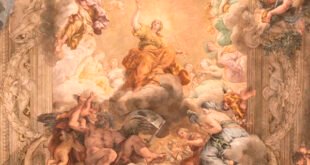

There are words that contain an entire world within them. Words that, though small, hold a depth capable of transforming the way we understand faith, grace, and our own relationship with God.
“Kecharitomene” is one of them.
Many Catholics have heard the Virgin Mary described as “full of grace.” We repeat it almost mechanically in the Hail Mary:
“Hail Mary, full of grace…”
But few people know that behind this expression lies an extraordinary Greek word: Kecharitomene.
It is not merely a beautiful greeting.
It is not pious poetry.
It is not a decorative spiritual phrase.
It is an immense theological declaration.
It is a word so profound that, for centuries, saints, Church Fathers, theologians, and biblical scholars have seen in it one of the strongest proofs of the mystery of the Immaculate Conception and of Mary’s absolute uniqueness in salvation history.
And today, in a world that has lost the sense of purity, grace, and the sacred, understanding “Kecharitomene” is more urgent than ever.
Where Does “Kecharitomene” Appear?
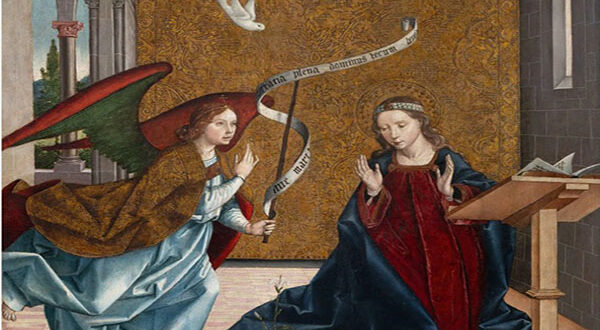
The word appears in the Gospel of Saint Luke during the Annunciation.
The Archangel Gabriel enters Mary’s presence and speaks words that would change the destiny of the world:
“Hail, full of grace, the Lord is with you.”
— Luke 1:28
In the original Greek, the text says:
Chaîre, kecharitoméne, ho Kyrios meta sou.
Here something astonishing happens: Gabriel does not call Mary by her name.
He does not simply say, “Hello, Mary.”
He calls her “Kecharitomene.”
As though it were a title.
As though it described her deepest identity.
As though this condition defined who she truly is.
What Does “Kecharitomene” Really Mean?
Most translations render it as “full of grace,” but the meaning is far deeper.
The word comes from the Greek verb charitóo, which means:
- to fill with grace,
- to favor supernaturally,
- to endow completely with divine grace.
But the specific grammatical form used in Luke is extremely important.
Kecharitomene is in the perfect passive participle
And this completely changes the depth of the text.
In simple terms, it means:
- an action fully completed in the past,
- whose effects remain permanently in the present.
In other words:
Mary has been filled with grace in a complete and lasting way.
Not partially.
Not temporarily.
Not for a brief moment.
But totally, perfectly, and permanently.
Many scholars translate the deeper sense as:
- “The one completely graced”
- “The one perfectly transformed by grace”
- “She who has been and remains full of grace”
This has enormous theological consequences.
The Connection to the Immaculate Conception
The Catholic Church teaches that the Virgin Mary was conceived without original sin.
This dogma was solemnly proclaimed in 1854 by Pius IX, although the belief existed from the earliest centuries of Christianity.
Many Protestants ask:
“Where is that found in the Bible?”
And this is precisely where “Kecharitomene” enters the discussion.
If Mary was completely filled with grace from the beginning, if she was totally transformed by God, then it is coherent to affirm that she was not under the dominion of sin.
Because grace and mortal sin do not coexist.
Divine grace is not a superficial spiritual decoration.
It is supernatural life.
And the absolute fullness of grace implies a singular holiness.
The Church Fathers understood this very early.
What the Church Fathers Taught
From the earliest centuries, Christians saw Mary as the “New Eve.”
Just as Eve was created without sin but disobeyed, Mary appears as the obedient woman who freely cooperates with God’s plan.
Saint Irenaeus of Lyons wrote in the second century:
“The knot of Eve’s disobedience was untied by Mary’s obedience.”
This comparison is not accidental.
Eve entered the world without sin.
The New Eve also had to possess a singular purity to become the worthy dwelling place of the Incarnate Word.
Later, Saint Ephrem the Syrian would write:
“You and Your Mother are the only ones completely beautiful; for there is no stain in You, and no sin in Your Mother.”
Ancient Christian tradition is deeply permeated by this vision.
Mary Is Not a Goddess… But Neither Is She an Ordinary Woman
Here it is important to avoid two extremes.
Error 1: Minimizing Mary
Many modern Christians speak about Mary as though she were merely “a good woman.”
But the Gospel never presents her that way.
The angel bows before her.
Elizabeth calls her:
“Blessed are you among women.”
— Luke 1:42
And she adds:
“Who am I that the mother of my Lord should come to me?”
— Luke 1:43
Scripture constantly presents Mary as someone absolutely unique in salvation history.
Error 2: Turning Mary into a goddess
The Church has never taught this.
Mary is not God.
She is not a fourth person of the Trinity.
She is not adored.
Adoration belongs to God alone.
But Mary does receive special veneration (hyperdulia) because no creature has ever been as united to Christ as she was.
Denying this uniqueness deeply impoverishes Christian faith.
“Kecharitomene” and the Modern Battle Against Purity
We live in an age obsessed with immediate pleasure.
Pornography has been normalized.
Impurity is celebrated.
Modesty is mocked.
Innocence is treated as weakness.
And precisely for that reason, Mary becomes uncomfortable for the modern world.
Because “Kecharitomene” reminds us of something the world hates:
The human person was created for grace, not corruption.
Modern culture constantly repeats:
- “everyone falls,”
- “nobody can be pure,”
- “sin is inevitable,”
- “live however you want.”
But Mary demonstrates that God’s grace can completely transform a life.
She is the great contradiction to modern cynicism.
The Virgin Mary as a Spiritual Model for Our Time
Many people think Mary is “too perfect” to be relatable.
But the exact opposite is true.
Precisely because she was full of grace, Mary lived human virtues in their fullness:
- humility,
- silence,
- strength,
- fidelity,
- purity,
- patience,
- obedience,
- perseverance in suffering.
She suffered.
She saw her Son persecuted.
She experienced rejection.
She lived through fear.
She remained at the foot of the Cross.
Her life was not easy.
It was holy.
And that is the difference.
“Let It Be Done unto Me”: The Response That Saved the World
All Marian spirituality culminates in one sentence:
“Behold the handmaid of the Lord; let it be done unto me according to your word.”
— Luke 1:38
Humanity had spent centuries saying “no” to God.
Then a young woman from Nazareth pronounced the most important “yes” in history.
That act of obedience opened the door to the Incarnation.
There is an immense lesson here for our spiritual life.
Holiness does not begin by doing spectacular things.
It begins by saying yes to God in ordinary daily life.
The Mystery of Grace: A Forgotten Lesson
The word “grace” has almost disappeared from modern Christian language.
Many reduce religion to:
- rules,
- emotions,
- self-help,
- psychological motivation.
But Christianity is about the supernatural transformation of the soul.
Sanctifying grace makes man a participant in divine life.
And Mary is the masterpiece of that grace.
“Kecharitomene” reminds us that holiness is not primarily human effort.
It is cooperation with the action of God.
Can a Christian Today Aspire to Purity?
Yes.
Not in the perfect way Mary did.
But authentically.
The problem is that many no longer even struggle.
They have accepted habitual sin as normal.
They have lost hope of changing.
They have reduced Christianity to “God understands my weaknesses.”
But grace exists precisely to transform the sinner.
The Virgin does not crush us with her holiness.
She shows us what God can do when a soul surrenders itself completely.
The Marian Dimension of the Church
The Church does not merely admire Mary.
She contemplates her as a model.
Catholic Church teaches that Mary is the figure of the Church:
- Virgin in faith,
- spiritual Mother,
- perfect disciple,
- woman obedient to the Word.
That is why authentic Christianity has always been profoundly Marian.
Where Mary disappears, the following usually disappear as well:
- reverence,
- the sense of the sacred,
- doctrinal purity,
- contemplative life,
- love for Christ crucified.
Because Mary always leads to Jesus.
Never to herself.
The Rosary: A Practical School of “Kecharitomene”
Many underestimate the Rosary.
They consider it repetitive.
Boring.
Outdated.
Yet for centuries it has been one of the most powerful spiritual weapons of Christendom.
The Rosary slowly educates the soul:
- it teaches contemplation,
- purifies the mind,
- orders the heart,
- introduces us into the mysteries of Christ.
And every Hail Mary reminds us precisely of this:
“Full of grace.”
It is not an empty phrase.
It is a theological proclamation.
A Humanity Without Grace Ends Up Empty
Never before have we had so many comforts.
And yet never before has there been so much anxiety, emptiness, and despair.
Why?
Because man was created for communion with God.
When grace disappears, the soul tries to fill itself with:
- consumption,
- entertainment,
- disordered sexuality,
- power,
- ideologies,
- constant distractions.
But none of these satisfy.
Mary, “Kecharitomene,” appears as the icon of humanity fully reconciled with God.
She represents what humanity was called to be from the beginning.
Practical Applications for Spiritual Life
1. Recover the Life of Grace
Frequent confession remains essential.
Many people live for years far from the sacraments and then wonder why they feel spiritually empty.
Grace is not theory.
It is real supernatural life.
2. Return to Marian Prayer
The Hail Mary prayed attentively can slowly transform the heart.
Not as superstition.
But as contemplation.
3. Guard Purity
Purity is not repression.
It is interior freedom.
A heart enslaved by passions will never be fully free.
Mary reveals the beauty of a soul completely oriented toward God.
4. Learn Silence
Mary speaks little in the Gospel.
But she listens deeply.
We live saturated with noise:
screens, social media, opinions, constant controversies.
Without interior silence, it is almost impossible to hear God.
5. Say “Yes” to God Every Day
Mary’s fiat did not happen only once.
She renewed it throughout her life:
in Bethlehem,
in Egypt,
in Nazareth,
on Calvary.
Daily holiness consists precisely in that.
“Kecharitomene”: A Word for a Sick Civilization
Our age needs to rediscover grace.
It needs to understand once again that man was not created to wallow forever in sin.
It needs to remember that holiness is possible.
And in the middle of a world that glorifies moral darkness, the Virgin Mary continues to shine as a sign of hope.
“Kecharitomene” is not merely a Marian title.
It is a promise.
The promise that God can still completely transform a soul.
The promise that grace is stronger than sin.
The promise that purity is not an impossible utopia.
And the promise that whoever truly draws close to Mary inevitably draws closer to Christ.
Because every authentic Marian devotion always leads to the same place:
To Jesus.