Related Articles


Introduction: When the world burns, God raises up saints
There are moments in history when everything seems to tremble: moral corruption, political division, spiritual crisis, weak leaders, and a confused society. Many then believe that darkness has won… but the history of the Church proves otherwise: precisely in the darkest times, God raises up souls of fire.
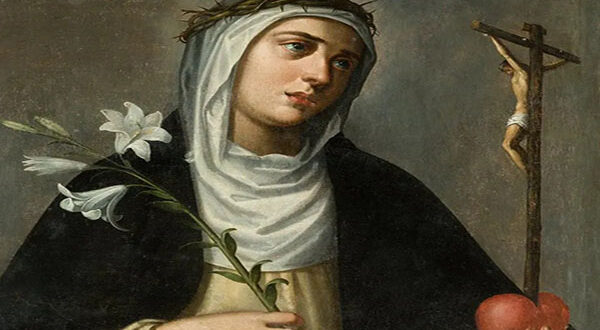
One of those souls was Saint Catherine of Siena.
She was neither a queen, nor a cloistered nun, nor a university theologian. She was a young laywoman, a Dominican tertiary, without formal education, born into a Europe wounded by wars, plague, ecclesial decadence, and power struggles. And yet, this simple woman ended up correcting popes, reconciling cities, guiding souls, writing immortal mystical works, and becoming a Doctor of the Church and Patroness of Europe.
How could a woman from the 14th century change the history of the Church and still speak so powerfully to the 21st century?
Because Saint Catherine was not merely a historical figure: she was a prophetic voice.
Today, in an age likewise marked by doctrinal crises, moral relativism, spiritual superficiality, and cultural confusion, her life resonates with astonishing relevance.
I. The historical context: A wounded Church and a Europe in crisis
Catherine was born on March 25, 1347, in Siena, Italy, during a deeply turbulent century.
Europe was experiencing:
- The Black Death (1348), which devastated millions of lives
- Constant wars between city-states
- Moral corruption in many ecclesiastical sectors
- The Avignon Papacy, in which the popes resided outside Rome under strong French political influence
- A widespread spiritual and social crisis
In that context, many could have despaired. But God was preparing a child to become a torch.
Catherine Benincasa was born into a large family, being the 24th or 25th child. From a very young age, she showed an intense spiritual life. At six years old, she had a vision of Christ dressed as a pontiff, accompanied by Saint Peter, Saint Paul, and Saint John.
That encounter marked her entire life.
II. A supernatural childhood: A soul consecrated from youth
While other girls dreamed of marriage or prestige, Catherine made a vow of virginity to Christ from a very young age.
Her family tried to marry her off, but she resisted with extraordinary radicality. She even cut off her hair to avoid pressure.
This gesture was not adolescent rebellion; it was a spiritual declaration:
“My only Spouse will be Christ.”
Here we find a fundamental theological truth: vocation is not born from human whim, but from a divine calling.
As Jeremiah says:
“Before I formed you in the womb I knew you, before you were born I consecrated you” (Jeremiah 1:5).
Catherine understood that she belonged entirely to God.
She eventually entered the Third Order of Saint Dominic (the Mantellate), living in the world, but not of the world.
III. The “inner cell”: Catherine’s great spiritual school
One of Saint Catherine’s deepest contributions was her spirituality of the “inner cell.”
Though she lived in her home, she transformed her soul into a monastery.
She taught that the heart must be a room where the soul meets God constantly.
This recalls Christ’s words:
“But when you pray, go into your room, close the door and pray to your Father, who is unseen” (Matthew 6:6).
For Catherine, that “room” was the interior of the soul.
Practical pastoral application today:
In a world saturated with noise, social media, digital anxiety, and constant distraction, Saint Catherine offers an urgent remedy:
Recover interior silence.
One cannot hear God amid constant chaos.
IV. Mystical marriage with Christ: A radical union
Catherine lived extraordinary mystical experiences, among them her “mystical marriage” with Christ, in which she received an invisible ring.
Far from sentimental piety, this episode expresses a central truth of Catholic spirituality:
The soul is called to a spousal union with God.
The Church does not understand holiness merely as moral obedience, but as transforming communion.
Catherine did not simply want to “do good things”; she wanted to belong entirely to Christ crucified.
Her spirituality was profoundly Christ-centered:
- Love for the Blood of Christ
- Devotion to the Cross
- Penance
- Active charity
She constantly repeated the importance of Christ’s Blood as the source of redemption.
This connects with Saint Peter:
“You were redeemed… with the precious blood of Christ” (1 Peter 1:18-19).
V. A mystic in action: Serving Christ in the poor, the sick, and sinners
Saint Catherine was not a contemplative detached from human suffering.
She cared for the sick, served plague victims, accompanied the condemned to execution, and worked for the conversion of sinners.
Here emerges an essential dimension:
Authentic mysticism produces concrete charity.
There is no true union with God without sacrificial love for neighbor.
As James teaches:
“Faith without works is dead” (James 2:26).
Catherine embraced Christ in the Eucharist and in the wounds of the suffering.
VI. Catherine and the Papacy: The saint who corrected the Pope
Perhaps one of the most striking aspects of her life was her intervention in the crisis of the Avignon Papacy.
With supernatural courage, she wrote to Pope Gregory XI, urging him to return to Rome.
She did not do this from political arrogance, but from ecclesial fidelity.
Her essential message was clear:
The Church must be governed with holiness, courage, and truth.
And what is astonishing is that she was heard.
Gregory XI finally returned to Rome in 1377.
Theological relevance:
Saint Catherine demonstrates that loving the Church does not mean remaining silent before her wounds.
Filial, reverent, and holy correction can be a profound form of fidelity.
For today:
In times of scandal or confusion, Catholics must fall neither into blind servility nor destructive rebellion, but into courageous fidelity.
Catherine loved the Papacy passionately, but she did not flatter its weaknesses.
VII. The Great Schism and her fight for unity
After Gregory XI’s death, the Great Western Schism erupted.
Catherine strongly defended the legitimacy of Pope Urban VI and worked tirelessly for unity.
Because she understood something essential:
Satan divides; Christ unites.
The unity of the Church is not an administrative detail: it is a theological sign.
Christ prayed:
“That they may all be one” (John 17:21).
Catherine suffered deeply over divisions, offering prayer, sacrifice, and action.
VIII. Doctor of the Church: A woman without formal education who taught generations
In 1970, Saint Paul VI proclaimed her a Doctor of the Church.
This was revolutionary: a medieval laywoman, without formal university education, recognized among the Church’s great doctrinal teachers.
Her most famous work, The Dialogue, is a jewel of spiritual theology.
Key themes of her doctrine:
- Knowledge of God and self
- Divine mercy
- The dignity of the soul
- Virtue as a path of transformation
- Christ as the bridge between God and man
One of her most famous phrases summarizes her mission:
“If you are what you should be, you will set the whole world ablaze.”
This is not self-help; it is theology of grace:
When the soul fully lives its vocation in God, it transforms history.
IX. Patroness of Europe: Why Catherine remains essential for the West
Saint John Paul II proclaimed her Patroness of Europe in 1999.
Why?
Because Europe cannot be understood merely as an economic or political project.
Europe was born from Christian roots.
Catherine represents:
- The dignity of conscience enlightened by God
- The centrality of Christ
- The defense of truth
- Moral reform
- Spiritual unity
In a secularized, technocratic Europe often disconnected from its roots, Saint Catherine reminds us that a civilization without a soul eventually loses itself.
X. Practical applications for today: How to live like Saint Catherine in the 21st century
1. Recover interior life
Less noise, more prayer.
2. Love the Church without naivety
Fidelity does not mean denying problems, but fighting for holiness.
3. Unite contemplation and action
It is not enough to pray; one must also serve.
4. Speak the truth
Catherine did not seek to please, but to save.
5. Live centered on Christ crucified
The Cross remains the answer to chaos.
XI. A spirituality for times of crisis
Saint Catherine teaches that crises are not an excuse to abandon faith, but an opportunity to radicalize holiness.
She did not wait for better times to act.
She became a saint in the midst of disaster.
And perhaps this is her most urgent lesson for us:
Do not curse the darkness; become light.
Conclusion: Saint Catherine and your own vocation
Saint Catherine of Siena was not great because of human power, but because of absolute docility to God.
Her life proclaims that holiness is not reserved for clergy, scholars, or extraordinary historical figures.
It is open to anyone who says “yes” without reservation.
In an age of confusion, lukewarmness, and noise, her voice still resounds:
“Enough of cowardly silence. Enough of superficial faith. Enough of comfortable Christianity.”
Christ is still seeking souls set ablaze.
And perhaps, as in Siena, He may also wish to change the world today… through one single person completely surrendered.
“Be who God meant you to be and you will set the world on fire.”
— Saint Catherine of Siena