Related Articles

Introduction: When a Crown Defied an Altar
There are moments in history when one decision changes not only the destiny of a nation, but also the spiritual course of millions of souls. The rise of Anglicanism was not merely the birth of a new Christian confession: it was a fracture of enormous proportions within Western Christendom, a rupture that blended power, passion, dynastic interests, and profound doctrinal consequences.
For many today, Anglicanism may seem like a simple “English version” of Christianity, one respectable tradition among the broad religious spectrum. But beneath that appearance of solemn liturgy, majestic choirs, and traditional aesthetics lies a complex history of separation from Rome, doctrinal redefinition, and a continuing crisis of identity.
To analyze Anglicanism from a traditional Catholic perspective does not imply mockery or contempt toward those who sincerely live their faith within that communion, but rather an exercise in truth, charity, and discernment. For authentic charity does not consist in hiding doctrinal differences, but in illuminating with clarity the path toward the fullness of revealed truth in Christ.
For, as Our Lord says:
“And ye shall know the truth, and the truth shall make you free” (John 8:32).
I. The Birth of Anglicanism: When the Problem Was Not Luther, but Henry VIII
1. England Before the Rupture: Deeply Catholic
For more than a thousand years, England was a Catholic nation. From the evangelization of Saint Augustine of Canterbury in the sixth century, England flourished as a land of saints, monasteries, martyrs, and profound Roman devotion. Not in vain was it called the “Dowry of Mary,” reflecting its special consecration to the Virgin.
Its cathedrals, universities, and ecclesiastical structures were fully united to the Successor of Peter.
2. Henry VIII: The Schism Born of Desire
The rupture did not begin primarily through a theological dispute, but through a matrimonial and political issue.
Henry VIII, King of England, desired to annul his marriage to Catherine of Aragon in order to marry Anne Boleyn. When Pope Clement VII did not grant the annulment he sought, Henry chose a revolutionary measure:
The Act of Supremacy (1534):
He proclaimed himself “Supreme Head of the Church of England.”
This act was an open rebellion against papal authority.
It was not initially a Protestant doctrinal revolution like Luther’s, but a jurisdictional separation. Yet once the bond with Rome was broken, the door was opened to increasingly profound theological transformations.
II. From Political Schism to Doctrinal Transformation
1. Edward VI and Protestantization
Under Edward VI, Anglicanism adopted clearly Calvinist and Lutheran influences:
- Rejection of the Sacrifice of the Mass.
- Practical denial of transubstantiation.
- Suppression of images and devotions.
- Liturgical reform through the Book of Common Prayer.
2. Elizabeth I and the “Via Media”
Under Elizabeth I, the so-called Via Media (“middle way”) was consolidated: neither fully Catholic nor fully Protestant.
This model sought to unite:
- Catholic episcopal structure.
- Reformed theology.
- National liturgy.
Yet this “middle way” generated a permanent internal tension:
What exactly is Anglicanism?
III. The Doctrinal Question: What Does Anglicanism Actually Teach?
Here we encounter one of its deepest problems: its enormous internal diversity.
1. The Thirty-Nine Articles of Religion
These historic doctrinal formularies reject several essential elements of Catholicism:
- Papal primacy.
- Purgatory.
- Veneration of saints and images.
- The sacrificial doctrine of the Mass.
- Certain sacramental principles.
2. Structural Ambiguity
Today within Anglicanism coexist:
- Anglo-Catholics (externally very close to Rome).
- Evangelical Protestants.
- Theological liberals.
- Progressive currents.
This provokes an unavoidable question:
Can a Church uphold objective truth if its essential doctrine admits internal contradictions?
Saint Paul warned:
“Jesus Christ the same yesterday, and to day, and for ever” (Hebrews 13:8).
Revealed truth cannot be reinvented according to eras or cultural sensitivities.
IV. Apostolic Succession and Apostolicae Curae
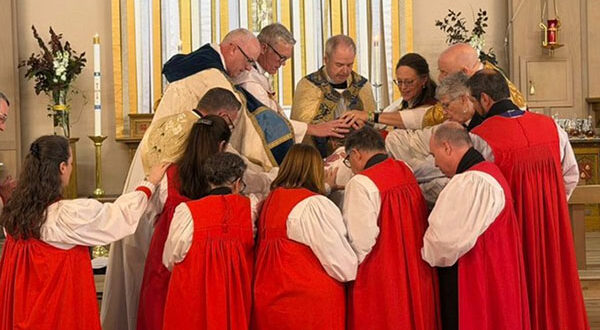
One of the most serious points from the Catholic perspective was Pope Leo XIII’s bull Apostolicae Curae (1896), which declared Anglican orders invalid.
Why?
Because of defects in:
- Liturgical form.
- Sacramental intention.
- Rupture with the sacrificial understanding of the priesthood.
Consequently, according to Catholic doctrine:
Anglican priests do not possess valid priesthood in the sacramental sense.
This carries an enormous consequence:
Without valid priesthood, there is no valid Eucharist as sacramental sacrifice in the Catholic sense.
And here we reach the heart of the drama:
This is not merely about structures or names, but about the Real Presence of Christ upon the altar.
V. Contemporary Anglicanism: Crisis of Identity and Cultural Adaptation
1. Female Ordination
Many Anglican communions accept women priests and bishops.
2. Sexual Morality
Various provinces have approved:
- Blessings of homosexual unions.
- Same-sex marriages.
- Doctrinal reinterpretations regarding sexuality.
3. Fragmentation
The Anglican Communion lives under profound tensions between conservative and progressive sectors.
This reflects a central issue:
When an ecclesial community separates from universal doctrinal authority, it risks continually redefining itself according to cultural pressures.
Romans 12:2 warns:
“And be not conformed to this world: but be ye transformed by the renewing of your mind.”
VI. Are There Valuable Elements in Anglicanism?
From intellectual honesty, yes:
- Liturgical beauty in certain sectors.
- Extraordinary musical heritage.
- Appreciation for ceremonial dignity.
- Serious biblical engagement in many communities.
But aesthetic beauty does not guarantee doctrinal fullness.
A beautiful liturgy without full sacramental communion raises a serious question:
Is it form without substance?
The Catholic Church teaches that fullness subsists where there remain:
- Scripture,
- Tradition,
- Magisterium,
- Valid sacraments,
- Apostolic succession in communion with Peter.
VII. The Ordinariates: A Bridge Home
Benedict XVI, through Anglicanorum Coetibus (2009), offered an extraordinary pastoral path for Anglicans who wished to enter full communion with Rome while preserving legitimate elements of their liturgical heritage.
This demonstrates a profoundly Catholic truth:
Rome does not seek to destroy what is true, but to purify it, elevate it, and bring it to fullness.
VIII. Pastoral Application: Lessons for Catholics Today
1. Faith Cannot Be Subordinated to Political Power
The origin of Anglicanism reminds us of the danger of adapting truth to personal convenience.
2. Visible Unity Matters
Christ prayed:
“That they all may be one” (John 17:21).
Christian division is not trivial; it is a wound to the visible Body of Christ.
3. Tradition Protects
Not every reform leads to renewal; some lead to loss.
4. Charity Requires Truth
To love our separated brethren means prayer, respect, and clear witness.
IX. A Spiritual Reflection: What Happens When Man Creates a Religion to Fit Himself?
The drama of many ecclesial ruptures can be summarized in one constant temptation:
To adapt God to our desires, rather than adapting our lives to God.
Henry VIII sought to reshape spiritual structure to fit his personal will. History demonstrates that when human power attempts to redefine divine truth, the consequences can span centuries.
X. Conclusion: Under the Microscope… and Beneath the Cross
The analysis of Anglicanism should not feed confessional pride, but gratitude and responsibility.
Gratitude, because Catholic doctrinal fidelity is not a human achievement, but grace.
Responsibility, because even today many within Catholicism can fall into the same Anglican temptation:
To adjust the faith to the spirit of the age.
The question remains:
Will we follow Christ as He founded His Church, or will we construct more comfortable versions for our own time?
The history of Anglicanism is both a warning and an invitation:
Truth may be costly, but departing from it costs far more.
For in the end, this is not about England, Henry VIII, or Canterbury.
It is about an eternal question:
Who has authority to define the Church: Christ or man?
And for the one who listens humbly to the voice of the Gospel, the answer still resounds powerfully from Caesarea Philippi:
“Thou art Peter, and upon this rock I will build my church” (Matthew 16:18).
Final Prayer
Lord Jesus Christ, Eternal Shepherd, guard Your Church in truth, strengthen the faithful in fidelity to Apostolic Tradition, enlighten those who sincerely seek Your face, and grant that all Christians may one day be reunited in the full unity of Your one Church. Amen.