
Related Articles



1. A scene that transcends the centuries
There are phrases that do not grow old. Words that, spoken two thousand years ago, still echo today in every Mass, in every soul that approaches God with humility. One of them is:
“Lord, I am not worthy that you should enter under my roof; but only say the word and my servant shall be healed” (cf. Matthew 8:8).
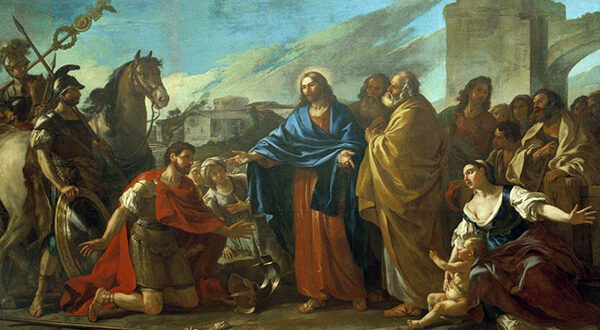
This expression arises from a surprising encounter: a Roman soldier—pagan, foreign, a symbol of oppressive power—approaches Jesus Christ with such pure faith that Jesus Himself “marvels” at it.
And here we already find something profoundly revolutionary:
God allows Himself to be amazed by human faith.
2. The context: an unexpected man
The account appears in Matthew 8:5–13. The protagonist is a centurion, an officer of the Roman army in charge of about a hundred soldiers—a man accustomed to command, discipline, and power.
However, this man does not present himself with arrogance, but with supplication:
- He has a servant who is gravely ill and suffering.
- He does not ask for himself, but for another.
- He does not demand; he implores.
This already breaks every expectation. Human power often hardens the heart. But here the opposite happens:
external authority coexists with deep interior humility.
3. “I am not worthy”: the gateway to true faith
At the center of the passage we find one of the most profound confessions in the Gospel:
“Lord, I am not worthy…”
These words do not arise from low self-esteem, but from spiritual truth:
- The centurion recognizes who Jesus is.
- At the same time, he recognizes who he himself is.
Classical theology teaches that humility is the foundation of all spiritual life.
Saint Thomas Aquinas would say that humility is “to walk in truth.”
And this man walks in truth:
- He does not boast of his merits.
- He does not believe he has rights before God.
- He does not try to negotiate.
He simply trusts.
Paradoxically, as spiritual tradition teaches,
the one who recognizes himself as unworthy becomes worthy of God’s gift.
4. “Say the word”: a faith that understands authority
The centurion adds something that elevates his faith to an extraordinary level:
“But only say the word, and my servant shall be healed.”
Here we find an impressive theological understanding:
4.1. The authority of Christ
The centurion compares Jesus with his own military experience:
- He gives orders → and they are obeyed.
- Jesus gives orders → and reality itself obeys.
He has understood something essential:
Christ has divine authority over creation.
4.2. The efficacy of the Word
In the Bible, the Word of God is not merely informative—it is creative:
- “God said… and it was done” (Genesis 1)
- “Let it be…” and reality changes
The centurion believes that a single word from Christ is enough.
He does not need signs, physical presence, or external rituals.
This makes him a model of pure faith:
Faith is trusting in what is not seen, yet known to be true (cf. Hebrews 11:1).
5. The astonishment of Jesus: faith where it was least expected
The Gospel says something extraordinary:
“When Jesus heard this, He marveled…”
It is not common for the Gospel to say that Jesus is surprised.
And here He is… by the faith of a pagan.
And He adds a powerful statement:
“Truly I tell you, I have not found anyone in Israel with such great faith.”
What does this mean theologically?
- Faith does not depend on external belonging
It is not enough to be part of the “chosen people.” - God looks at the heart
And finds faith where it is least expected. - The Kingdom is universal
“Many will come from east and west…”
This passage anticipates something crucial:
salvation is not a privilege, but a gift offered to all.
6. Eucharistic dimension: the phrase we repeat today
Every time we participate in the Holy Mass, before receiving Communion, we repeat:
“Lord, I am not worthy that you should enter under my roof…”
This is not a coincidence. It is profoundly providential.
What does this teach us?
- That the Eucharist is not a right, but a gift.
- That we approach Christ not by merit, but by grace.
- That the proper attitude is that of the centurion:
humility + absolute faith in the Word of Christ.
When the priest says, “The Body of Christ,”
and we respond, “Amen,” we are doing what the centurion did:
👉 Believing that the Word of Christ transforms reality.
7. Practical applications for daily life
This passage is not just a beautiful story. It is a concrete spiritual guide.
7.1. Learn to intercede for others
The centurion intercedes for his servant.
👉 Today, in an individualistic world, this is revolutionary:
pray for your family, for your children, for those who suffer.
7.2. Trust even when you do not see
The miracle happens at a distance.
👉 You do not need to “feel” in order to believe.
Mature faith trusts even in God’s silence.
7.3. Acknowledge your limits without despair
“I am not worthy” is not defeat—it is openness.
👉 Grace enters where there is truth, not where there is pride.
7.4. Let Christ have authority in your life
The centurion understood authority.
👉 Ask yourself:
- Do I let Christ guide my decisions?
- Or do I only consult Him when it suits me?
7.5. Believe in the power of the Word
One word is enough.
👉 Scripture, liturgy, the sacraments…
are not empty symbols: they are the real action of God.
8. A deeply relevant message today
We live in a time marked by:
- Self-sufficiency (“I can do it alone”)
- Relativism (“everyone has their own truth”)
- Spiritual superficiality
The centurion offers us the opposite path:
- Humility instead of pride
- Trust instead of control
- Faith instead of skepticism
And he reminds us of something essential:
👉 You do not need to have everything figured out in order to believe.
You need to trust in the One who holds everything in His hands.
9. Conclusion: the faith God seeks today
The centurion was not a theologian, nor a disciple, nor a member of the chosen people.
But he had what truly matters:
- A humble heart
- Radical trust
- A deep understanding of who Christ is
And that was enough for Jesus to say:
“I have not found such great faith.”
Today, that same invitation remains open.
It is not about being perfect.
It is about being able to say, in truth:
👉 “Lord, I am not worthy… but I fully trust in You.”
10. Final prayer
Lord Jesus,
like the centurion, I recognize that I am not worthy,
but I believe that Your Word has the power to heal my life.
Increase my faith,
make me humble,
and teach me to trust even when I do not see.
May I never doubt You,
and may my life become a constant act of faith.
Amen.