Related Articles


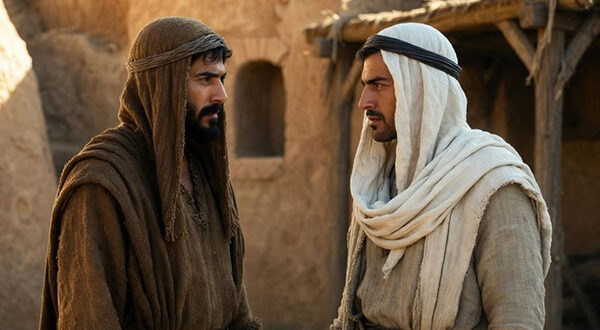
For centuries, two neighboring peoples looked up to the same heaven, prayed to the same God, and read the same Law… yet they deeply rejected one another.
They were the Jews and the Samaritans.
For many modern readers, this rivalry may seem like just a historical curiosity of the Bible. However, understanding the relationship between these two peoples opens a fascinating window into the world of Jesus Christ, the depth of several biblical passages, and an extremely relevant spiritual lesson: how to relate to those who share our faith… but not our way of living it.
Because the story of Jews and Samaritans is not just an episode from the past.
It is also a mirror in which humanity—and sometimes even Christians—continue to see themselves reflected.
1. Two brotherly peoples… who ended up divided
To understand the conflict, we must go back more than a thousand years before Christ.
Everything begins with the ancient people of Israel, the chosen people of God.
After the reigns of Saul, David, and Solomon, the kingdom was divided into two:
- The Northern Kingdom (Israel)
- The Southern Kingdom (Judah)
The Northern Kingdom had its capital in Samaria. From there would arise the name Samaritans.
This political division soon became a religious division as well.
The Northern Kingdom began to develop religious practices different from the official worship of Jerusalem, which generated deep tensions with the Jews of the south.
But the decisive moment came in 722 BC, during the Assyrian conquest of the Kingdom of Israel.
The Assyrians conquered the Northern Kingdom and deported a large part of its population. In their place they brought settlers from other nations. The result was a cultural and religious mixture.
From the Jewish point of view, this was a spiritual tragedy.
For the Jews of the south, the Samaritans became:
- a mixed people
- religiously suspicious
- and, above all, not fully faithful to the Law of God
Thus began a rivalry that would last for centuries.
2. The breaking point: Where should God be worshiped?
One of the great disagreements between the two peoples concerned the legitimate place of worship.
The Jews affirmed that the only legitimate place was the Temple of Jerusalem.
The Samaritans maintained that the true place chosen by God was Mount Gerizim.
In fact, they built their own temple there.
This disagreement was not merely geographical.
It was theological.
The question was:
Where has God chosen to meet His people?
For the Jews, accepting the Samaritan temple meant accepting a corruption of the true worship.
For the Samaritans, Jerusalem represented a deviation from the original place chosen by God.
Thus, two peoples who venerated the same God began to see one another as heretics.
3. Social rupture: a hatred that crossed daily life
In the time of Christ the division was total.
Jews avoided traveling through Samaria when moving between Galilee and Judea. They preferred to take a detour.
The reason was clear: they did not want contact with Samaritans.
The hostility was mutual.
For a devout Jew, a Samaritan was considered:
- impure
- heterodox
- a religious enemy
This is why what Jesus does in the Gospel is so striking.
4. Jesus breaks the barriers
The Gospel shows several episodes in which Jesus challenges this historical conflict.
One of the most famous is the encounter with the Samaritan woman in the Gospel of John.
There Jesus begins a conversation that breaks every social taboo.
First, because He speaks with a woman.
Second, because she is a Samaritan.
The woman herself is surprised and says:
“How is it that you, a Jew, ask a drink of me, a woman of Samaria?”
(John 4:9)
Jesus responds with an extraordinary teaching about true worship:
“Woman, believe me, the hour is coming when you will worship the Father neither on this mountain nor in Jerusalem… the true worshipers will worship the Father in spirit and truth.”
(John 4:21–23)
Here Jesus reveals something revolutionary.
The center of faith will no longer be a geographical place.
It will be a living relationship with God.
5. The parable that shocked everyone
Perhaps the most powerful teaching appears in the famous parable of the Good Samaritan.
A man is attacked and left half dead.
Passing by him are:
- a priest
- a Levite
Both ignore him.
The one who stops to help… is a Samaritan.
Jesus concludes by asking:
“Which of these proved to be neighbor to the man who fell among the robbers?”
The answer is unavoidable:
“The one who showed mercy.”
For a first-century Jew, this parable was shocking.
Jesus was implicitly saying:
A Samaritan can live the will of God better than a religious Jew.
He was not denying the truth of Judaism.
He was reminding people of something deeper:
True fidelity to God is demonstrated through charity.
6. Two peoples, one God
Theologically, Jews and Samaritans shared fundamental elements:
- they believed in the same God of Abraham
- they accepted the Law of Moses
- they expected a Messiah
However, they differed on several key points:
| Jews | Samaritans |
|---|---|
| Recognized the entire Old Testament | Accepted only the Pentateuch |
| Temple in Jerusalem | Temple on Mount Gerizim |
| Rabbinic tradition | Their own tradition |
| Strict ethnic identity | More mixed identity |
Even so, from a biblical perspective both peoples had a common root.
Both belonged to the history of salvation.
7. The spiritual lesson many forget
This story teaches something very profound:
Religious division can arise even among those who believe in the same God.
The problem is not always the absence of faith.
Sometimes the problem is the way it is lived.
This is tremendously relevant today.
Even now tensions exist between:
- different sensibilities within Christianity
- different liturgical traditions
- different theological interpretations
The story of Jews and Samaritans warns us of a danger:
turning religious identity into a reason for despising others.
8. Christ’s pastoral vision
Jesus does not relativize truth.
He clearly affirms:
“Salvation is from the Jews.” (John 4:22)
But at the same time He opens the universal horizon of salvation.
His mission is not to fuel rivalries.
It is to reconcile human beings with God and with one another.
That is why the Gospel shows something surprising:
The Samaritans also respond to the Christian message.
In the Acts of the Apostles, the apostles evangelize Samaria with great success.
The ancient rivalry begins to disappear within the early Church.
9. Applications for our life today
The story of Jews and Samaritans is not merely biblical archaeology.
It is a very concrete spiritual guide.
1. Do not absolutize our differences
We may share the same faith and still have different sensibilities.
That should not turn into hatred.
2. Charity is the true orthodoxy
The parable of the Good Samaritan reminds us that fidelity to God is measured by love of neighbor.
It is not enough to be right.
We must love.
3. God can act where we least expect it
Jesus chose a Samaritan as the moral example.
This teaches us humility.
God’s grace is not limited to our schemes.
4. Avoid religious contempt
History shows that contempt among believers produces centuries of wounds.
The Christian is called to be a bridge, not a wall.
10. A final reflection
At its heart, the story of Jews and Samaritans is the story of a divided humanity.
Two peoples.
One God.
But separated hearts.
Christ came precisely to heal that rupture.
That is why the Gospel insists so strongly on one central truth:
our neighbor is not only the one who thinks like us.
It is anyone who suffers, anyone who needs mercy.
Perhaps that is why Jesus chose a Samaritan as the hero of His parable.
Because He wanted us to understand something essential:
Holiness does not belong to a group.
It belongs to the one who lives the love of God.
And that remains, today as yesterday, the true religion.