Related Articles
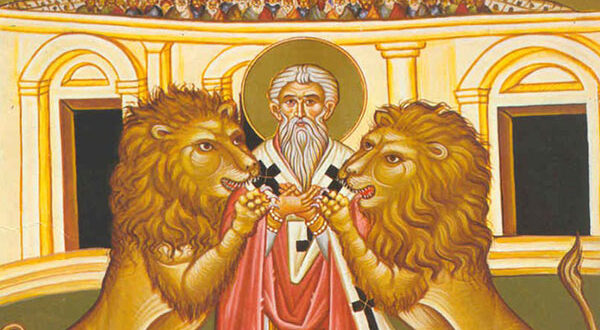
Throughout the history of the Church there are phrases that, because of their spiritual power, have crossed the centuries like a spark that ignites the hearts of Christians. One of them belongs to a bishop of the first century who was walking toward his execution in Rome. Chained, guarded by soldiers, and fully aware of his fate, he wrote words that would become one of the most profound testimonies of early Christian spirituality:
“I am the wheat of Christ; let me be ground by the teeth of wild beasts so that I may become the pure bread of Christ.”
The one who pronounced these words was Saint Ignatius of Antioch, one of the most important Apostolic Fathers of early Christianity. His testimony is not simply a heroic story from the past: it is a gateway into a profound spirituality — the mysticism of martyrdom — which reveals how the first Christians understood union with Christ, suffering, and radical love for God.
In a world where Christianity is often lived in a superficial or merely cultural way, the example of Ignatius brings us back to the roots: to follow Christ means to give oneself completely, even when the price is one’s own life.
- A Bishop from the Earliest Times of the Church
Antioch: cradle of missionary Christianity
Ignatius was the bishop of Antioch, one of the most important centers of early Christianity. According to the Acts of the Apostles, it was there that the disciples were first called Christians.
In Antioch, great figures of the Church preached:
Saint Peter
Saint Paul
Saint Barnabas
This apostolic environment deeply shaped Ignatius. Tradition holds that he was a direct disciple of the apostles, probably of Peter or John. This makes his writings a living bridge between the apostolic generation and the later Church.
Ignatius is not simply an ancient saint: he is a voice that connects us with original Christianity.
- Persecution and the Journey to Rome
At the beginning of the second century, during the reign of the emperor Trajan, persecutions against Christians erupted.
Ignatius was arrested and condemned to die in Rome, to be devoured by wild beasts in the arena.
Yet what is extraordinary is that his transfer to the capital of the empire became a kind of spiritual pilgrimage. During the journey he wrote several letters to Christian communities:
Ephesians
Romans
Smyrnaeans
Magnesians
Trallians
Philadelphians
In these letters we find some of the earliest texts about:
the Eucharist
the authority of the bishop
the unity of the Church
the spirituality of martyrdom
But the most impressive aspect is his attitude toward death.
Ignatius does not flee from martyrdom.
He does not try to avoid it.
He does not seek to save his life.
On the contrary: he desires it as the definitive encounter with Christ.
- “I Am the Wheat of Christ”: A Deeply Eucharistic Spirituality
The famous phrase of Ignatius appears in his letter to the Christians of Rome.
“Allow me to be food for the wild beasts, through whom I can reach God. I am the wheat of Christ…”
This image contains extraordinarily deep symbolism.
The wheat that becomes bread
In antiquity, wheat had to pass through three stages:
it had to be harvested
it had to be ground
it had to be kneaded and baked
Only then did it become bread.
Ignatius applies this image to his own martyrdom.
His life is the wheat
The wild beasts are the millstone
Martyrdom is the oven
The result: to become bread for God.
This spirituality is deeply connected to the Eucharist.
Just as Christ gives Himself in the Eucharistic bread, Ignatius desires to become an offering himself.
- Martyrdom as Union with Christ
For the early Christians, martyrdom was not an absurd tragedy.
It was a real participation in the Passion of Christ.
Saint Ignatius expresses this clearly:
“Allow me to imitate the passion of my God.”
Here we encounter one of the central ideas of Christian spirituality: the imitation of Christ.
Jesus said:
“If anyone would come after me, let him deny himself, take up his cross daily, and follow me.”
(Luke 9:23)
Martyrdom is the supreme form of this imitation.
Christ died out of love.
The martyr dies out of fidelity to that love.
- The Mysticism of Martyrdom in the Early Church
The Christians of the first centuries understood martyrdom as a special vocation.
It was not sought recklessly, but neither was it avoided at the cost of denying Christ.
In the Gospel we find the foundation of this attitude.
Jesus said:
“Whoever loses his life for my sake will find it.”
(Matthew 16:25)
The martyr believes deeply in this promise.
For him, death is not defeat.
It is birth into eternal life.
That is why Ignatius writes something striking:
“Now I begin to be a disciple.”
In other words: only in martyrdom does he feel that he truly begins to follow Christ.
- The Theology of Martyrdom
The Church has always regarded martyrdom as the most perfect form of Christian witness.
The word “martyr” comes from the Greek martys, which means witness.
The martyr is the one who bears witness to Christ with his own blood.
Christian tradition affirms that martyrdom produces several spiritual fruits:
- Witness to the truth
The martyr proclaims that Christ is worth more than life itself.
- Strengthening of faith
The blood of martyrs strengthens the Church.
The early Christian writer Tertullian expressed it this way:
“The blood of the martyrs is the seed of Christians.”
- Participation in redemption
The martyr unites himself to the sacrifice of Christ.
He adds nothing to redemption — which is already perfect — but participates spiritually in it.
- Ignatius and the Unity of the Church
Another key aspect of his letters is his insistence on ecclesial unity.
Ignatius is one of the first authors who clearly speaks about the role of the bishop.
For him, the Church must remain united:
to the bishop
to the presbyters
to the community
This structure is not merely organizational.
It is sacramental.
The visible unity reflects the spiritual unity of the Body of Christ.
- Martyrdom Today: Does It Still Exist?
Many people might think martyrdom belongs only to the early centuries.
But reality is different.
According to various studies, the 20th and 21st centuries have been among the bloodiest for Christians.
In many countries, thousands of believers still die for their faith.
The mysticism of martyrdom lived by Ignatius remains alive.
But there is also another form of martyrdom.
The Fathers of the Church spoke of two types:
red martyrdom → the shedding of blood
white martyrdom → daily sacrifice
- The Daily Martyrdom of the Christian
Most Christians will not be called to physical martyrdom.
But all of us are called to die to ourselves.
This happens every day when:
we forgive those who have hurt us
we choose truth instead of lies
we defend our faith in a hostile environment
we sacrifice our ego out of love
Saint Paul expressed it clearly:
“I have been crucified with Christ; it is no longer I who live, but Christ who lives in me.”
(Galatians 2:20)
This is the essence of the Christian life.
- Practical Applications for Spiritual Life
The example of Ignatius is not merely a heroic story.
It is a spiritual school.
We can apply his teaching in several aspects of life.
- Living the faith with radical commitment
Ignatius reminds us that Christianity is not an ideology nor merely a cultural tradition.
It is a total surrender to Christ.
- Rediscovering the Eucharist
The spirituality of being the “wheat of Christ” invites us to better understand the Mass.
In every Eucharist:
Christ gives Himself
we are called to give ourselves with Him
- Accepting suffering with meaning
Suffering, when united with Christ, can be transformed into an offering.
- Giving public witness to faith
The world needs courageous Christians.
Not aggressive ones.
But firm ones.
- A Lesson for Our Time
We live in an age in which faith is often reduced to something private.
The witness of Ignatius reminds us of something fundamental:
Christ deserves our whole life.
Not just a moment on Sunday.
Not just a cultural tradition.
Our whole life.
Ignatius walked toward his death with joy because he was convinced of one truth:
true life is found in Christ.
Conclusion: Becoming “the Wheat of Christ”
The phrase of Ignatius still resonates nearly two thousand years later.
“I am the wheat of Christ.”
This expression summarizes the entire Christian spirituality:
allowing ourselves to be transformed
accepting purification
becoming an offering
The Christian is called to become bread for others, just as Christ did.
Perhaps we will not be asked to die in a Roman amphitheater.
But we will be asked something equally profound:
to live every day as an offering of love to God.
And when we do so, even in small things, the mystery lived by Ignatius becomes reality in us as well.
Because true discipleship consists precisely in this:
allowing Christ to transform us until our entire life becomes bread for the world.