
Related Articles


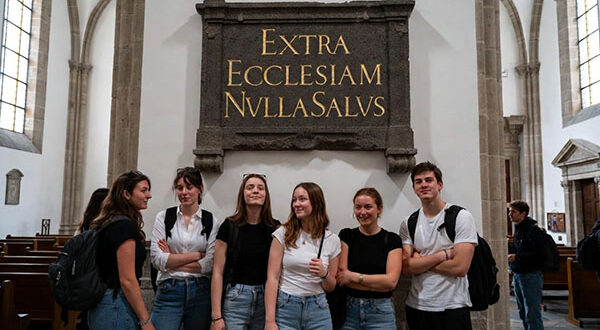
In a world marked by relativism, religious pluralism, and doctrinal confusion, few Latin expressions have been quoted — and so often misunderstood — as this one: Extra Ecclesiam Nulla Salus. Literally translated, it means: “Outside the Church there is no salvation.”
At first glance, it may sound harsh, exclusionary, or even threatening. However, when studied with theological rigor and contemplated in the light of the authentic Magisterium — especially in the teaching of Pius XII in his encyclical Mystici Corporis Christi — we discover that it is not a “doctrinal club,” but a profoundly mystical, Christological, and pastoral affirmation.
It is not a boundary that condemns; it is a mystery that reveals how God has willed to save the world in Christ and through His Body, which is the Church.
1. Where does this affirmation come from?
The formula has ancient roots. Already in the third century, Saint Cyprian of Carthage affirmed:
“He cannot have God for his Father who does not have the Church for his Mother.”
From the earliest centuries, the Church understood that Christ did not come to found merely a spiritual current, but a visible and sacramental Body: His Church.
Jesus Himself expressed this clearly:
“I am the way, and the truth, and the life; no one comes to the Father except through me” (Jn 14:6).
And also:
“He who believes and is baptized will be saved” (Mk 16:16).
Christ is the only Savior. But Christ does not act in isolation; He acts in His Body. And that Body is the Church.
2. The classical understanding: the Church as the Ark of salvation
For centuries, theology compared the Church to Noah’s Ark. Just as outside the ark there was no salvation from the flood, outside the Church there is no eternal salvation.
But this affirmation did not refer to a merely sociological or juridical membership. It never meant that any person who does not appear in a parish registry is automatically condemned. The Church has always distinguished between:
- Visible membership (baptism, profession of faith, communion with the Pope and the bishops).
- Invisible or implicit membership (desire for truth, sincere search for God, invincible ignorance).
Here is where the luminous teaching of Pius XII enters with clarity.
3. The great key: Mystici Corporis Christi
In 1943, in the midst of the Second World War, Pope Pius XII published the encyclical Mystici Corporis Christi. In it, he develops one of the deepest explanations of the mystery of the Church as the Mystical Body of Christ.
Here we find an essential teaching:
Not all who are united to the Church are united in the same way.
Pius XII distinguishes between:
- Members in the full sense: the baptized, who profess the true faith and are in communion with legitimate authority.
- Those ordered to the Body by an unconscious desire: persons who, through no fault of their own, do not know the Church but sincerely seek God and fulfill His will according to the light they have received.
This does not relativize the doctrine. It deepens it.
Salvation always comes through Christ. And it always comes through the Church, because the Church is His Body. But this mediation can take forms known fully only to God.
It is not about a “parallel invisible Church,” but about the universal efficacy of grace flowing from the Body of Christ.
4. Invisible belonging: a mystery of grace
Pius XII speaks of those who are “ordered” to the Mystical Body by an implicit desire.
What does this mean?
It means that a person may be related to the Church without explicitly knowing it. If someone:
- Sincerely seeks the truth.
- Acts according to a rightly formed conscience.
- Responds to the interior grace of God.
That person is not outside the reach of salvation.
But — and here is the key point — if such a person is saved, he or she is saved through Christ and through the Church, even without knowing it.
There is no salvation parallel to the Church. There is a mysterious participation in her.
5. What the doctrine does NOT mean
It is important to clarify some contemporary misunderstandings.
It does not mean:
- That all religions are equal.
- That the Church is merely “one option among many.”
- That baptism is unnecessary.
- That doctrinal truth is secondary.
The Church continues to affirm that she possesses the fullness of the means of salvation: the Eucharist, the sacraments, apostolic succession, the integrity of the faith.
Implicit desire does not replace visible belonging when the latter is possible.
6. Relevance in today’s world
We live in an age marked by religious pluralism and spiritual indifference. Many sincere people do not truly know the Church, but rather caricatured versions of her.
Here this doctrine acquires immense pastoral significance:
- It urges us to evangelize without arrogance.
- It reminds us that God’s grace acts beyond our visible boundaries.
- It frees us from both harsh exclusivism and soft relativism.
The Church is not a closed club.
She is the living Body of Christ extended throughout history.
7. Practical applications for daily life
1. Value our belonging
If we have received baptism, the sacraments, and the fullness of faith, it is not by our own merit. It is an immense gift.
The doctrine of Extra Ecclesiam Nulla Salus should not generate pride, but gratitude and responsibility.
2. Live real communion
It is not enough to be “registered.” Belonging to the Body implies:
- Frequent sacramental life.
- Doctrinal fidelity.
- Active charity.
- Unity with the Magisterium.
3. Evangelize with charity and clarity
If we believe that the Church is where Christ acts fully, we cannot remain silent. But neither can we impose.
Truth is proposed, not imposed.
4. Trust in divine mercy
We must avoid two extremes:
- Condemning everyone who is outside.
- Claiming that it makes no difference whether one belongs or not.
Salvation is a mystery of grace, not a mathematical equation.
8. A rigorous theological synthesis
From a theological standpoint:
- Christ is the only universal mediator.
- The Church is the Mystical Body of Christ.
- Every saving grace flows from Christ the Head through His Body.
- There can exist an ordering to the Body without visible membership.
- Full belonging is the ordinary mode willed by God.
Therefore:
Outside the Church there is no salvation, because outside Christ there is no salvation.
And there is no Christ separated from His Body.
9. The mystery that commits us
This doctrine is not a threat.
It is an invitation.
It invites us to:
- Remain united to Christ.
- Love the Church deeply.
- Work for unity.
- Pray for the conversion of the world.
- Live our faith coherently.
It reminds us that the Church is not just another human structure, but the universal sacrament of salvation.
10. Conclusion: belonging is a gift and a mission
When we understand Extra Ecclesiam Nulla Salus in the light of Mystici Corporis Christi, the phrase ceases to sound exclusionary and reveals itself as a proclamation of hope.
Christ did not leave humanity orphaned.
He gave us His Body.
He gave us the Church.
And if God can mysteriously save those who do not fully know her, this does not diminish her necessity; rather, it underscores the greatness of the divine plan.
May this truth move us to live our faith with greater depth, greater coherence, and greater love.
Because belonging to the Church is not a label.
It is participation in the living Body of Christ.
It is allowing His grace to transform us.
It is entering into the mystery of eternal communion.
And in that mystery, far from exclusions, we find the deepest universality:
the universality of Christ’s redeeming love which, through His Church, desires to draw all people to Himself.