Related Articles


There are saints who seem “minor” in modern calendars, reduced to a quick blessing at the end of Mass or to a holy card forgotten in a drawer. But the Church, which has a long memory and a deep heart, knows well that Saint Blaise is not a relic of the past, but a living witness of how faith touches the body, food, illness, and everyday life.
To speak of Saint Blaise is to speak of the throat… but also of the Word. It is to speak of blessed food… but also of the Bread that saves. It is to speak of a popular devotion… deeply rooted in a very serious and very relevant theology.
This article aims to help you understand, live, and transmit this tradition with meaning, depth, and spiritual fruit.
1. Who Was Saint Blaise? A Bishop, a Martyr, and a Shepherd with the Smell of His People
Saint Blaise (Blasius) was bishop of Sebaste, in Armenia (present-day Turkey), at the end of the 3rd century and the beginning of the 4th. He lived during times of persecution, specifically under Emperor Licinius.
According to tradition, before becoming a bishop he was a physician, which is no minor detail: from his human formation he was already linked to the care of the body and the relief of suffering.
Persecuted for his faith, he withdrew to a cave in the mountains where—according to hagiographical accounts—animals came to him to be healed, a powerful image of the shepherd who restores the harmony of creation wounded by sin.
Eventually he was arrested, tortured, and martyred. His death was not silent: it was a public confession of Christ. For this reason the Church venerates him not only as a miracle worker, but as a martyr, that is, a faithful witness unto the end.
2. The Miracle of the Throat: The Origin of a Universal Devotion
The best-known tradition recounts that while Saint Blaise was being led to prison, a desperate mother brought her child to him, who was choking on a fishbone lodged in his throat.
Saint Blaise prayed… and the child was healed.
From that moment on, the Church recognized him as a special intercessor for diseases of the throat, and his memorial (February 3) became associated with a very concrete blessing: the Blessing of Throats.
Here it is important to underline something essential:
👉 This is not magic or superstition, but a sacramental intercession. That is, a trusting plea to God, supported by the communion of saints, so that grace may also reach our bodily frailty.
3. The Throat in Theological Perspective: More Than an Organ, a Spiritual Place
Why the throat?
Christian theology does not separate body and soul. The throat is:
- The place through which food enters
- The place through which words come out
- The place through which we breathe
In biblical terms, the throat is linked to life itself. Psalm 63 says:
“O God, you are my God, for you I long; for you my soul is thirsting. My body pines for you like a dry, weary land without water.” (Ps 63:1)
And Jesus himself affirms:
“Man does not live by bread alone, but by every word that comes from the mouth of God.” (Mt 4:4)
Saint Blaise, protector of the throat, reminds us that:
- What we eat must be received with gratitude.
- What we say must be purified.
- What we breathe is a gift.
4. The Blessing of Throats: Liturgical and Pastoral Meaning
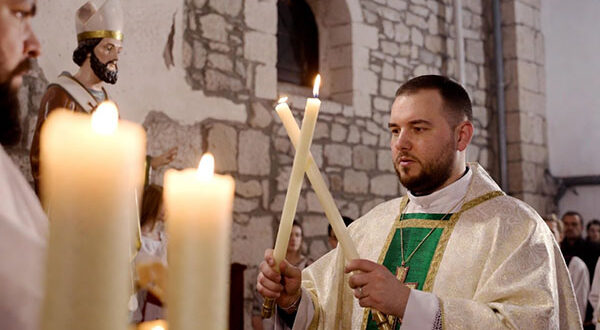
The Church, in her wisdom, has preserved this blessing with a sober and profound rite. Traditionally it is carried out with two crossed candles, a clear symbol of:
- The Cross of Christ, from which all true healing flows.
- The light, which overcomes the darkness of illness and fear.
The traditional formula essentially says:
“Through the intercession of Saint Blaise, bishop and martyr, may God deliver you from diseases of the throat and from every other evil.”
Theologically, this blessing:
- Recognizes God as the source of all healing
- Invokes the communion of saints
- Embraces the integral good of the person, not only the physical
Pastorally, it is a beautiful gesture because it touches people who are distant, children, the elderly, the sick… It is an open door to grace.
5. Saint Blaise and the Blessing of Food: Faith Reaching the Table
Less well known, but deeply rooted in many places, is the custom of blessing food on the feast of Saint Blaise, especially bread, fruit, sweets, or basic products.
Why?
Because Saint Blaise is associated with:
- The throat
- Food
- Protection against physical ailments
But the background is profoundly biblical and theological.
In Sacred Scripture, blessing food means recognizing that everything comes from God:
“Everything created by God is good, and nothing is to be rejected if it is received with thanksgiving.” (1 Tim 4:4)
The blessing of food on Saint Blaise’s day expresses three essential truths:
- We depend on God, even for the most basic things.
- Food is not merely consumption, but a gift.
- Eating is a human act, but also a spiritual one.
6. A Rigorous Practical Guide: Living Saint Blaise Today (Theologically and Pastorally)
A. In the parish
- Celebrate the Blessing of Throats with prior catechesis, explaining its meaning.
- Offer the blessing of food, avoiding any tone of superstition.
- Relate the devotion to the Eucharist, the true Bread that heals and saves.
B. In the family
- Bless the table on Saint Blaise’s day in a special way.
- Explain to children who the saint was and why he is invoked.
- Pray for those who suffer from throat illnesses, cancer, respiratory problems, or voice disorders.
C. In personal life
- Ask Saint Blaise not only for bodily health, but also for:
- Purity in speech
- Prudence in speaking
- Strength to confess the faith
- Make a small examination of conscience:
- Do I use my voice to bless or to wound?
- Do I give thanks for what I eat?
- Do I care for my body as a temple of the Spirit?
7. Saint Blaise Today: A Surprisingly Contemporary Devotion
In a world where:
- Food is trivialized
- Speech is poisoned
- Interior silence is broken
Saint Blaise reminds us of something deeply countercultural:
👉 God wants to save everything, even what is everyday, bodily, and small.
It is no coincidence that his devotion endures. It is not nostalgia. It is Christian wisdom.
Saint Blaise is not only the saint of the throat: he is the saint of grateful living, of incarnate faith, of the blessing that transforms the ordinary into a place of grace.
May Saint Blaise Intercede for Us
So that our throats may proclaim the truth,
our tables may be places of gratitude,
and our entire lives may become a blessing.
Because when faith is lived this way, the Gospel becomes flesh… and also bread.