Related Articles
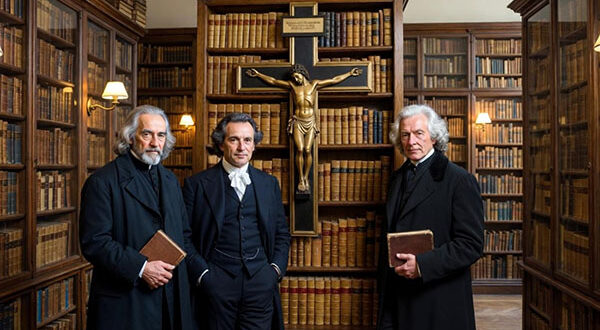
We live in a fascinating and dangerous age. Never has the human being had so much access to knowledge, and never has he been so confused about what is essential: who he is, where he comes from, and where he is going. Modern philosophy has profoundly shaped our culture, our laws, our way of thinking… and, often without us noticing, even our way of believing.
But here arises the great question:
Is modern philosophy an enemy of Catholicism? Or can it be purified, assumed, and elevated by faith?
This article does not seek to demonize or idealize, but to offer a rigorous theological and pastoral discernment. Because what is at stake is not an academic discussion, but your soul.
“See to it that no one takes you captive through philosophy and empty deceit, according to human tradition… and not according to Christ.” (Colossians 2:8)
Saint Paul does not condemn philosophy in itself. He condemns philosophy that separates itself from Christ.
1. What do we mean by “modern philosophy”?
Modern philosophy was born in Europe between the 16th and 18th centuries. It represents a radical shift from classical philosophy (Plato, Aristotle) and medieval philosophy (especially St. Thomas Aquinas).
If classical philosophy asked:
What is reality?
Modern philosophy begins by asking:
What can I know?
This shift may seem technical, but it is revolutionary.
Some key names:
- René Descartes (1596–1650)
- Immanuel Kant (1724–1804)
- David Hume (1711–1776)
- Jean-Jacques Rousseau (1712–1778)
- Georg Wilhelm Friedrich Hegel (1770–1831)
What do they have in common? The displacement of the center from God and being, toward the human subject.
2. From “Being” to the “Self”: The Birth of Subjectivism
Descartes and Methodical Doubt
René Descartes begins his system with the famous phrase:
“Cogito, ergo sum” (I think, therefore I am).
The starting point is no longer objective reality, but individual consciousness.
Certainty arises from the self, not from being.
This inaugurates a historical process that will culminate in:
- Moral subjectivism (“what matters is what I feel”)
- Relativism (“everyone has their own truth”)
- Radical individualism
The Catholic faith, by contrast, begins from a revealed truth that does not depend on my perception.
“Jesus Christ is the same yesterday, today, and forever.” (Hebrews 13:8)
Truth does not change according to the subject.
3. Kant and the Limits of Knowledge: An Unknowable God?
Immanuel Kant argued that we cannot know the “thing in itself,” only phenomena.
This implies that God cannot be known rationally, but only postulated morally.
Here a profound fracture opens:
- Catholic theology affirms that reason can know the existence of God (cf. Romans 1:20).
- Kant limits reason to the empirical realm.
This approach prepared the ground for modern agnosticism.
However, the Church has never feared reason. On the contrary.
St. Thomas taught that faith and reason are two wings that lift the human spirit toward truth.
The modern rupture between faith and reason is one of the great dramas of our time.
4. Rousseau and the Myth of Natural Goodness
Rousseau claimed that man is naturally good and that society corrupts him.
The Catholic faith teaches something more realistic and profound:
- Man was created good.
- But he is wounded by original sin.
Denying original sin leads to utopian ideologies that believe it is enough to change external structures to redeem man.
The history of the 20th century tragically demonstrates otherwise.
The problem of the world lies first not in structures, but in the human heart.
“For out of the heart come evil thoughts…” (Matthew 15:19)
5. Hegel and History Without Transcendence
Hegel proposed a dialectical view of history as the inevitable progress of the absolute spirit.
Many modern political systems draw inspiration from this idea of necessary progress.
The problem is that Providence is replaced by historical process.
For Catholicism:
- History has meaning.
- But it is not automatic.
- It is open to human freedom.
- It culminates in Christ.
Salvation is not the fruit of a dialectic, but of the Cross.
6. Present Cultural Consequences
Modern philosophy has influenced:
- Secularism
- Moral relativism
- Scientism
- Ethical emotivism
- The loss of the sense of the sacred
Today we live in a culture where:
- Truth is opinion.
- Good is preference.
- Identity is construction.
- Freedom is self-determination without reference to truth.
But freedom without truth becomes slavery.
7. Should Catholics Reject All Modern Philosophy?
Here we must be rigorous and fair.
The Church does not reject modern philosophy as a whole.
She has engaged in critical dialogue with it.
For example:
- She recognizes the importance of personal conscience.
- She values the dignity of the subject.
- She defends authentic freedom.
But she purifies what deviates.
The error is not in reflecting on the subject.
The error lies in absolutizing it.
Truth is not born from man.
Man is born for truth.
8. The Theological Response: Recovering Christian Realism
The Catholic tradition proposes an ontological realism:
- Reality exists independently of my mind.
- Truth is the conformity of the intellect to reality.
- God is the ultimate foundation of being.
This realism protects:
- Moral objectivity.
- Doctrinal stability.
- The authentic dignity of the person.
Without objective truth, there is no true love.
Because to love is to will the good of the other.
And if the good is relative, love is emptied.
9. Practical Applications for Your Daily Life
This topic is not theoretical. It is profoundly pastoral.
1. Examine Your Cultural Assumptions
Ask yourself:
- Do I believe that truth depends on what I feel?
- Do I think morality is relative?
- Have I separated faith and reason in my life?
Conversion begins with thought.
2. Form Your Intellect
Read classical and Christian philosophy.
Study the Catechism.
Do not be afraid to think.
Faith is not sentimentalism. It is adhesion to Truth.
3. Recover the Sacramental Life
Modern philosophy is combated not only with books, but with grace.
Frequent confession.
The Eucharist.
Adoration.
Christ is not an idea. He is a Person.
4. Live Freedom as Obedience to Truth
True freedom is not doing what I want, but doing what I ought.
Christ does not enslave us with truth. He frees us.
“You will know the truth, and the truth will set you free.” (John 8:32)
10. A Final Discernment: Crisis or Purification
Modernity is not only decline. It is also an opportunity for purification.
In a relativistic world, the witness of firm faith shines brighter.
In a subjective culture, truth lived with charity attracts.
In a secularized society, Christian coherence evangelizes.
The Church has passed through empires, heresies, and revolutions.
She will also endure modernity.
But she needs Catholics who are formed, conscious, and deeply rooted in Christ.
Conclusion: Returning to Christ, the Eternal Foundation
Modern philosophy raised legitimate questions.
But when man places himself at the absolute center, he ends up losing himself.
Catholicism does not fear reason.
It elevates it.
It does not fear freedom.
It purifies it.
It does not fear modern thought.
It discerns it.
The great battle is not between the Church and culture.
It is between truth and subjectivism.
And that battle begins in your mind and in your heart.
More than ever, we need Christians who think rigorously, love deeply, and live coherently.
Because only Christ fully answers modern restlessness.
And as Saint Augustine wrote:
“You have made us for Yourself, O Lord, and our heart is restless until it rests in You.”
Modernity seeks rest in the self.
Faith finds it in God.
And there lies the decisive difference.