Related Articles
Introduction: When the Soul Already Knows It Will See God, but Cannot Yet Behold Him
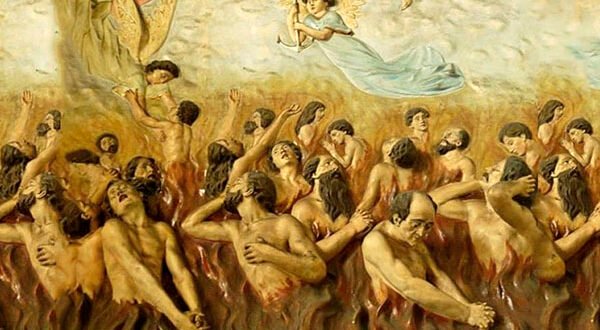
There is a reality of the Catholic faith which, although it forms part of the Church’s traditional teaching, is not always explained in sufficient depth: the sufferings experienced by the souls in Purgatory.
When we speak of Purgatory, we immediately tend to think of a place of suffering, of purifying fire, or of the prayers we offer for our deceased loved ones. However, behind this reality lies a much deeper theological teaching, one that allows us to understand not only what happens after death, but also the nature of sin, the holiness of God, and the ultimate destiny of the human soul.
Traditional Catholic theology distinguishes between two major kinds of suffering in Purgatory:
- The pain of loss (poena damni): the suffering that arises from temporary deprivation of the Beatific Vision, that is, from not yet being able to behold God face to face.
- The pain of sense (poena sensus): the purifying suffering which, according to traditional theological teaching, affects the soul because of the consequences of sin and the need to satisfy the temporal punishment that may still remain.
These two expressions belong to the language of scholastic theology and help explain a spiritual reality that goes beyond our earthly experience.
At the outset, an important distinction must be established: the Church teaches that there is purification after death for those who die in God’s grace, but it has not defined every detail concerning the exact nature of Purgatory’s sufferings, nor has it established as dogma every particular explanation offered by theologians concerning fire or the way in which the pain of sense is experienced.
We must therefore distinguish between defined doctrine, traditional teaching, and theological explanations that seek to explore it more deeply.
Understanding this distinction does not diminish the richness of the doctrine. On the contrary, it allows us to approach the mystery with greater accuracy, avoiding both superficial interpretations and imaginary descriptions that lack sufficient foundation.
For Purgatory is not simply a place where souls suffer. Above all, it is the manifestation of a profoundly consoling truth: God does not abandon those who die in His friendship, but brings to completion the work of purification that He began in them during their earthly lives.
1. What Exactly Is Purgatory According to Catholic Teaching?
The Catechism of the Catholic Church teaches:
“All who die in God’s grace and friendship, but still imperfectly purified, are indeed assured of their eternal salvation; but after death they undergo purification, so as to achieve the holiness necessary to enter the joy of heaven” (CCC, 1030).
This definition contains three fundamental affirmations.
First: the souls in Purgatory have died in God’s grace and friendship.
They are not condemned souls, nor are they people whose eternal destiny remains uncertain. Their salvation is assured.
Second: they still need to be purified.
Although they have died reconciled with God, they may still retain the consequences of their sins, some remaining need for purification, or certain disordered attachments that were not fully healed during their earthly lives.
Third: their destination is Heaven.
Purgatory is not a third path between Heaven and Hell. Nor is it a second opportunity to convert after having definitively rejected God.
It is the purification of those who already belong to God and are destined to contemplate Him eternally.
The Catechism adds that this doctrine is particularly connected with the practice of praying for the dead, so that they may be freed from their sins (CCC, 1032).
The Church, therefore, does not present Purgatory as a secondary speculation, but as a truth closely connected with the communion of saints, divine justice, and Christian hope.
2. The Pain of Loss: The Suffering of Not Yet Being Able to Behold God
The first great pain of Purgatory: poena damni
To understand this pain, we must remember the ultimate purpose for which the human being exists.
God created man to know Him, love Him, and share eternally in His life. No created good can fully satisfy the deepest desire of the human heart, because we have been called to an infinite good: God Himself.
Saint Augustine expressed this spiritual longing in one of the best-known passages of his Confessions:
“You have made us for Yourself, O Lord, and our heart is restless until it rests in You.”
This statement sheds profound light on the reality of Purgatory.
During our earthly lives, we can become distracted by countless things. We can seek happiness in money, recognition, pleasures, professional success, or human relationships. We can even become accustomed to living with lukewarm faith, relegating God to second place.
But after death, the soul finds itself before the truth of its eternal destiny.
It understands with a clarity it did not possess during its earthly existence that God is its supreme good and that nothing can be compared with Him.
And yet it still cannot behold Him in the Beatific Vision.
What does this suffering consist of?
Theology calls this the pain of loss, the temporary deprivation of the Beatific Vision.
It does not mean that God has rejected the soul, nor that there is a rupture in its friendship with Him. Nor does it mean that the soul has lost hope of attaining Heaven.
On the contrary: the soul knows that it belongs to God and that its eternal destiny is assured.
Precisely for this reason, the waiting is painful.
We can understand this through an imperfect comparison: imagine someone who knows that a person they love deeply is waiting for them, who is certain that they will be reunited and that nothing can ultimately prevent that encounter. Nevertheless, an obstacle must still be overcome before the reunion can take place.
The distance does not mean that love has ceased. In fact, love makes the waiting more intense.
In Purgatory, this reality reaches a depth that we cannot fully experience in our present life.
The purified soul desires God with an intensity that is no longer scattered among the worries, distractions, and interests of this world.
The more deeply the soul understands that God is its ultimate happiness, the more painful the temporary deprivation of His vision becomes.
The difference between the pain of loss in Purgatory and in Hell
Here it is essential to establish a doctrinal distinction.
In Hell, separation from God is definitive. Those who die in mortal sin without repenting remain eternally deprived of communion with Him.
In Purgatory, by contrast, deprivation of the Beatific Vision is temporary.
The souls undergoing purification are not condemned. They have not lost God forever. Their purification takes place within the certainty of their salvation.
Therefore, although both realities are theologically related to deprivation of the Beatific Vision, they must not be confused.
The suffering of the soul in Purgatory is that of someone waiting for the fullness of a union they already know they will attain; the suffering of the condemned is that of someone who has definitively lost that communion.
This difference completely transforms the spiritual meaning of these two pains.
3. The Pain of Sense: The Suffering of Purification
The second great pain of Purgatory: poena sensus
The second kind of pain is called poena sensus, a Latin expression that can be translated as “pain of sense.”
Whereas the pain of loss is related to the temporary deprivation of the vision of God, the pain of sense refers to the purifying suffering that traditional theology attributes to the souls in Purgatory.
To understand it correctly, we must begin with a fundamental truth: sin does not merely break or weaken our relationship with God; it also leaves consequences within our souls.
Even when a sin has been forgiven, certain spiritual consequences may remain and need to be healed.
Consider, for example, a person who has sincerely confessed their sins of pride, impatience, or selfishness. Sacramental absolution restores sanctifying grace if it had been lost, but this does not necessarily mean that every disordered inclination that led that person to sin immediately disappears.
A tendency towards pride, difficulty in forgiving, or an excessive attachment to certain material goods may remain.
The person has received forgiveness, but still needs to be transformed inwardly.
This reality helps us understand the need for final purification.
What exactly does the pain of sense mean?
Traditional theology distinguishes between deprivation of the supreme good, which corresponds to the pain of loss, and the purifying sufferings grouped under the name of pain of sense.
Nevertheless, it is important to avoid an excessively simplified interpretation.
We should not imagine that every venial sin automatically produces a specific pain, or that there is a mathematical correspondence between a particular fault and a specific amount of suffering.
Nor can we claim to know exactly how the soul experiences these sufferings.
The expression “of sense” belongs to a theological classification that seeks to explain the sufferings associated with the state of purification. It does not authorise us to describe all their mechanisms with certainty, nor to transfer without qualification the physical sensations we know from our bodily existence to the spiritual world.
In scholastic theology, particularly in the Thomistic tradition, it has been maintained that the souls in Purgatory experience a genuine pain of sense, frequently associated with the purifying fire mentioned in ecclesiastical tradition.
However, the exact nature of this fire and the way in which it can affect a soul separated from the body have been subjects of theological discussion.
We must therefore preserve traditional teaching without turning a particular theological explanation into dogma.
Disordered attachment to created things
One of the most important aspects of understanding the purification of the soul is disordered attachment to created goods.
The Catechism of the Catholic Church explains in paragraph 1472 that every sin, even venial sin, entails an unhealthy attachment to creatures that must be purified, either during earthly life or after death.
This teaching is fundamental.
It does not mean that loving the things of this world is wrong. God has created genuinely good things: family, friendship, work, beauty, nature, and the material goods necessary for a dignified life.
The problem arises when we love these goods in a disordered way, placing them above God or using them against the order of charity.
For example:
- Attachment to money: when financial security becomes a concern that displaces trust in Divine Providence.
- Vanity: when we constantly need the approval of others to feel that our lives have value.
- Resentment: when we deliberately hold on to bitterness and refuse to forgive.
- Pride: when we find it difficult to acknowledge our mistakes and humbly accept the truth.
- Disordered sensuality: when we seek pleasure without respecting the dignity of our bodies and the moral law.
- Comfort: when we systematically avoid every sacrifice that could help us grow in virtue.
- Spiritual lukewarmness: when we know our Christian obligations but constantly postpone our conversion.
These realities show that purification does not simply consist of eliminating a list of faults. It consists of healing everything that still prevents the soul from loving God with the perfection to which it has been called.
Sin leaves wounds even after forgiveness
We can use a simple comparison.
Imagine someone who has suffered an illness and receives treatment that eliminates the cause of their condition. Although the illness has been overcome, they may still need time to recover and regain their full strength.
Something similar happens, allowing for the necessary differences, in the spiritual life.
The Sacrament of Penance forgives sins and reconciles us with God. However, the purification of sin’s consequences may still require a process of transformation.
The Church calls one of these consequences that may remain after guilt has been forgiven temporal punishment due to sin.
We should not understand it as God’s revenge, but as a reality connected with the very nature of sin and the need to fully restore the order of justice and charity.
In this way, we can better understand why a person may die reconciled with God and nevertheless still need further purification.
4. What Does Sacred Scripture Say About the Pains of Purgatory?
The Bible does not present a systematic description of the two pains using the Latin expressions poena damni and poena sensus. This classification belongs to the development of theological reflection.
Nevertheless, we find various passages that help us understand the biblical foundations of purification after death.
4.1. The Purifying Fire of 1 Corinthians 3:11-15
One of the most important texts for the theology of Purgatory is found in Saint Paul’s First Letter to the Corinthians:
“The work of each will come to light, for the Day will disclose it. It will be revealed with fire, and the fire itself will test the quality of each one’s work. If the work that someone has built on the foundation survives, that person will receive a reward. But if someone’s work is burned up, that person will suffer loss; the person will be saved, but only as through fire” (1 Corinthians 3:13-15).
The context of this passage concerns the responsibility of those who build upon the foundation that is Jesus Christ.
Saint Paul speaks about people’s works and how they will be tested before God.
The image of fire expresses the testing and revelation of the quality of those works.
The Church has traditionally recognised in this passage one of the biblical references that help support the doctrine of final purification.
The Catechism mentions it among the biblical traditions that speak of purifying fire (CCC, 1031).
It should be made clear that the text does not explicitly describe the two pains of Purgatory, nor does it provide a physical explanation of that fire. Its interpretation requires attention to the context and to the traditional reading of the Church.
But it contains an idea of enormous importance: a person can attain salvation and yet still need to undergo purification.
4.2. Prayer for the Dead in 2 Maccabees 12:38-46
Another fundamental text is found in the Second Book of Maccabees.
After a battle, Judas Maccabeus discovers that some of the fallen Jewish soldiers were carrying objects consecrated to idols, contrary to the Law.
Faced with this situation, he takes up a collection and sends an offering to Jerusalem so that a sacrifice may be offered for the deceased.
The passage concludes:
“Therefore he made atonement for the dead, that they might be delivered from their sin” (2 Maccabees 12:45).
This passage has extraordinary doctrinal importance.
Prayer for the dead does not appear here as a medieval invention or as a custom arising from popular superstition.
We find a religious practice from the Jewish tradition predating Christianity, expressing the conviction that the living can intercede for those who have died.
The Catholic Church recognises this passage as a particularly significant biblical foundation for prayer for the dead.
Christians who recognise the authority of the deuterocanonical books find here a particularly clear teaching: charity does not end with death, and prayer for the deceased has genuine spiritual meaning.
4.3. Nothing Impure Can Enter God’s Presence
The Book of Revelation contains a fundamental statement about the holiness of Heaven:
“Nothing unclean shall enter it” (Revelation 21:27).
The context refers to the heavenly Jerusalem, presented as God’s definitive dwelling with humanity.
This statement illuminates an essential truth: full communion with God requires complete holiness.
It is not enough for a person simply to desire to enter Heaven. Their soul must be fully purified.
In this sense, Purgatory reveals God’s absolute holiness and the need for man to be transformed in order to share in His glory.
4.4. The Possibility of Forgiveness in the Age to Come
We also find a significant reference in the words of Jesus Christ:
“And whoever speaks a word against the Son of Man will be forgiven; but whoever speaks against the Holy Spirit will not be forgiven, either in this age or in the age to come” (Matthew 12:32).
Catholic tradition has seen in this statement an indirect reference to the possibility that certain faults may be forgiven in the life to come.
This does not mean that after death there is a new opportunity to repent of a life spent rejecting God.
The traditional interpretation is that certain consequences or faults may be purified in the state that follows death.
The Catechism includes this interpretation in paragraph 1031, expressly citing this Gospel passage.
5. Since When Has the Church Believed in Purgatory?
The doctrine of Purgatory did not suddenly appear in the Middle Ages, although it was during the development of medieval theology that it received a more systematic conceptual formulation.
Its foundations are found in Sacred Scripture, the ancient practice of praying for the dead, and the reflection of the Church Fathers.
The Practice of the Early Church
From the first centuries of Christianity, we find testimonies of prayers for the deceased and the liturgical commemoration of the dead.
This practice expresses the conviction that the members of the Church remain united in Christ even after death.
Among the patristic testimonies, Saint Augustine of Hippo (354-430) stands out. He addressed the question of purification after death and recommended prayer for the deceased.
In his work The City of God, Book XXI, Chapter 24, he reflects on the possibility that certain people may be saved through purifying suffering after this life.
Likewise, in his Confessions, Book IX, Chapter 13, we find his prayer for his mother, Saint Monica, who died in the year 387.
This testimony is particularly significant because it shows how prayer for the deceased formed part of ancient Christian spirituality.
We should not attribute to Saint Augustine a definitive description of every characteristic of Purgatory as later developed by scholastic theology. His thought shows, rather, that theological reflection was developing.
The Contribution of Saint Gregory the Great
Another important witness is Saint Gregory the Great (c. 540-604), Pope and Doctor of the Church.
In his Dialogues, particularly Book IV, he addresses the question of purification after death and recounts various accounts connected with it.
Some of these accounts belong to the genre of religious narratives of his time. They must therefore be read with an understanding of their nature and not treated as though every detail constituted a doctrinal definition.
What matters for our subject is that Saint Gregory helped transmit and develop Christian reflection on the purification of certain souls after death.
The Development of Doctrine in the Councils
The teaching on Purgatory acquired a more precise doctrinal formulation over the centuries.
Among the most important events are:
- Second Council of Lyon (1274): it set out the doctrine concerning the purification of souls and the assistance they receive through the suffrages of the faithful.
- Council of Florence (1439): it expressly formulated the teaching concerning souls who, after death, need purification and can be helped through the suffrages of the living.
- Council of Trent (1563): it solemnly reaffirmed Catholic teaching on Purgatory and the usefulness of prayers, almsgiving, and especially the sacrifice of the Mass offered for the deceased.
The decree on Purgatory from the Twenty-Fifth Session of the Council of Trent deserves special attention.
The Council Fathers insisted that the doctrine handed down by the Fathers and earlier councils should be faithfully taught. At the same time, they warned against excessively difficult questions, uncertain claims, and explanations that might encourage curiosity or superstition.
This warning remains extraordinarily relevant today.
The Church invites us to believe firmly in Purgatory, but not to turn its unknown aspects into a field for uncontrolled imagination.
The purpose of this doctrine is not to satisfy our curiosity about the afterlife, but to lead us towards a life of greater holiness and charity.
6. Is the Fire of Purgatory Real? Traditional Teaching and Its Limits
One of the questions that has aroused the greatest interest throughout the history of Catholic spirituality concerns the nature of purifying fire.
When the saints and theologians speak of the fire of Purgatory, should we understand it as a material fire, similar to the one we know on earth? Is it a spiritual reality? Is it an image expressing the intensity of purifying suffering?
The answer requires prudence.
Fire in the Tradition of the Church
The Catechism of the Catholic Church, in paragraph 1031, recalls that the tradition of the Church, drawing upon certain passages of Scripture, speaks of a purifying fire.
This expression forms part of a very ancient theological tradition.
Some authors, particularly within scholastic theology, maintained that the fire of Purgatory should be understood as an actual reality and not merely as a metaphor.
Saint Thomas Aquinas, for example, addresses this question in the Supplement to the Summa Theologiae, Questions 70 and following, where he discusses the pains of Purgatory and their relationship with fire.
In the Thomistic tradition, it is maintained that separated souls can experience a pain of sense and that purifying fire constitutes a reality connected with that pain.
Nevertheless, it is necessary to distinguish this theological explanation from a dogmatic definition.
The Church has not defined that the fire of Purgatory is material in the same sense as the physical fire of our world, nor has it scientifically explained how it could act upon a soul separated from the body.
For this reason, we should not present a particular explanation of its nature as binding doctrine for all Catholics.
What we must maintain is the reality of purification and the existence of suffering associated with it, according to traditional theological teaching.
Why Does God Use Purification?
This question leads us to the heart of the mystery.
God does not purify because He needs to punish for pleasure or because He finds satisfaction in the suffering of His creatures.
God is infinitely holy and loves man with perfect mercy.
But precisely because He loves him, He does not wish to leave him in a state of imperfection incompatible with the fullness of heavenly communion.
Purification is a manifestation of His justice and His mercy.
Imagine a piece of gold containing impurities. In order to reveal its full purity, it must undergo a refining process.
The comparison should not be taken literally, but it helps us understand the spiritual transformation expressed by this doctrine.
Purgatory is not an arbitrary punishment imposed upon souls whom God has already forgiven. It is the final purification of those who are destined to share fully in His glory.
7. Can the Souls in Purgatory Continue to Sin or Reject Their Purification?
This question deserves an explanation because some popular representations of Purgatory can convey a mistaken idea.
The souls in Purgatory are not in a state of indecision between loving God and rejecting Him.
They have died in grace and friendship with Him. Their salvation is assured.
Therefore, we should not imagine them as people who continue committing sins, rebelling against God, or attempting to escape their destiny through a new moral decision.
Purification is not a second earthly life.
Nor should it be confused with a new opportunity to change one’s eternal destiny.
The fundamental difference is that the soul is already definitively oriented towards God, but still needs to attain the fullness of holiness required to enter heavenly glory.
Here we find a very important spiritual lesson for our daily lives:
We should not wait until death to begin detaching ourselves from everything that separates us from God.
Conversion, penance, frequent Confession, charity, and the practice of the virtues are means available to us during our lives to advance towards holiness.
8. Do All the Souls in Purgatory Suffer Equally?
We cannot claim that all souls experience exactly the same degree of suffering.
Traditional theology has considered that there may be differences in the intensity of the pains, related to each soul’s spiritual condition and the purification it needs.
Nevertheless, we must be prudent when attempting to establish overly precise categories.
The Church has not defined a scale of suffering, nor has it established how long each soul must remain in Purgatory.
Nor do we have criteria for calculating the duration of a particular person’s purification.
In reality, our measurements of time cannot simply be transferred to the condition of souls separated from the body.
When we speak of days, years, or centuries in relation to Purgatory, we must avoid presenting such expressions as though we knew exactly how time functions in that state.
Can a Person Who Has Lived a Holy Life Still Need Purgatory?
Yes.
A person’s holiness during life does not allow us to conclude automatically that they have attained absolutely perfect purification.
A person may have lived with great fidelity to God, practised charity, and made significant sacrifices, yet still need final purification.
It is also possible that a person has achieved such profound purification during life through grace, charity, and penance that no temporal punishment remains to be satisfied.
The Catechism itself, in paragraph 1472, acknowledges that a conversion arising from fervent charity can achieve the sinner’s complete purification.
Therefore, Christian life does not consist simply of avoiding grave sins in order to secure our eternal destiny.
We are called to grow continually in holiness.
9. The Relationship Between Sin, Guilt, and Temporal Punishment
To fully understand the two pains of Purgatory, we must examine an essential distinction in Catholic doctrine: the difference between guilt, eternal punishment, and temporal punishment.
Sin is an offence against God and a rupture of the order He has established.
But its consequences do not always disappear simultaneously.
The Guilt of Sin
Guilt is the moral responsibility we incur when we voluntarily perform an action contrary to God’s law.
When we commit a mortal sin, we lose sanctifying grace and break our friendship with God.
The Sacrament of Penance, received with the necessary dispositions, reconciles us with Him and restores grace.
When we commit venial sins, these weaken our charity, although they do not destroy our friendship with God.
Eternal Punishment
Eternal punishment is related to the loss of communion with God as a consequence of mortal sin.
When a person dies without repenting of a mortal sin and without receiving divine forgiveness, they face definitive separation from God.
This reality belongs to the mystery of Hell and must not be confused with Purgatory.
Temporal Punishment
Temporal punishment is the consequence of sin that may remain even after guilt has been forgiven.
For example, a person who has committed an injustice may sincerely repent and receive sacramental absolution. Nevertheless, there may still be an obligation to repair the harm caused.
If they have stolen something, they should seek to return what was taken. If they have slandered someone, they should try to repair the damage to that person’s reputation. If they have caused suffering, they should seek reconciliation and make amends as far as possible.
Forgiveness does not automatically make the consequences of the evil committed disappear.
This distinction is essential for understanding Purgatory.
The Catechism develops this teaching in paragraphs 1472 and 1473, explaining that purification from the consequences of sin can take place during earthly life or after death.
Therefore, temporal punishment should not be understood as an economic debt paid through a mathematically determined amount of suffering.
It is a dimension of justice and of man’s spiritual transformation.
10. Can We Help the Souls in Purgatory Bear Their Sufferings?
One of the most consoling teachings of the Catholic faith
After understanding the pains of Purgatory, a question naturally arises, one that should challenge every Catholic:
If there are souls that need to be purified before contemplating God, can we do anything for them?
The Church’s answer is clear: yes, we can help them through our suffrages.
This possibility constitutes one of the most beautiful expressions of the communion of saints.
Death does not destroy the spiritual unity of those who belong to Christ.
The Church teaches that there is a communion between the faithful who are pilgrims on earth, the souls undergoing purification after death, and the saints who already enjoy heavenly glory.
The Catechism explains this reality in paragraphs 954-959 and develops the subject of prayer for the dead specifically in paragraph 1032.
10.1. The Sacrifice of Holy Mass
The Holy Mass is the most important means recommended by the Church for helping the souls in Purgatory.
It is not simply a human prayer or a sentimental remembrance of the deceased.
The Eucharist makes sacramentally present the one sacrifice of Jesus Christ, offered once and for all on the Cross.
Therefore, offering a Mass for someone who has died means entrusting that person to the infinite merits of Christ.
The Church has preserved this practice since ancient times, and the Council of Trent expressly reaffirmed it.
When we request a Mass for our parents, grandparents, relatives, or friends who have died, we are performing a genuine work of supernatural charity.
It is a concrete way of living the faith in the communion of saints.
10.2. Praying the Holy Rosary
The Rosary is another widespread practice among Catholics for entrusting the deceased to God.
Through its mysteries, we contemplate the life of Jesus Christ and the participation of the Blessed Virgin Mary in the work of Redemption.
We can offer our prayers for the souls in Purgatory, asking God to grant them the purification necessary to attain glory.
We must not forget that prayer is not a magical formula. Its effectiveness comes from divine grace and God’s mercy.
10.3. Indulgences Applied to the Deceased
The doctrine of indulgences is closely related to the purification of temporal punishment.
The Catechism defines an indulgence as:
“The remission before God of the temporal punishment due to sins whose guilt has already been forgiven” (CCC, 1471).
The Church, as the minister of Redemption, grants indulgences to the faithful who fulfil the prescribed conditions.
Indulgences may be partial or plenary.
They can also be applied to the deceased by way of suffrage, that is, by entrusting them to God so that He may grant them the fruits of this grace.
We must not confuse an indulgence with the forgiveness of sins. Guilt must have been forgiven through the means established by Christ, especially the Sacrament of Penance.
Nor does this mean that we can determine the state of a particular soul or automatically guarantee the outcome of an indulgence applied to that person.
The Church offers us this spiritual means as an expression of the communion of saints.
10.4. Almsgiving and Works of Charity
The Catechism also recommends almsgiving and works of penance on behalf of the deceased.
Helping someone in need, feeding the hungry, visiting the sick, or assisting someone going through difficulties are acts of charity that we can offer to God for our deceased loved ones.
This practice reminds us that the Christian faith cannot be reduced to words.
Love for the deceased must be accompanied by a life consistent with the Gospel.
10.5. Small Daily Acts of Penance
We can also offer small daily sacrifices for the souls in Purgatory.
For example:
- Voluntarily giving up an unnecessary comfort.
- Accepting an inconvenience with patience.
- Avoiding hurtful words.
- Practising humility when we feel offended.
- Performing an act of mercy without seeking recognition.
- Offering our difficulties and sufferings to God.
These actions acquire supernatural meaning when they are performed in God’s grace, with a right intention, and united to Jesus Christ.
Charity can transform even the small sacrifices of our daily lives into a spiritual offering.
11. The Virgin Mary and the Souls in Purgatory
For centuries, Catholic spirituality has maintained a special devotion to the Blessed Virgin Mary on behalf of the souls in Purgatory.
Mary is invoked as Mother of Mercy, Comforter of the Afflicted, and Queen of Heaven.
Her spiritual motherhood, given in relation to Christ’s disciples, is a source of confidence for the faithful.
In Saint John’s Gospel, we find these words of Jesus from the Cross:
“Woman, behold, your son” (John 19:26).
And to the beloved disciple:
“Behold, your mother” (John 19:27).
Catholic tradition has recognised in this episode a spiritual dimension that goes beyond the personal relationship between Mary and Saint John.
Mary is the Mother of Christ’s disciples and accompanies the Church maternally on its pilgrimage towards eternity.
For this reason, the faithful have traditionally sought her intercession when entrusting the deceased to God.
The Scapular and Particular Promises
Among these devotions, we find the tradition of the Brown Scapular of Mount Carmel and the promises associated with what is known as the Sabbatine Privilege.
This subject must be treated with historical accuracy.
The tradition of the Sabbatine Privilege is connected with an ancient bull attributed to Pope John XXII, known as Sacratissimo uti culmine. However, its historical authenticity and the interpretation of its content have been subjects of controversy.
The Church has warned against superstitious interpretations of the scapular and against the idea that simply wearing it automatically guarantees salvation or release from the pains of Purgatory within a specific period.
The scapular is, above all, a sign of spiritual belonging to the Carmelite family and of commitment to a Christian life under Mary’s maternal protection.
True Marian devotion always leads to Jesus Christ.
It does not replace conversion, the sacraments, or fidelity to the Gospel.
12. What Can We Learn from Purgatory for Our Christian Lives?
The doctrine of Purgatory should not awaken only our interest in what happens after death.
Its purpose is also to help us live better in the present.
In fact, one of the most important spiritual consequences of this teaching is the realisation that holiness does not consist merely in avoiding mortal sin, but in allowing God to transform our hearts completely.
We may attend Mass every Sunday, pray the Rosary, fulfil our religious duties, and yet retain attitudes that require profound conversion.
We may be practising Christians and still be proud, impatient, selfish, resentful, or excessively attached to material goods.
Purgatory reminds us that God calls us to genuine holiness, not merely external observance.
Learning to Detach Ourselves from What Separates Us from God
We live in a society that places enormous importance on possessions, consumption, social recognition, and the immediate satisfaction of desires.
We constantly receive messages encouraging us to accumulate things, seek pleasurable experiences, and make our personal well-being the main objective of existence.
None of this means that material goods are evil.
The problem arises when they end up occupying the place that belongs to God.
The doctrine of the pains of Purgatory invites us to ask ourselves:
- Am I too attached to money?
- Am I excessively concerned about what other people think of me?
- Am I capable of sincerely forgiving?
- Do I practise humility when someone corrects me?
- Am I willing to give something up for love of God?
- Do I devote enough time to prayer?
- Have I turned certain comforts into indispensable necessities?
These questions should not produce despair, but rather a sincere desire for conversion.
God’s grace can transform what we cannot correct through our own efforts alone.
Frequent Confession as a Path of Purification
The Sacrament of Penance is one of the great gifts Christ has left to His Church.
Through it, we receive forgiveness for our sins and are reconciled with God.
But Confession should not become a routine practice performed simply to fulfil a religious obligation.
It should become a true encounter with divine mercy.
A sincere examination of conscience, repentance, integral confession of our sins, and the firm purpose of amendment help us recognise our weaknesses and advance in holiness.
Furthermore, sacramental satisfaction reminds us that we must repair, as far as possible, the evil we have caused.
Voluntary Penance
Catholic spiritual tradition has always valued penance as a means of ordering our desires and strengthening our will.
Fasting, abstinence, mortification of the senses, and voluntarily giving up certain comforts can help us grow in interior freedom.
This does not mean despising our bodies or seeking suffering for its own sake.
Christian penance has meaning when it is united to the love of God and conversion of heart.
Saint Paul expresses this transformation through an exhortation:
“Put on the new self, created in God’s way in righteousness and holiness of truth” (Ephesians 4:24).
Christian life is precisely this: progressively abandoning the old self and allowing Christ to live in us.
13. Why Is Purgatory Also a Doctrine of Hope?
At first glance, speaking about punishments, suffering, and purification may seem unsettling.
Nevertheless, Purgatory contains a profoundly hopeful message.
Consider what it means that God does not abandon a soul that has died in His grace, even though it has not yet been fully purified.
It means that His mercy does not leave the work of salvation unfinished.
It means that human weakness need not definitively prevent entry into glory when a person has died reconciled with God.
It means that holiness is so important that God wants His children to participate in it fully.
And it also means that Christian love can continue beyond death through the communion of saints.
Justice and Mercy Are Not Contradictory
At times, divine justice and mercy are presented as though they were opposing realities.
But this opposition does not exist in God.
His mercy does not mean indifference towards sin, and His justice does not mean an absence of love.
God forgives, heals, and transforms.
Purgatory allows us to understand this relationship in a particularly profound way.
The soul that needs purification is not abandoned to its imperfection or condemned because of it. It is led towards the fullness for which it was created.
Divine mercy does not consist in declaring sin irrelevant, but in offering man the grace necessary to overcome its consequences.
God does not simply want to forgive us: He wants to make us holy.
This is one of the most important spiritual lessons we can draw from the doctrine of Purgatory.
14. A Necessary Warning: Do Not Turn Purgatory into a Field of Superstition
Devotion to the souls in Purgatory has produced numerous prayers, accounts, and popular traditions throughout the centuries.
Some of these testimonies belong to the particular spirituality of certain saints or religious communities.
Others form part of pious accounts whose historical authenticity cannot always be established.
For this reason, it is important to maintain a clear distinction between:
- Doctrine of faith: there is purification after death for those who die in God’s grace but are still imperfectly purified.
- Traditional teaching: the souls in Purgatory need purification and can be helped through the suffrages of the faithful.
- Theological explanations: the distinction between the pain of loss and the pain of sense, as well as the different interpretations concerning the nature of purifying fire.
- Private revelations and particular accounts: testimonies that do not belong to the deposit of faith and must be evaluated prudently.
The Council of Trent was particularly careful about this matter.
In its decree on Purgatory, it called for difficult and speculative questions that did not contribute to the spiritual edification of the faithful to be avoided, together with uncertain claims and superstitions.
This recommendation remains fully relevant today.
We do not need to know supposed timetables of Purgatory, calculate the sufferings of each soul, or attribute messages to the deceased that we cannot verify.
What truly matters is believing what the Church teaches and practising what she recommends: praying for the deceased, offering Holy Mass for them, and living our own lives in continuous conversion.
15. How to Live Devotion to the Souls in Purgatory Today
The doctrine we have explored should not remain merely theological knowledge.
It must be translated into a concrete spirituality.
There are traditional practices that we can recover or strengthen in our daily lives.
1. Pray daily for the deceased.
We can set aside a few minutes each day to entrust our deceased relatives and all the souls in need of purification to God.
A simple and traditional prayer is:
Eternal rest grant unto them, O Lord, and let perpetual light shine upon them. May they rest in peace. Amen.
2. Arrange Masses for our deceased relatives.
The celebration of the Eucharist is the principal suffrage that the Church recommends for the deceased. We can recover this practice, especially on anniversaries of death and significant family dates.
3. Live the month of November intensely.
The Church devotes special attention to the faithful departed during this month, especially on the Commemoration of All the Faithful Departed, on 2 November.
It is a privileged opportunity to renew our prayers for those who have gone before us.
4. Visit cemeteries.
Visiting the cemetery, accompanied by prayer, is an expression of respect for the deceased and of hope in the resurrection of the body.
We do not venerate death; rather, we remember that our loved ones await, like us, the fullness of life in Christ.
5. Practise charity and penance.
We can offer voluntary sacrifices, perform works of mercy, and live our Christian obligations with greater fidelity.
6. Prepare ourselves for our own death.
Perhaps this is the most important consequence.
We should not live obsessively thinking about Purgatory, but rather seek to make our lives more closely united to Jesus Christ each day.
The best preparation for death consists in living in God’s grace, receiving the sacraments worthily, practising charity, and growing in holiness.
Conclusion: Let Us Not Wait Until Purgatory to Begin Purifying Our Souls
Traditional Catholic doctrine distinguishes between two great pains in Purgatory: the pain of loss, related to the temporary deprivation of the Beatific Vision, and the pain of sense, connected with the purifying suffering that traditional theology recognises in this state.
The first allows us to understand the suffering of a soul that ardently desires to behold God but is not yet able to do so.
The second reminds us that sin leaves consequences and that holiness requires genuine purification.
Both realities lead us to the same truth: God created us for holiness, and nothing imperfect can enter the fullness of His glory.
But we must never forget that the souls in Purgatory are saved. They are not abandoned or condemned souls. They are souls destined for Heaven who need to complete their purification.
Therefore, our attitude towards them must be marked by charity, prayer, and hope.
When we offer a Mass for our deceased loved ones, when we pray a Rosary for them, when we perform an act of mercy, or when we offer a sacrifice for their purification, we are living one of the most beautiful expressions of the communion of saints.
At the same time, Purgatory asks us a question that we should not ignore:
Are we making use of our lives to become saints, or are we leaving for later what God is asking of us today?
Let us not wait until death finds us clinging to everything we have refused to abandon.
Let us learn to live detached from worldly things, to forgive, to make reparation for our faults, to practise humility, and to love God above all things.
For the purpose of our existence is not simply to avoid condemnation.
It is to attain eternal union with God.
And while we are still pilgrims on this earth, we have the opportunity to grow in grace, purify our hearts, and prepare ourselves to one day behold the face of the One for whom we were created.
May the Blessed Virgin Mary, Mother of Mercy, intercede for us and for all the souls in Purgatory.
Eternal rest grant unto them, O Lord, and let perpetual light shine upon them. May they rest in peace. Amen.
Doctrinal and Theological Sources for Further Study
For those who wish to study this subject in greater depth, the following are some of the fundamental sources of Catholic doctrine:
- Sacred Scripture: 2 Maccabees 12:38-46; 1 Corinthians 3:11-15; Matthew 12:32; Revelation 21:27.
- Catechism of the Catholic Church: paragraphs 954-959, 1030-1032, and 1471-1473.
- Second Council of Lyon (1274): teaching on the purification of souls and the suffrages of the faithful.
- Council of Florence (1439): doctrinal formulation concerning purification after death.
- Council of Trent (1563): Twenty-Fifth Session, Decree on Purgatory.
- Saint Augustine: The City of God, Book XXI, Chapter 24; Confessions, Book IX, Chapter 13.
- Saint Gregory the Great: Dialogues, Book IV.
- Saint Thomas Aquinas: Supplement to the Summa Theologiae, Questions 69-72, on purification after death and the pains of Purgatory.
As official references for consulting the doctrine directly:
- Catechism of the Catholic Church: Final Purification or Purgatory (1030-1032).
- Catechism: Indulgences and the Punishments Due to Sin (1471-1473).
- Council of Trent: Decree on Purgatory (Twenty-Fifth Session).
The teaching we must preserve is simple and profound: death does not bring charity to an end. While we journey towards God, we can continue to love, remember, and help through prayer those who have departed and await the fullness of heavenly glory.