Related Articles



There is a question that, at first glance, may seem strange, but which contains enormous historical and theological force:
Where are the relics of the body of the Virgin Mary?
The Church preserves and venerates the relics of countless saints. Bones, skulls, incorrupt bodies, ashes, garments, and other objects associated with those who gave their lives to Christ are venerated. From the earliest centuries, Christians showed profound respect for the bodily remains of martyrs and saints.
And yet, when we turn our attention to the person most venerated after Christ, we encounter something surprising: there is no universally recognized tradition of bodily relics of the Virgin Mary.
And this is particularly striking.
Mary was the Mother of God. She was intimately united to the mystery of the Incarnation. She remained close to Christ throughout His earthly life, stood beneath the Cross, and accompanied the newborn Church. If some Christian community had possessed her body, we might reasonably expect that body to have been the object of extraordinary veneration from the earliest times.
But that did not happen.
The absence of bodily relics of Mary constitutes one of those historical details which, when properly understood, proves deeply significant for the doctrine of the Assumption.
It is not an “archaeological proof” in the modern sense. Nor can we honestly say that the non-existence of relics, by itself, proves the dogma mathematically. Catholic faith is not built upon isolated archaeological arguments.
But we can affirm something much more interesting: the historical absence of Mary’s body fits in an extraordinarily coherent way with the ancient Christian conviction that the Mother of God was glorified in body and soul.
And this is where a fascinating story begins.
1. The Church Does Not Treat Mary’s Body as It Would the Body of Any Other Saint
To understand the importance of this question, we must first remember what a relic means.
For Christianity, the human body is not simply a shell surrounding the person. Man is a unity of body and soul. That is why the Church venerates the remains of the saints: because those bodies participated in the life of grace, were temples of the Holy Spirit, and await the resurrection at the end of time.
Saint Paul writes:
“Do you not know that your body is a temple of the Holy Spirit?”
(1 Corinthians 6:19)
The Christian doctrine of the body is therefore radically different from any materialistic or purely spiritual conception.
The body matters.
The body will be resurrected.
Christian salvation does not consist in the soul escaping matter forever. The ultimate destiny of man is the resurrection of the flesh.
That is why the relics of the saints make sense.
And precisely for that reason, it is so striking that there is no universally accepted bodily relic of Mary.
The question therefore becomes unavoidable:
If Mary died and her body remained on earth, why do we not find a comparable tradition concerning her remains?
The question does not prove the Assumption by itself, but it opens an extraordinarily interesting window onto Christian tradition.
2. The Silence of the First Centuries
Here we must be rigorous.
We cannot claim that Christians of the first and second centuries left us an explicit and fully developed doctrine of the Assumption exactly in the terms in which it would be defined in 1950.
In fact, historical scholarship recognizes that there is a notable silence in the earliest Christian sources concerning the end of Mary’s earthly life. The first four centuries are particularly sparse in explicit testimony about her death and glorification. Narrative traditions concerning the Dormition become clearer in later centuries.
This must be acknowledged without fear.
Catholic faith does not need to pretend that every detail of dogma appears fully developed in documents from the first century.
Christian Revelation does not work that way.
There is a difference between the deposit of faith, the progressive understanding of that deposit, and the later dogmatic formulation.
A seed may be present before the tree reaches its full height.
And this is precisely what happened with numerous aspects of Christian doctrine.
The Trinity, the divinity of Christ, the divine motherhood of Mary, and the relationship between grace and nature were all expressed progressively with greater precision as the Church confronted controversies, heresies, and new questions.
A later definition does not necessarily mean a later invention.
It may mean a later precise formulation of an ancient faith.
3. The Curious Absence of a Body
Here we encounter one of the most interesting details.
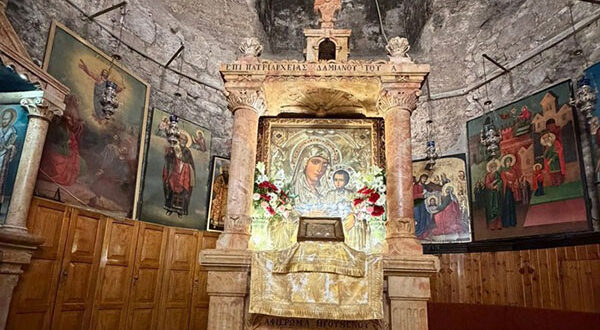
There are ancient traditions that place the end of Mary’s earthly life in Jerusalem, while other traditions later associated Mary with Ephesus. There are also places traditionally connected with her burial.
But we find a fundamental difference compared with other saints:
there is no universally accepted tradition preserving Mary’s body as a bodily relic.
Some Catholic sources have specifically pointed out this peculiarity: there are traditions concerning her tomb, but there is no comparable universal tradition concerning possession and veneration of her bodily remains.
This is especially striking if we consider the importance of relics in ancient Christianity.
Christians did not have an attitude of contempt toward the bodies of the saints.
Quite the opposite.
Martyrs were buried with honor. Their tombs became places of pilgrimage. The Eucharist was celebrated over their graves. Their remains were solemnly transferred. Relics became visible signs of communion between the Church on earth and the Church triumphant.
So why is Mary such an extraordinary exception?
The traditional Christian answer is precisely that her body did not remain on earth to become a relic.
4. Jerusalem and the Mysterious Empty Tomb
One of the best-known traditions appears centuries later in the preaching of Saint John Damascene.
According to a tradition he transmitted, Juvenal, Bishop of Jerusalem, is said to have explained, in the context of the Council of Chalcedon in 451, that the Emperor Marcian and Empress Pulcheria wished to possess the body of the Mother of God.
The response was significant: Mary’s tomb had been found empty.
The tradition associated this fact with the conclusion of the Apostles that her body had been taken into heaven. This account is transmitted by Saint John Damascene, one of the great patristic witnesses to the Dormition.
Again, we must distinguish history from tradition.
We cannot turn this later account into a first-century recording of what happened.
But we can ask something:
Why did a later Christian tradition consider the absence of Mary’s body precisely the element that cohered with her bodily glorification?
Because the internal logic of the tradition is very clear.
Christ had not left His Mother’s body behind on earth merely as a relic.
The Mother had been uniquely associated with the victory of her Son.
5. The Dormition: A Deeply Rooted Eastern Tradition
In the East, the feast we traditionally call the Assumption is known as the Dormition of the Mother of God.
The word “Dormition” is extraordinarily beautiful.
It does not necessarily deny the reality of death. Rather, it expresses a Christian understanding of death as a passage toward life.
Death no longer has the final word.
That is why traditional representations of the Dormition show Mary resting while Christ appears holding her soul.
Eastern liturgy developed an extraordinary spirituality around this mystery.
And here we encounter a fundamental point: Eastern and Western traditions converge in the conviction that Mary participates in a unique way in the glory of Christ.
The belief in Mary’s bodily assumption became firmly established in both Eastern and Western Christianity between the seventh and eighth centuries, although traditions concerning the Dormition are earlier.
Therefore, it would be a mistake to imagine that the Assumption was simply an idea invented by a pope in 1950.
Pope Pius XII did not “create” the Assumption.
He solemnly defined it as dogma after a long process involving reception, theological reflection, liturgy, patristic tradition, and consultation with the world’s bishops.
6. Saint John Damascene and an Impressive Theological Logic
Saint John Damascene offers a reflection that deserves to be meditated upon.
His argument is not archaeological.
It is theological.
If Mary was the Mother of God; if she carried the Incarnate Word in her womb; if she remained intimately associated with the mystery of Christ; if she was preserved from original sin according to the doctrine of the Immaculate Conception, then it is profoundly fitting that her body should not remain subject to the ordinary corruption of the grave.
Saint John Damascene develops precisely this logic of fittingness.
His thought was later taken up by Pius XII in the doctrinal preparation for the dogmatic definition.
The idea can be summarized like this:
She who gave her flesh to the Savior should not be abandoned definitively to corruption.
Not because Mary was a goddess.
Not because she possessed power of her own.
Not because she was equal to Christ.
But precisely because every privilege of Mary comes from Christ and is ordered toward Christ.
The Assumption does not diminish Jesus.
It glorifies Him.
7. “A Woman Clothed with the Sun”
Scripture does not contain a sentence that literally says: “Mary was bodily assumed into heaven.”
And it would be intellectually dishonest to claim otherwise.
But the Church has always read Scripture as a whole, illuminated by Tradition.
One particularly significant passage is Revelation 12:
“A great sign appeared in heaven: a woman clothed with the sun, with the moon under her feet, and on her head a crown of twelve stars.”
The interpretation of the chapter is complex and possesses an ecclesial dimension: the woman represents the People of God, Israel, and the Church, and in Catholic tradition she is also applied in a privileged way to Mary.
We are not looking at a historical photograph of the Assumption.
We are looking at a biblical image that Christian tradition has associated with Mary’s glorification.
Pius XII specifically noted that theologians had seen in the woman of Revelation an image compatible with the mystery of the Virgin’s glorification.
And there is another fundamental text:
“Blessed is she who believed that there would be a fulfillment of what was spoken to her from the Lord.”
(Luke 1:45)
Mary’s entire life is a life of faith.
The Assumption appears as the culmination of that existence entirely surrendered to God.
8. The Dogma of 1950: Not an Invention, but a Definition
On November 1, 1950, on the Solemnity of All Saints, Pope Pius XII promulgated the apostolic constitution Munificentissimus Deus and solemnly defined:
“The Immaculate Mother of God, the ever-Virgin Mary, having completed the course of her earthly life, was assumed body and soul into heavenly glory.”
This is the dogmatic definition.
And it contains an important detail.
Pius XII did not explicitly define whether Mary died before being assumed or whether she was glorified without experiencing death. The formula “having completed the course of her earthly life” leaves this question open.
The Church therefore requires belief in the bodily Assumption, but does not require Catholics to resolve every historical detail concerning precisely how it took place.
This demonstrates remarkable doctrinal prudence.
9. The Absence of Relics Is Not an Isolated Proof
Here we must pause in order to avoid making an exaggerated claim.
To say, “There are no relics; therefore the Assumption is archaeologically proven,” would be incorrect.
The absence of evidence does not automatically constitute positive proof.
But there is something different:
when the absence of the body coincides with an ancient tradition of bodily glorification, that absence becomes a historically suggestive fact.
The question is not:
“Do we have a relic?”
The question is:
“Why, in a Christian culture profoundly marked by the veneration of relics, did no universal tradition of venerating Mary’s body develop?”
And the traditional answer of the Church is coherent:
because Mary’s body did not remain on earth.
We should not turn this into a simplistic argument.
But neither should we ignore its historical and spiritual force.
10. The Assumption Is Not an Isolated Privilege
Perhaps this is the most important theological point.
The Assumption is not some kind of “special reward” disconnected from the rest of the faith.
It is intimately connected with four great Christian truths:
Christ.
The Immaculate Conception.
The dignity of the human body.
The resurrection of the flesh.
Christ truly rose.
It was not merely a spiritual apparition.
The tomb was empty.
Christ’s glorified body is an essential part of Christian faith.
Mary participates anticipatively in that glorification.
For this reason, Pius XII explained that the Assumption strengthens our hope in our own resurrection.
Mary is, in a certain sense, the visible anticipation of the Church’s final destiny.
She already beholds what we hope for.
11. The Assumption as an Answer to the Materialism of Our Time
This doctrine is surprisingly relevant today.
We live in an age that oscillates between two opposite errors.
On the one hand, there is a materialism that reduces the human being to chemistry, neurons, hormones, and biological data.
On the other hand, there is a disembodied spirituality that speaks of “being energy,” “freeing the soul,” or abandoning the body as though it were an irrelevant accident.
Christianity rejects both perspectives.
The body is good because it was created by God.
The body has dignity because Christ assumed a human body.
The body is destined for resurrection.
And Mary shows us the goal in advance.
In a culture obsessed with physical appearance and, at the same time, deeply unconcerned about the eternal destiny of the body, the Assumption contains a powerful paradox:
the body is not an object to display or an instrument to consume; it is part of the person destined for glory.
12. The Assumption and the Dignity of Woman
There is also a profoundly beautiful dimension here.
According to the faith of the Church, the first human creature to behold the glory of Christ bodily is a woman.
Not a political queen.
Not an empress.
Not a celebrity.
A humble woman from Nazareth.
The young woman who said:
“Behold, I am the handmaid of the Lord; let it be to me according to your word.”
(Luke 1:38)
is the glorified woman.
This radically transforms the Christian understanding of greatness.
The world says: greatness belongs to the one who dominates.
The Gospel responds: greatness belongs to the one who gives himself.
The world says: what matters is the person who manages to be seen.
Mary responds: what matters is the person who allows God to be seen in his or her life.
The world says: the body is an object of consumption.
The Assumption responds: the body is destined for eternity.
13. What Does This Mean for Our Everyday Lives?
The Assumption is not simply a doctrine that we must memorize.
It has pastoral consequences.
First: It reminds us that our bodies have dignity
We must not despise them.
But neither should we turn them into idols.
The Christian cares for his or her body because it belongs to God.
Second: It teaches us to live with our eyes fixed on heaven
Mary did not end in the earth.
Her story did not conclude in a tomb.
Nor does ours end with death.
Death is real, painful, and mysterious, but it is not our final destiny.
Third: It helps us understand the value of purity
The Assumption is profoundly incompatible with a vulgar view of the body.
The body can be a temple.
It can be an instrument of love.
It can be offered to God.
It can participate in holiness.
Fourth: It teaches us to hope
In a society dominated by immediacy, Mary teaches patience.
God does not improvise.
The history of salvation has a destiny.
And that destiny is glorious.
14. The “Absent Relics” as a Silent Catechesis
Perhaps here we find the most beautiful image of the entire mystery.
Normally, a relic says:
“Here are the remains of someone who lived a holy life.”
But in Mary’s case, the silence seems to say something different:
“Do not look here below for what God has already taken into glory.”
We do not have Mary’s body as we have the bodily relics of so many saints.
Instead, we have a tradition pointing upward.
It is as though the absence itself has become a sign.
The tomb cannot hold the one who, by God’s singular privilege, has been glorified body and soul.
We should not turn this into a simplistic argument.
But neither should we ignore its historical and spiritual force.
15. A Woman Already Glorified and a Church Still on Pilgrimage
The Church contemplates Mary as what the Church herself is called to become.
The Catechism and Catholic tradition present the Assumption as an anticipation of the glorious destiny of the members of Christ.
Mary is a sign of hope.
Therefore, the Assumption should not produce a sentimental devotion disconnected from Christian life.
It should produce conversion.
When we pray:
“Holy Mary, Mother of God, pray for us sinners, now and at the hour of our death,”
we are asking precisely the one who has already crossed the threshold of death and participates in heavenly glory to accompany us on our own journey.
She knows where we are going.
She has already arrived.
Conclusion: A Body We Do Not Find Because the Church Believes It Is in Heaven
The opening question now returns with all its force:
Where are the relics of Mary’s body?
Historically, we do not possess a universally recognized bodily relic that can be identified as her body. There are traditions concerning her tomb and places associated with her Dormition, but we do not find a tradition comparable to the veneration of bodily relics of so many saints.
And precisely here we encounter one of the most fascinating details in Christian tradition.
The Church does not affirm the Assumption simply because “the body was never found.”
She affirms it because she recognizes in it a truth coherent with the whole mystery of Christ, with received Tradition, with the liturgy, with the Fathers’ reflection, and with the organic development of faith.
After centuries of reflection, Pius XII solemnly defined it in 1950 as a divinely revealed truth. The definition was presented not as something new, but as the culmination of a faith that the Church had confessed and deepened throughout the centuries.
And perhaps the best way to understand it is this:
Mary has no bodily relics because, according to the faith of the Church, she herself is already a living relic of Christ’s definitive victory over death.
In her, we see our own destiny anticipated.
We were not created for corruption.
We were not created to disappear.
We were not created simply to accumulate years and eventually die.
We were created for God.
We were created for resurrection.
We were created for glory.
And Mary, the humble Virgin of Nazareth, already beholds what we hope to receive through the mercy of Christ.
Therefore the Assumption is not a distant doctrine.
It is a promise.
When the Church looks upon Mary glorified body and soul in heaven, she is also looking toward the future of all those who remain faithful to Christ.
The tomb does not have the last word.
Death does not have the last word.
Sin does not have the last word.
Christ has the last word.
And Mary, assumed into heaven body and soul, remains before us as living evidence that the victory of her Son is not a metaphor.
It is a real victory.
Over sin.
Over death.
And, finally, over the corruption of the grave.