
Related Articles


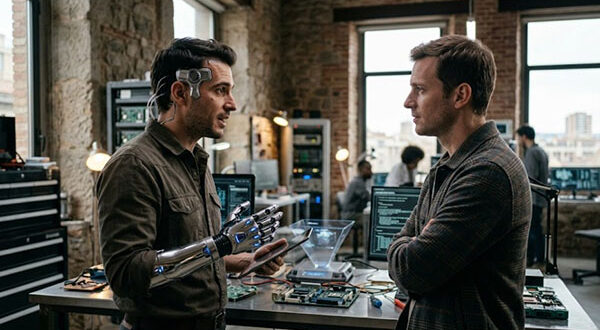
We live in an age fascinated by the possibility of transforming the human being. Medicine can replace organs, correct hereditary diseases, implant electronic devices in the body, considerably extend life, and modify certain biological functions. Artificial intelligence is beginning to become integrated into activities that until recently seemed exclusively human. Genetic engineering makes it possible to intervene in DNA. Neurotechnologies seek to connect the brain with machines. Robotics is developing increasingly sophisticated prostheses. And some researchers, philosophers, and entrepreneurs are even beginning to speak of overcoming the biological limits of our species.
Against this backdrop, a school of thought has emerged known as transhumanism.
In general terms, transhumanism maintains that human beings do not necessarily have to passively accept their current biological limitations. Aging, illness, certain disabilities, bodily deterioration, and even, in some of its more radical versions, death, are regarded as problems that could potentially be solved through science and technology.
At first glance, some of these aspirations may appear profoundly human. Who could be opposed to curing a disease? Who would deliberately want to preserve a disability that can be treated? Who would not be grateful for medicine capable of alleviating pain?
The Catholic Church is not opposed to science, medicine, or technological progress. On the contrary: the Christian tradition has always recognized the value of human intelligence and its ability to know, order, and transform the world.
The problem arises when technology ceases to be regarded as an instrument at the service of the person and begins to become a philosophy about what man is and what he ought to become.
Then the question is no longer merely scientific.
It becomes an anthropological question.
And ultimately, a theological one.
Because behind the question, “What can we do with the human being?” lies another, much deeper question:
“Who is the human being?”
And behind that appears an even more radical question:
“Who has the authority to decide what man should be?”
The Christian answer begins precisely here: man did not create himself.
He is a creature.
And being a creature does not mean being inferior, contemptible, or incapable. It means that our existence is a gift received from God, that our nature possesses an objective order, and that our perfection does not consist in turning ourselves into our own gods.
1. The Great Problem of Transhumanism: Not Every Limitation Is an Injustice
One of the fundamental intuitions of transhumanism consists in interpreting many human limitations as defects that should be eliminated.
Some limitations are indeed consequences of sin, illness, or the disorder present in a fallen world. Curing them constitutes a profoundly human work and is compatible with Christian faith.
But here a decisive distinction appears.
Not every human limitation is a defect that must be eliminated.
Man is limited because he is a creature.
We are not omniscient.
We are not omnipotent.
We are not immortal by nature.
We cannot be everywhere simultaneously.
We cannot completely control our bodies.
We cannot prevent every illness.
We cannot indefinitely prevent aging.
We cannot escape death through our own strength.
These characteristics are not necessarily accidents that technology must eliminate.
Some belong precisely to our creaturely condition.
Christianity begins by recognizing a truth that the modern mentality finds difficult to accept:
man is not God.
The Book of Genesis presents this truth from the very first pages of Scripture. God creates man, not as an autonomous and self-sufficient being, but as a creature dependent upon his Creator.
“Then God said, ‘Let us make man in our image, after our likeness’” (Gen 1:26).
Man possesses extraordinary dignity because he has been created in the image of God.
But precisely for this reason, his dignity does not come from having manufactured himself.
We are worthy because God has willed us.
Here there is a fundamental difference between Christian anthropology and certain versions of transhumanism.
For Christianity, dignity precedes our technical capacity.
For certain transhumanist currents, however, there is a risk that dignity may ultimately become linked to the ability to modify, improve, or augment our faculties.
And then a disturbing question arises:
What will happen to the person who cannot improve himself?
If society begins to value human beings according to their cognitive ability, biological performance, longevity, productive capacity, or degree of technological enhancement, the vulnerable human being may eventually be regarded as an inferior being.
The elderly.
The sick.
The disabled.
The embryo.
The poor.
The person who cannot afford certain technologies.
The person who simply wants to remain as he is.
The Christian logic works in exactly the opposite way.
The weakest person does not possess less dignity.
Precisely because his dignity does not depend upon his performance.
2. From the Pride of Babel to the Contemporary Technological Dream
The temptation to overcome human limitations through knowledge and power did not begin with computers, artificial intelligence, or genetic engineering.
It is much older.
We find it symbolically in the account of the Tower of Babel:
“Come, let us build ourselves a city, and a tower with its top in the heavens” (Gen 11:4).
Babel represents, among other things, the human pretension to reach by its own strength what belongs to God.
The problem is not building.
The problem is not using intelligence.
The problem is not developing technology.
The problem is turning technical capacity into a form of spiritual self-sufficiency.
Man can build a tower.
But he cannot build himself into God.
This distinction is essential.
The Bible does not present human work as something evil. From Genesis onward, man receives a mission to cultivate and care for creation. Human intelligence truly participates, although in a limited manner, in the providential ordering of the world.
Technology can be good.
Medicine can be good.
Surgery can be good.
Genetic research can be good.
Artificial intelligence can have beneficial applications.
The moral question never consists simply in asking:
“Can we do it?”
The correct question is:
“Should we do it?”
And even more profoundly:
“Does it respect what man is?”
Because technical possibility does not automatically create a moral right.
The fact that something can be done does not mean that it should be done.
3. Technology Is an Instrument; It Cannot Become the Master
The Christian tradition regards creation as something entrusted to man.
Man receives intelligence in order to know.
He receives will in order to choose.
He receives hands in order to work.
He receives creativity in order to build.
But none of these faculties makes man the absolute owner of reality.
Man is a steward.
Not an absolute master.
This distinction has enormous consequences.
A physician who uses a prosthesis to restore mobility to a person is using technology to restore a bodily function.
A surgeon who replaces a heart valve is treating a disease.
Gene therapy that corrects a pathological disorder can constitute an extraordinary expression of medicine.
But it is something entirely different to conclude:
“Since we can technically intervene in the human organism, we can freely redesign human nature according to our desires.”
Here a philosophical leap occurs that Christian anthropology cannot accept.
To cure is not the same as to redesign.
To restore is not the same as to manufacture.
To assist is not the same as to dominate.
Improving a diseased function is not necessarily the same as creating a new human nature.
Medicine traditionally seeks to heal the sick.
Transhumanism, in its more radical versions, may ultimately aspire to manufacture a different kind of human being.
And that distinction is fundamental.
4. What Does It Mean for Man to Have a Nature?
Christian anthropology affirms that the human being possesses a nature.
This assertion may seem strange in an age in which we constantly hear about identity, autonomy, and self-construction.
But it constitutes one of the foundations of Christian morality.
Man is not an absolutely neutral material upon which each individual can write any project whatsoever.
We are not a finished product made by ourselves.
We are a unity of body and soul.
The Christian philosophical and theological tradition, especially through Saint Thomas Aquinas, teaches that the rational soul is the form of the human body.
Therefore, the body is not simply an accidental container for the “self.”
The body belongs to what we are.
This has extraordinary importance in the face of certain contemporary conceptions that tend to radically separate personal identity from the body.
The Christian vision does not despise the body.
Quite the contrary.
The body forms part of the person.
And precisely because of this, it deserves respect.
But respecting the body does not mean turning it into an object that can be manipulated without limits.
The human body possesses a structure and a purpose.
It has an order.
And Christian morality recognizes that there is a difference between respecting that order and arbitrarily attempting to abolish it.
5. Original Sin: The Wound That Transhumanism Cannot Repair
Here we reach the theological heart of the question.
Why does Christian anthropology regard any project that seeks to save man solely through technology as insufficient?
Because man’s principal problem is not technological.
It is spiritual.
Humanity does not merely need better machines.
It needs redemption.
The Book of Genesis presents the fall precisely under the sign of the attempt at autonomy from God:
“You will be like gods” (Gen 3:5).
This phrase constitutes one of the keys to understanding human history.
Original sin does not consist simply in eating a forbidden fruit.
It is rebellion against the order established by God.
Man wants to determine good and evil for himself.
He wants to cease receiving his existence as a gift.
He wants to become the ultimate measure of reality.
In other words:
he wants to be autonomous from God.
This temptation remains present.
And it can take religious, political, philosophical, or technological forms.
Radical transhumanism can become a modern manifestation of an ancient temptation: the pursuit of salvation constructed by man himself.
Previously, immortality was sought through myths.
Then through philosophies.
Today it may be sought through biotechnology, artificial intelligence, cryonics, genetic manipulation, or integration between brain and machine.
The language changes.
The temptation remains.
6. Original Sin Does Not Mean That Man Is Evil by Nature
An important clarification is necessary here.
The doctrine of Original Sin does not teach that man is an essentially evil creature.
The Church teaches precisely the opposite.
God created man good.
“And God saw everything that he had made, and behold, it was very good” (Gen 1:31).
Original Sin introduced a profound wound into human nature.
It did not completely destroy nature.
But it left it wounded.
The intellect became darkened.
The will became weakened.
The passions became disordered.
The inclination toward sin remains.
Death entered the human condition.
That is why man experiences within himself a contradiction that no technology can completely resolve.
Saint Paul expresses this experience with extraordinary force:
“For I do not do the good I want, but the evil I do not want” (Rom 7:19).
We can develop extraordinary technologies and still be capable of hatred.
We can prolong life and remain selfish.
We can increase our memory and remain proud.
We can expand our cognitive abilities and remain incapable of loving properly.
We can manufacture increasingly intelligent machines and fail to make the human heart more holy.
Here a decisive truth appears:
technical progress does not automatically equal moral progress.
7. Man Can Change Many Things Without Changing the Heart
Modern history demonstrates this paradox.
Humanity has achieved extraordinary scientific advances.
But scientific knowledge has not eliminated war.
Technology has not eliminated injustice.
Instant communication has not eliminated loneliness.
Social networks have not eliminated isolation.
Advanced medicine has not eliminated the fear of death.
Material abundance has not eliminated anxiety.
Education has not eliminated evil.
This demonstrates that the human problem cannot be reduced to a question of capabilities.
Man does not merely need to be able to do more.
He needs to love better.
And this completely changes the perspective.
A person can possess an extraordinary memory and use it to deceive.
He can possess exceptional intelligence and use it to manipulate.
He can possess enhanced physical strength and use it to dominate.
He can possess extraordinary technological tools and use them to destroy.
Therefore, the Christian question is not:
“How can we make man more powerful?”
But:
“How can we make man better?”
And the Christian answer is not a technology.
It is grace.
8. True Christian Transformation
This is particularly interesting because Christianity also speaks of a radical transformation of man.
But it is not the transhumanist transformation.
Saint Paul writes:
“Be transformed by the renewal of your mind” (Rom 12:2).
Christian transformation begins within.
It does not consist in replacing the human body with a machine.
It consists in allowing grace to heal and elevate man.
It does not seek to manufacture a “superman.”
It seeks to transform the sinner into a saint.
The difference is immense.
Transhumanism seeks to overcome the human condition through technical power.
Christianity seeks to enable man to reach his true fullness through the grace of God.
Transhumanism may dream of overcoming death through biology.
Christianity announces the resurrection of the flesh.
Transhumanism may seek a technologically augmented humanity.
Christianity announces a redeemed and glorified humanity.
And here we encounter one of the most beautiful points of Christian faith.
God’s response to man’s problem is not to destroy human nature, but to assume it, heal it, and elevate it.
9. The Incarnation Destroys the False Opposition Between Body and Spirit
The center of Christianity is the Incarnation.
“And the Word became flesh and dwelt among us” (Jn 1:14).
This statement has enormous anthropological consequences.
God does not save man by despising his body.
The Son of God assumed a true human nature.
He was born.
He grew.
He worked.
He felt hunger.
He felt thirst.
He became tired.
He wept.
He suffered.
He died.
And He rose bodily.
Matter is not evil.
The body is not a prison from which we must escape.
Creation is not a mistake that must be corrected through superior technology.
Creation is good because it comes from God.
But it is wounded by sin and awaits its definitive restoration.
Therefore, Christian hope is not to abandon the body.
It is the resurrection of the flesh.
The Creed does not simply say, “I believe in the immortality of the soul.”
Catholic faith professes:
“I believe in the resurrection of the body.”
This truth is profoundly countercultural.
Christianity does not promise to turn us into digital beings.
It does not promise an eternity manufactured in laboratories.
It promises something infinitely greater:
that God Himself will resurrect man.
10. The Difference Between Technological Immortality and Eternal Life
This point deserves particular attention.
Suppose hypothetically that science could extend human life for hundreds of years.
That would be extraordinary.
But it would not solve the fundamental problem.
Because indefinitely prolonged life would still not be Christian eternal life.
Eternal life does not simply consist in having more time.
It consists in participating in the life of God.
Jesus Christ says:
“And this is eternal life, that they know you, the only true God, and Jesus Christ whom you have sent” (Jn 17:3).
Christian eternity is not simply infinite duration.
It is communion with God.
Therefore, no technology can produce it.
We can modify tissues.
We can replace organs.
We can intervene in genes.
We can enhance certain abilities.
But we cannot manufacture sanctifying grace.
We cannot manufacture divine sonship.
We cannot manufacture the beatific vision.
We cannot manufacture heaven.
Salvation is not a technological product.
It is a gift from God.
11. Technology Can Become a New Form of Idolatry
Idolatry does not consist only in kneeling before a statue.
It can also consist in attributing to a creature what belongs only to God.
Technology is a human creation.
It is the fruit of the intelligence that God has given man.
But when technology begins to receive absolute trust, it can become an idol.
This happens when we expect from it what only God can give.
When we expect it to eliminate every disease.
To eliminate all suffering.
To eliminate death.
To determine good and evil.
To solve loneliness.
To give meaning to existence.
To decide who deserves to live.
To determine what it means to be human.
At that point, technology ceases to be an instrument.
It becomes a kind of secular savior.
And human history knows well enough the dangers of false salvations.
12. The Paradox of Wanting to Defeat Death Without Accepting Life as a Gift
There is also a profound spiritual contradiction.
Modern man may regard death as an absolute absurdity while simultaneously attempting to eliminate it through technology.
But Christian faith teaches that death is a real enemy, although it does not have the final word.
Saint Paul says:
“The last enemy to be destroyed is death” (1 Cor 15:26).
Christianity does not glorify death.
Christ Himself wept at Lazarus’s tomb.
The Church accompanies the sick.
She prays for the dying.
She administers the Anointing of the Sick.
She promotes medicine.
She defends life.
But she does not promise that medicine can transform our earthly existence into an indefinitely prolonged existence.
Death reminds man that he is not God.
And precisely because we are not God, we need God.
13. Aging: Absolute Enemy or Call to Hope?
One of the aspirations of transhumanism is to overcome aging.
From a medical perspective, combating age-related diseases is legitimate and desirable.
But from Christian anthropology, we must distinguish between treating illness and regarding man’s mortal condition as an error that must be eliminated in principle.
Old age also possesses a spiritual dimension.
The elderly person reminds society that man is not valuable because of his productivity.
He reminds us that human life cannot be measured exclusively in economic terms.
He reminds us that we need one another’s care.
And he reminds us of something our culture tries to hide:
we are mortal.
This awareness can be profoundly healthy.
Death should not become an obsession, but awareness of our mortality can help us order our lives.
“Teach us to number our days, that we may gain a heart of wisdom” (Ps 90:12).
14. Technology Can Relieve Suffering, But It Cannot Explain Its Meaning
Another fundamental difference concerns suffering.
Medicine should combat avoidable suffering.
Christianity never teaches that we should seek pain for its own sake.
But neither does it claim that all suffering is meaningless.
Here we encounter one of the great mysteries of faith.
Christ did not immediately eliminate all suffering from the world.
He entered into it.
He assumed it.
He redeemed it from within.
The Cross is the Christian response to suffering.
This does not mean that we should reject medical advances.
It means that even when medicine cannot cure, the person still possesses dignity.
And this truth is fundamental in a society that risks identifying dignity with health, autonomy, or efficiency.
Christianity proclaims something radical:
the sick person remains fully human.
15. What Happens When Perfection Becomes an Obligation?
Transhumanism also raises a social problem.
If certain technologies succeed in increasing human abilities, a new form of inequality may emerge.
Imagine a society in which certain genetic, cognitive, or neurological enhancements become possible.
Will they be optional?
Will they be accessible to everyone?
Will parents be able to reject certain interventions on their children?
Could there come a time when someone is considered irresponsible for failing to “enhance” his children technologically?
These questions do not belong only to science fiction.
The logic of efficiency could ultimately generate a new form of social pressure.
Previously people were told:
“You must be richer.”
Then:
“You must be more productive.”
Now a new message may emerge:
“You must be biologically superior.”
Humanity would then risk producing a new aristocracy: based not only on wealth, but on access to human-enhancement technologies.
Christianity must continually remind us that no additional ability creates additional dignity.
A disabled child is no less valuable than an athlete.
An elderly person is no less valuable than a young person.
A sick person is no less valuable than a healthy person.
A man with lesser intellectual abilities is no less valuable than a scientist.
Dignity cannot be bought.
It cannot be programmed.
It cannot be implanted.
It cannot be downloaded.
It cannot be enhanced.
It is received from God.
16. The Danger of a Humanity Divided Between the “Enhanced” and the “Unenhanced”
If the transhumanist logic were to become radicalized, a distinction could emerge between “enhanced” human beings and “natural” human beings.
This would raise a grave moral question.
Would they remain equal?
Would they have the same rights?
Would those who rejected certain technologies be considered inferior?
Would technological capacity become a criterion for social selection?
History teaches that when a society begins to classify human beings according to their value, the consequences can be devastating.
Christian doctrine offers a radically different criterion:
every human being possesses an inviolable dignity because he or she has been created in the image of God.
This dignity does not increase with intelligence.
It does not diminish through illness.
It does not disappear with old age.
It does not depend on autonomy.
It does not depend on productivity.
It does not depend on technological level.
17. The Body as an Object of Consumption
There is another danger.
If the body can be modified indefinitely according to individual desires, it may ultimately become a consumer product.
Today I change my clothes.
Tomorrow I change my body.
Today I modify my appearance.
Tomorrow I modify my abilities.
The logic of the market can enter into the most intimate dimension of the person.
The body ceases to be received as part of one’s identity and begins to be treated as a configurable platform.
But Christian anthropology teaches that I am not simply a user who possesses a body.
I am a bodily person.
My body forms part of my being.
This does not mean that every bodily modification is morally illicit. Legitimate medical interventions and necessary treatments exist.
It means that the body cannot be regarded as morally neutral material that we may manipulate without reference to the truth about the person.
18. Freedom Does Not Mean Being Able to Do Anything
Another central point appears here.
One of the most frequently used words in our culture is “freedom.”
But Christian freedom does not mean:
“I can do whatever I want.”
It means:
“I have the capacity to choose the good.”
A person can be extremely free from a technical point of view and profoundly enslaved from a moral point of view.
He may have infinite possibilities and be incapable of governing his passions.
He may have access to countless technologies and not know why he lives.
He may control machines and not control his anger.
He may modify his body and not know who he is.
True freedom requires truth.
Christ says:
“You will know the truth, and the truth will make you free” (Jn 8:32).
Therefore, human freedom needs a truth about man.
If we do not know what man is, neither can we know what it means to respect him.
19. True Progress: Perfecting the Person, Not Manufacturing a Product
The Church is not called to reject all progress.
She is called to discern it.
The Christian can sincerely rejoice in scientific advances that cure disease, alleviate suffering, and help people.
But he must remember that there is a difference between:
technical progress
and
human progress.
The first increases our capabilities.
The second improves the way we use them.
We can have more technology and less wisdom.
More information and less truth.
More communication and less communion.
More capacity for intervention and less prudence.
More power and less virtue.
Therefore, the truly Christian question concerning scientific progress is not:
“Should we stop progress?”
But:
“What kind of progress do we want?”
20. The Virtue of Prudence in the Face of Technological Fascination
The Catholic tradition offers an extraordinary tool for discerning these problems: prudence.
Prudence is not fear.
It is not an irrational rejection of what is new.
It does not mean returning to the past.
Prudence means deliberating correctly about how to achieve a genuine good.
Faced with a new technology, the Christian should ask:
What is it for?
Whom does it benefit?
Whom might it harm?
Does it respect human dignity?
Does it respect bodily integrity?
Does it respect life?
Will it generate new forms of inequality?
Does it foster virtue or feed vanity?
Does it help man fulfill his vocation or turn him into an object?
Does it promote service or domination?
Is it being used to heal or to satisfy an obsession with control?
These questions are far more important than the fascination produced by a new technology.
21. The Christian Should Not Fear Science
It is important to say this clearly.
The Catholic faith has no reason to fear science.
Science studies creation.
And creation belongs to God.
Human intelligence is also a gift from God.
Therefore, scientific research can be a form of service to one’s neighbor.
A physician who studies a disease seeks to alleviate suffering.
A researcher who develops a therapy may be carrying out a work of mercy.
An engineer who creates a prosthesis may restore independence to a person.
A scientist who studies a genetic disease may help numerous families.
All of this can be good.
The question arises when technology abandons humility and begins to present itself as a total philosophy of existence.
Science can tell us how a reality works.
But it cannot, by itself, tell us the ultimate meaning of our existence.
It can describe the brain.
It cannot prove that man is only a brain.
It can describe DNA.
It cannot reduce the person to a genetic sequence.
It can measure neural processes.
It cannot reduce love, freedom, moral consciousness, and dignity to simple quantifiable objects without losing something essential about human reality.
22. The Mystery of the Human Soul
Christian anthropology affirms that man possesses a spiritual and immortal soul.
This means that the person cannot be reduced to matter.
Although there are extraordinarily important correlations between brain activity and thought, it does not follow that thought is simply a biological machine.
Man possesses intellect and will.
He is capable of knowing truth.
He is capable of loving.
He is capable of giving himself.
He is capable of sacrificing himself for another.
He is capable of recognizing a moral obligation even when nobody is watching.
He is capable of seeking God.
These dimensions point toward a reality that cannot be adequately understood from a purely mechanistic vision.
Therefore, man is not simply an extremely complex machine.
He is a person.
23. Can a Machine Have a Soul?
This question will appear with increasing frequency.
Artificial intelligence can produce texts, images, sounds, and responses that are surprisingly sophisticated.
But producing intelligent responses does not necessarily mean possessing spiritual intelligence.
A machine can process information.
Man knows.
A machine can imitate language.
Man seeks truth.
A machine can generate an appropriate moral response.
Man experiences moral obligation.
A machine can reproduce expressions of affection.
Man truly loves.
The question cannot be resolved simply by observing external behavior.
Christian anthropology considers the human person to possess a spiritual dimension that cannot be reduced to information processing.
Therefore, it would be a theological error to think that, by uploading enough information into a machine, we could transfer our soul.
The human soul is not a file.
The person is not software.
The resurrection is not a backup.
24. The Dream of “Uploading” Consciousness
Some forms of transhumanism imagine that in the future it might be possible to copy the structure of a person’s brain and transfer it to another medium.
Even assuming that such a technology could one day reproduce certain neural patterns with extraordinary precision, a fundamental question would remain:
Would that copy really be the same person?
From Christian anthropology, the person is not identified simply with a collection of data.
Personal identity possesses bodily and spiritual unity.
The soul cannot be transferred like a file.
Human life is not a computer program.
Therefore, Christianity offers a hope infinitely deeper than “digital immortality.”
God knows each person.
God does not need to copy him.
God can resurrect him.
25. The Mystery of the Resurrection: The True Christian Response to Transhumanism
The doctrine of the resurrection of the flesh constitutes perhaps the Church’s deepest response to the dream of technologically defeating death.
Saint Paul proclaims:
“It is sown a perishable body, it is raised an imperishable body” (1 Cor 15:42).
Christian hope does not consist in escaping embodiment.
It consists in God bringing the human body to a fullness that infinitely surpasses every technological possibility.
The glorified body will not be a machine.
It will not be an artificially improved version.
It will be the human body transformed by the power of God.
Here lies the difference between technological self-salvation and Christian salvation.
The first says:
“We will succeed in surpassing ourselves.”
The second proclaims:
“God will save us.”
The first is born of self-sufficiency.
The second is born of grace.
26. The Spiritual Danger of Technological Pride
Technology can foster a particularly subtle form of pride.
Modern man may come to think:
“If I can do it, I do not need to accept limits.”
But limitation is not always the enemy of freedom.
Sometimes limitation reveals our condition.
A child needs to receive.
A sick person needs help.
An elderly person needs care.
The human being needs rest.
We all need others.
We all need forgiveness.
We all need to love and be loved.
We all need God.
The culture of self-sufficiency regards these dependencies as defects.
Christian anthropology also understands them as opportunities for communion.
Man was not created to be self-sufficient.
He was created for God and for others.
27. Grace Does Not Destroy Nature: It Perfects It
One of the great affirmations of the Catholic tradition is that grace does not destroy nature, but perfects it.
This is fundamental.
The Christian response to transhumanism does not consist in despising human nature.
It consists in recognizing that human nature possesses its own perfection and that, in addition, it has been called to a supernatural elevation.
Man is made for something greater than an indefinitely prolonged biological existence.
He is made for God.
The human vocation surpasses infinitely every project of technological enhancement.
Man’s destiny is not to become a technologically superior creature.
It is to become, by grace, an adopted child of God and to participate in His life.
28. Holiness Is the True “Improvement” of Man
Here we can use a provocative expression:
The Church also believes in the perfection of man.
But she calls it holiness.
A saint is not someone who is biologically superior.
He is someone whose will has been conformed to God.
Saint Francis of Assisi did not need enhanced intelligence.
Saint Teresa of Ávila did not need neural implants.
Saint Joseph did not need to artificially extend his life.
The martyrs did not need to eliminate suffering.
Christian greatness does not consist in possessing more power.
It consists in loving more.
Therefore, holiness constitutes a radical critique of the transhumanist ideal understood as absolute self-transcendence.
The saint does not say:
“I will make myself perfect.”
He says:
“Lord, make me holy.”
29. What Should a Catholic Do About Transhumanism?
It is not enough to criticize transhumanism intellectually.
The Christian needs to live concretely.
First, he must cultivate a healthy relationship with technology.
Do not demonize it.
But neither should you idolize it.
Use it.
Do not serve it.
Second, he must recover the sense of being a creature.
Give thanks for life.
Give thanks for the body.
Give thanks for health.
Give thanks for intelligence.
Also recognize limitations.
Third, he must recover the virtue of temperance.
Not everything that is technically possible is necessary.
Not everything new is better.
Not every convenience improves life.
Not every optimization produces happiness.
Fourth, he must recover sacramental life.
Because no device can provide sanctifying grace.
No artificial intelligence can absolve sins.
No technology can consecrate the Eucharist.
No machine can replace the supernatural encounter with Christ.
30. The Eucharist in the Face of the Dream of Technological Immortality
There is a profoundly beautiful contrast here.
Transhumanism dreams of preserving life.
The Church offers man the Bread of Life.
Christ says:
“I am the bread of life; whoever comes to me shall not hunger” (Jn 6:35).
Technology can attempt to prolong our biological existence.
Christ offers eternal life.
The difference is infinite.
The Eucharist does not magically make man biologically immortal.
But it unites the Christian with Christ and directs his entire existence toward the resurrection.
The Christian does not need to invent a technology to escape death.
He needs to live united to the One who conquered death.
31. Confession in the Face of the Dream of Artificial Perfection
There is also a contrast between the transhumanist logic and the Sacrament of Penance.
Transhumanism may say:
“Eliminate your defects.”
The Gospel says:
“Repent.”
The difference is profound.
Sin is not simply a programming defect.
It is not a biological error.
It is not an anomaly that can be corrected through engineering.
It is a rupture in the relationship with God.
Therefore, it requires repentance.
It requires grace.
It requires mercy.
It requires redemption.
Genetic modification cannot absolve a sin.
A brain interface cannot restore friendship with God.
A machine cannot replace the Sacrament of Reconciliation.
Man needs something that no technology can produce:
forgiveness.
32. The Family in the Face of the Laboratory
The family also needs to recover its mission.
In a culture obsessed with designing human beings, there is a risk that even children will begin to be viewed as projects.
“How do I want my child to be?”
“What abilities do I want him to have?”
“What characteristics do I want to select?”
But a child is not a product.
He is a gift.
Parents receive a person who does not absolutely belong to them.
They are not manufacturers of human beings.
They are guardians.
Fatherhood and motherhood are essentially acts of welcome.
Therefore, the Christian family can become one of the places where a truth that technological culture may forget is preserved:
a person does not need to be designed in order to be loved.
33. Educating Children in a Technological Culture
Catholic parents have an enormous mission here.
It is not enough to ban certain technologies.
Children need to learn how to discern them.
They must understand that a screen is not an enemy.
But neither is it a friend.
Artificial intelligence can be useful.
But it cannot replace conscience.
A social network can connect people.
But it cannot replace true friendship.
A technological tool can help with studying.
But it cannot replace personal effort.
An application can remind us to pray.
But it cannot love God for us.
Technology must occupy its proper place:
an instrument, never a master.
34. Christian Life as a School of Dependence
Perhaps one of the greatest spiritual challenges posed by transhumanism is the recovery of the value of dependence.
We depend on God.
We depend on our parents.
We depend on our family.
We depend on our friends.
We depend on society.
We depend on those who care for us when we become ill.
And finally, we depend completely upon God for our salvation.
Contemporary culture often interprets dependence as humiliation.
Christianity can show that receiving is also a form of loving.
The child receives.
The sick person receives.
The elderly person receives.
The poor person receives.
And so do we, constantly.
Existence itself is received.
35. Man Does Not Need to Become God Because God Became Man
Here we find perhaps the most beautiful answer to the entire question.
Modern man may dream of becoming divine through technology.
Christianity announces something infinitely more astonishing:
God became man.
It was not man who climbed up to God.
It was God who descended to man.
We do not need to manufacture our own divinity.
God has offered us participation in His life.
The Christian tradition calls this divinization or deification by grace.
Saint Peter speaks of becoming “partakers of the divine nature” (2 Pet 1:4).
But this divinization does not mean that we become gods by nature.
It means that we participate in God’s life by grace.
The difference is absolute.
Radical transhumanism may say:
“We will become like gods through our own ability.”
Christianity says:
“God makes us His children by grace.”
One is self-sufficiency.
The other is gift.
36. Humility as a Technological Virtue
Perhaps one of the virtues most needed in the twenty-first century is humility.
Not false humility that despises intelligence.
But true humility that recognizes truth.
Technology can do extraordinary things.
But it cannot answer for us the ultimate questions:
Where do I come from?
Why do I exist?
What is good?
Why must I love?
Why should I forgive?
What happens after death?
Why is there something rather than nothing?
Who is God?
What does it mean to be happy?
These questions belong to a level that no machine can solve by itself.
Man needs science.
But he also needs philosophy.
He needs morality.
He needs religion.
And he needs revelation.
37. The Church Before the Future: Neither Technophobia nor Technolatry
The Catholic position should not fall into either extreme.
On the one hand, technophobia, which regards every innovation as suspicious.
On the other, technolatry, which regards every innovation as moral progress.
Both positions are inadequate.
The Christian must follow a third path:
discernment.
Accept what is good.
Reject what is evil.
Correct what is dangerous.
Regulate what requires limits.
Promote research directed toward the true human good.
And always remember that technology must be subordinated to the person.
38. The Great Question for Our Time
The decisive question will not simply be how much technology will be able to do.
It will probably be capable of doing an enormous amount.
The question will be:
“What will we do with that power?”
A knife can be used to prepare food or to kill.
Genetic technology can cure or be used to select and discard human beings.
Artificial intelligence can help or manipulate.
Neurotechnology can rehabilitate or control.
Biotechnology can heal or become an instrument of discrimination.
Therefore, humanity’s future will depend not only on brilliant scientists.
It will also depend on virtuous people.
We will need science.
But we will need wisdom even more.
39. The Real Enemy Is Not the Machine, but Sin
This statement deserves to be engraved in our minds.
The fundamental problem is not that machines are becoming too powerful.
The problem is that the human heart remains wounded by sin.
Powerful technology in the hands of a virtuous person can become an instrument of good.
Powerful technology in the hands of a person dominated by pride can become an instrument of destruction.
Therefore, Christianity does not propose merely improving tools.
It proposes converting the heart.
“Create in me a clean heart, O God” (Ps 51:10).
This prayer will remain necessary even if humanity possesses unimaginable technologies.
40. The Future Does Not Belong to the Man Who Controls Everything
Modern mentality may suggest that the ideal human being will be the one who completely controls his body, environment, intelligence, longevity, and ultimately his own existence.
Christian anthropology proposes a completely different image.
The truly great man is not the one who controls everything.
He is the one who learns to give himself.
Christ Himself is the supreme model.
He does not save the world through self-sufficiency.
He saves it through obedience and love.
“He humbled himself by becoming obedient to the point of death, even death on a cross” (Phil 2:8).
Here we find the complete inversion of Babel.
Babel says:
“Let us climb up to heaven.”
Christ says:
“Thy will be done.”
Babel represents pride.
Christ represents obedience.
Babel wants to conquer.
Christ gives Himself.
Babel wants to become great through itself.
Christ becomes small in order to save.
And here we find the true Christian response to technological pride.
41. We Do Not Need a “Superman”: We Need Saints
Contemporary society may dream of people who are faster, more intelligent, more resilient, longer-lived, and more capable.
The Church dreams of something different.
Holy men.
Holy women.
Holy fathers.
Holy mothers.
Holy priests.
Holy young people.
Holy elderly people.
Holy scientists.
Holy doctors.
Holy engineers.
Holy programmers.
Holy entrepreneurs.
Because an extraordinarily intelligent but morally corrupt person can do enormous harm.
By contrast, a scientist who truly loves God and neighbor can use his knowledge as a service.
The question is not merely how to increase abilities.
It is how to order those abilities toward the good.
42. A Simple Rule for Discerning Technology
Faced with any future innovation, the Catholic can ask five questions:
First: Does it protect or degrade human dignity?
Second: Does it serve the person or turn the person into an object?
Third: Does it cure a disease or seek arbitrarily to redefine what it means to be human?
Fourth: Does it promote the common good or create new forms of domination?
Fifth: Does it help me live my vocation better or feed my pride?
These questions will not solve every scientific problem.
But they will help us maintain the correct horizon.
43. The Pastoral Response: Form Consciences, Not Produce Fear
The Church also has a pastoral responsibility.
She must not limit herself to saying:
“Technology is dangerous.”
She must form consciences capable of discerning.
Catholics need to know Christian anthropology.
They need to understand what the person is.
What the body is.
What the soul is.
What freedom is.
What conscience is.
What sin is.
What grace is.
What redemption is.
What resurrection is.
Without these foundations, the debate about technology is reduced to opinions.
With them, we can exercise genuine moral discernment.
44. Pastoral Care for the Technological Age
Parishes and Catholic communities should increasingly speak about these issues.
Not merely in a defensive manner.
But also positively.
Young people must be taught that their value does not depend on “likes.”
That their intelligence does not determine their dignity.
That their bodies are not consumer objects.
That illness does not make them inferior beings.
That death does not mean their lives have been failures.
That technology can be used without becoming a religion.
That prayer remains necessary even though machines can answer questions.
That confession remains necessary even though applications can help improve habits.
That the Eucharist remains the center of Christian life even though the world can connect digitally in a matter of seconds.
And that no machine will ever be able to replace Christ.
45. The True Revolution: Recovering the Sense of Being a Creature
Perhaps the great spiritual task of our time is to recover a word that modernity finds uncomfortable:
creature.
We are creatures.
And that is good news.
It means that we do not have to invent our own foundation.
We do not have to justify our existence.
We do not have to turn ourselves into gods.
We do not have to continually prove our worth.
God has willed us.
God sustains us.
God calls us.
God redeems us.
God awaits us.
The condition of being a creature is not a humiliation.
It is the root of gratitude.
Conclusion: From the Pride of Babel to the Humility of Christ
Transhumanism raises some of the most important questions that humanity will have to face during the coming decades.
What can we modify?
What should we modify?
What does it mean to improve the human being?
What limits exist?
Who establishes them?
What relationship should exist between technology and dignity?
What will happen when we can intervene deeply in human biology?
These questions cannot be answered only in laboratories.
They need philosophy.
They need ethics.
They need law.
And, above all, they need a true anthropology.
Christian anthropology begins with a simple but revolutionary affirmation:
man is a creature.
He is not God.
But he has been created in the image of God.
He is not perfect.
But he has been created for perfection.
He is not immortal by nature.
But he has been called to eternal life.
He is wounded by sin.
But he can be healed by grace.
His body is mortal.
But it is destined for resurrection.
He cannot save himself.
But he has been redeemed by Christ.
This is the fundamental difference.
Transhumanism, when it becomes an ideology of absolute self-transcendence, dreams of overcoming man through man’s own power.
Christianity announces that man reaches his true greatness when he stops pretending to be God and humbly accepts receiving from God what he could never give himself.
Technology can give us extraordinary tools.
It can heal.
It can help.
It can alleviate.
It can improve many conditions of our existence.
We should be grateful for this and use it responsibly.
But we must never confuse a tool with a savior.
Because no machine can redeem sin.
No algorithm can bestow grace.
No implant can produce holiness.
No laboratory can manufacture eternal life.
No artificial intelligence can take God’s place.
And no technology will ever be able to answer the deepest question of the human heart:
“For whom was I created?”
The Christian answer remains unchanged:
“You were created for God.”
Saint Augustine expressed it in words that have crossed the centuries:
“You have made us for Yourself, O Lord, and our heart is restless until it rests in You.”
That is the point that no technological revolution can change.
Man can transform the world.
He can build machines.
He can explore the universe.
He can modify certain aspects of his organism.
He can develop extraordinary tools.
But he will never cease to be a creature.
And precisely because he is a creature, his greatness does not consist in controlling everything.
It consists in humbly recognizing from whom he has received his existence.
The true question of the future will not be whether we will be capable of becoming something more than human.
It will be whether we will finally learn to be truly human.
And for the Christian, being truly human means living according to the truth of our nature, recognizing the wound of sin, welcoming grace, loving God above all things, loving our neighbor, and walking toward the destiny for which we were created:
eternal communion with God.
We do not need to manufacture a new man.
We need Christ to make all things new.
“Behold, I make all things new” (Rev 21:5).
That is the true future of man.
Not the pride of Babel.
Not the illusion of a salvation manufactured by our own hands.
But Christ.
Grace.
Redemption.
Resurrection.
And eternal life.