Related Articles
Every Gesture in the Liturgy Speaks of God… and Also of Us
We live in an age in which body language has taken on enormous importance. A glance, a hug, a handshake, or standing before an authority communicates far more than words alone. Yet there is a much older, deeper, and holier form of body language that often goes unnoticed even by many Catholics: the liturgical postures.
Why do we stand to hear the Gospel? Why do we kneel during the Consecration? Why do we remain seated at certain moments? Does it matter if someone chooses to do otherwise? Are these merely external rules, or do they express a much deeper spiritual reality?
The Church’s answer is clear: in the liturgy, nothing is accidental. Bodily postures are part of the worship we offer to God and constitute a true language of faith. Our bodies also pray. We do not pray only with our minds or our hearts; we pray with our whole being.
In a culture marked by individualism, where everyone seems free to decide how to express their religious feelings, the liturgy reminds us of a forgotten truth: we do not celebrate our own personal faith, but the faith of the entire Church.
To discover the meaning of the liturgical postures is to rediscover the beauty of the Holy Mass and to understand that even the smallest of our gestures can become an act of worship.
The Human Person: Body and Soul United to Give Glory to God
The Christian faith has never regarded the body as something secondary.
From Genesis we know that God created man with both body and soul.
“So God created man in His own image; in the image of God He created him.” (Genesis 1:27)
The mystery of the Incarnation confirms this reality even more profoundly.
Jesus Christ assumed a true human body.
He ate.
He walked.
He wept.
He knelt.
He raised His hands to bless.
He bowed His head on the Cross.
He rose bodily from the dead.
Christianity never separates the spiritual from the physical.
That is why the liturgy does not separate them either.
Our bodies fully participate in prayer.
Saint Paul declares:
“Therefore glorify God in your body.” (1 Corinthians 6:20)
The liturgy is precisely that: glorifying God with our entire existence.
The Liturgy Speaks Through Visible Signs
The sacraments make use of water, oil, bread, wine, the laying on of hands, incense, light, and silence.
Why?
Because God speaks through visible and tangible signs.
We also respond through signs.
The postures are part of this sacramental language.
They are not mere movements.
They are living symbols.
The Church teaches that human beings express interior realities through outward signs.
This is seen throughout Sacred Scripture.
When Abraham worshiped God…
…he prostrated himself.
When Moses encountered the burning bush…
…he removed his sandals.
When Solomon dedicated the Temple…
…he stretched out his hands.
When the Magi found the Christ Child…
…they fell down in worship.
When the disciples saw the risen Christ…
…they knelt before Him.
The posture reveals the attitude of the heart.
The Unity of the People of God
There is another fundamental aspect.
The liturgy is not a private prayer.
It is the prayer of the community.
All form one single Body.
That is why the Church desires that the faithful adopt the same postures.
The General Instruction of the Roman Missal explains that this unity of posture manifests:
- the unity of the community
- common participation
- ecclesial communion
- reverence for the mystery being celebrated
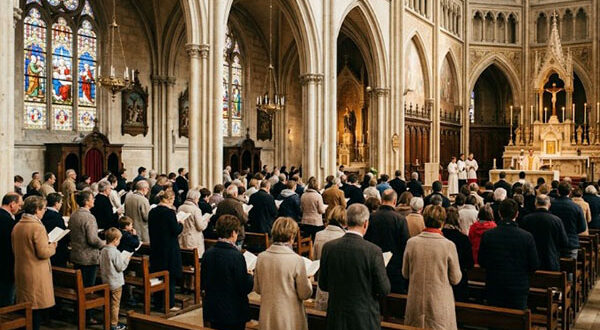
When the entire assembly stands, kneels, or sits at the same time, it silently proclaims a great truth:
We are one people worshiping the one true God.
Standing: The Posture of the Risen People
It may surprise many to learn that in the early Church, standing was a posture rich with spiritual significance.
It was not simply a comfortable way to listen.
It was the posture proper to those who had risen with Christ.
For this reason, the first Christians stood especially during the Easter season.
Standing expresses:
- the dignity of God’s children
- spiritual vigilance
- readiness
- reverence
- hope
- victory over sin
Christ has conquered death.
Those who belong to Him no longer remain bowed down.
That is why the priest says:
“Let us pray.”
Immediately, the entire assembly stands.
It is the posture of the priestly people presenting their prayer to the Father.
Why Do We Stand for the Gospel?
We do not do the same during the other readings.
The Gospel occupies an absolutely unique place.
It is Christ Himself who speaks to His Church.
Therefore:
- the Alleluia is sung
- incense is used on solemn occasions
- the deacon requests a blessing
- everyone traces the Sign of the Cross on forehead, lips, and heart
- all stand
We do not stand out of respect for the reader.
We stand because the Lord comes to speak to us.
It is Christ Himself proclaiming His Word.
Sitting: Listening as Disciples
We live in a hyperactive society.
Remaining silent has become increasingly difficult.
Yet the liturgy also invites us to sit.
Sitting does not mean resting.
It means listening.
Learning.
Meditating.
Interiorizing.
Mary of Bethany sat at Jesus’ feet listening to His teaching.
The disciples sat while listening to the Master.
For this reason, the Church remains seated during:
- the readings (except the Gospel)
- the Responsorial Psalm
- the homily
- certain parts of the Offertory
It is the posture of the disciple.
Kneeling: The Supreme Gesture of Adoration
Perhaps no posture possesses such profound spiritual richness as kneeling.
Today, in many places, kneeling seems almost strange.
Contemporary culture often equates freedom with refusing to kneel before anyone.
Yet the Christian knows that only One deserves our knees: the One who created us.
Saint Paul writes:
“At the name of Jesus every knee should bow, in heaven and on earth and under the earth.” (Philippians 2:10)
Kneeling expresses:
- adoration
- humility
- dependence upon God
- repentance
- recognition of the divine presence
For this reason, the Church reserves this posture for the holiest moments.
The Consecration: Heaven Touches Earth
During the Consecration, the greatest miracle in the world takes place.
The bread ceases to be bread.
The wine ceases to be wine.
Christ becomes truly present.
Not symbolically.
Not merely spiritually.
Not metaphorically.
Truly.
Really.
Substantially.
The Church responds with adoration.
That is why she kneels.
Not because it is a medieval custom.
But because the King of the Universe has just become present upon the altar.
The priest’s genuflection and the kneeling of the entire assembly proclaim one and the same truth:
Jesus Christ is here.
Genuflection: A Silent Profession of Faith
When entering a church, many people genuflect almost absentmindedly.
Yet this small gesture summarizes the entire Catholic faith in the Real Presence.
To bend one knee before the tabernacle means recognizing that Christ is truly present there.
We are not greeting a building.
We are not reverencing a symbol.
We are worshiping the Lord.
Every genuflection should be made slowly, consciously, and with profound love.
Bowing: Reverence and Humility
Not every act of worship requires kneeling.
The liturgy also makes use of different kinds of bows.
A bow of the head expresses reverence.
A profound bow expresses veneration.
The priest performs several bows during the Holy Mass.
The faithful also bow their heads, for example, at the mention of the name of Jesus, of the Blessed Virgin Mary, and of the saint of the day whenever indicated by the liturgical rubrics or by legitimate custom.
These are not empty gestures.
They are acts of love.
Striking the Breast: Acknowledging Our Own Poverty
During the Confiteor (“I confess…”), many people strike their breast.
Why?
Because the heart represents the very center of the human person.
We acknowledge that sin originates within us.
We do not blame others.
We do not blame the world.
We ask for mercy.
It is a profoundly evangelical gesture.
Hands Joined: The Symbol of Prayer
Hands joined together express:
- recollection
- supplication
- self-surrender
- trust
Although this posture is not always obligatory for the faithful, it is a traditional gesture that greatly helps recollection.
Our bodies help our souls.
Our posture supports our prayer.
Do These Postures Really Matter?
Some people might say:
“What really matters is the heart.”
That is true.
But Sacred Scripture never opposes the heart to the body.
Love always seeks to express itself.
A child who loves embraces.
A husband kisses his beloved.
A believer also worships with the body.
External postures do not replace interior faith.
But they do express it and nourish it.
There is a profound interaction between body and soul.
Modern psychology confirms something that the Church has known for centuries: our bodily gestures influence our interior dispositions.
When we kneel in faith, our hearts learn humility.
When we stand attentively, we learn readiness.
When we keep silence, we learn to listen.
The liturgy also educates our bodies in order to shape our souls.
The Danger of Liturgical Subjectivism
One of the pastoral challenges of our time is the tendency to think that each believer may express the faith solely according to personal preference.
This mentality often gives rise to attitudes such as:
- deciding independently when to sit or stand without regard for the common celebration;
- omitting the genuflection out of convenience or habit;
- remaining distracted during moments of adoration;
- reducing liturgical gestures to empty formalities without spiritual meaning.
Yet the liturgy is not a space for individual improvisation.
It is the Church’s public worship, received as a precious treasure and faithfully handed down from generation to generation.
The liturgical norms do not exist merely to impose uniformity through legalism.
Rather, they safeguard the truth of the mystery being celebrated and foster the full participation of all the faithful.
When everyone acts according to personal preference, the common language of the liturgy is fragmented.
When the entire assembly performs the same gestures with faith and reverence, the communion of the Church becomes visibly manifest.
Teaching Children the Language of the Liturgy
Children learn far more from what they see than from what they hear.
If they watch their parents:
- kneel with devotion;
- keep silence before the tabernacle;
- make a slow and reverent genuflection;
- respond attentively during the Mass;
- remain recollected during the Consecration;
they will understand, even before they are able to explain it with words, that something extraordinary is taking place in the church.
Liturgical education begins with example.
Gestures repeated with love gradually form the heart and prepare children to discover the greatness of the Eucharistic mystery.
Liturgical Postures as a Path to Holiness
The saints never despised small gestures.
They knew that holiness is also built through fidelity in what appears to be little.
A genuflection made with love.
A bow performed with reverence.
A silence kept with recollection.
A kneeling filled with adoration.
All these dispose the soul to receive grace.
The liturgy does not seek aesthetic perfection but the interior transformation of the believer.
Every posture becomes a school of virtue.
Humility.
Obedience.
Attentiveness.
Availability.
Adoration.
All these virtues find concrete expression in the body, and that bodily expression strengthens the spiritual life.
Rediscovering the Language of the Body to Rediscover the Mystery
We live surrounded by images, screens, and constant distractions, yet we understand less and less the value of silence, reverence, and those sacred signs that point toward eternity.
The liturgical postures are an antidote to such superficiality.
They remind us that God deserves our full attention and that our encounter with Him involves the whole person.
When we stand, we proclaim that Christ has risen and calls us to walk in hope.
When we sit, we acknowledge that we are disciples in need of listening to His Word.
When we kneel, we confess that Jesus is truly present and that He alone is worthy of our adoration.
When we bow our heads or make a genuflection, we express with our bodies what we believe with our hearts.
Ultimately, the liturgical postures are not merely movements learned in childhood, nor are they empty formalities inherited from the past.
They are a profound and silent catechesis that has crossed the centuries, united the whole Church, and continues to draw believers into the mystery of Christ.
To understand them and to live them consciously transforms our participation in the Holy Mass, strengthens our faith, and helps us offer God worship “in spirit and truth” (John 4:23), with both soul and body, with both mind and heart.
The next time you participate in the Holy Eucharist, pay close attention to every gesture.
You will discover that the liturgy speaks a language that needs very few words:
the language of a people who stand together to listen to their Lord, sit together to learn from Him, and bend the knee together to adore the living God, who continues to make Himself truly present upon the altar out of love for humanity.