
Related Articles



In an age where speaking about limits seems offensive, where everything is interpreted through feelings, and where many believe mercy means “letting people do whatever they want,” there is one canon of Canon Law that still resounds with uncomfortable, forceful, and profoundly evangelical power: Canon 915.
Many people know it only because of media controversies. Others reduce it to political debates. Some priests prefer to avoid it so as not to create conflict. And not a few faithful Catholics have never even heard of it.
Yet behind this canon lies an immense spiritual truth: the Eucharist is not just any symbol, but Christ Himself; and to approach unworthily to receive Him can become a grave sacrilege.
Canon 915 is not a “cold” rule, nor a legalistic obsession of the Church. It is, in reality, a concrete expression of love for Christ, reverence for the Eucharist, and charity toward souls.
Because the Church not only has the duty to nourish the faithful spiritually. She also has the duty to prevent people from spiritually harming themselves.
And that, precisely, is what this canon does.
What Exactly Does Canon 915 Say?
The text of the canon is brief, yet enormously profound:
“Those who have been excommunicated or interdicted after the imposition or declaration of the penalty and others obstinately persevering in manifest grave sin are not to be admitted to Holy Communion.”
This canon belongs to the Code of Canon Law promulgated by John Paul II in 1983.
At first glance, it may appear to be merely a disciplinary norm. But behind those words lies an entire theology of the Eucharist, sin, scandal, and salvation.
The canon speaks of three fundamental elements:
- Grave sin
- Manifest
- Obstinate persistence
It does not refer to just any private sin. Nor to the interior struggles we all have. Nor to occasional weakness. It speaks of objective, public, and persevering situations that gravely contradict God’s law.
And here is one of the most important points: Canon 915 does not judge a person’s internal soul — only God knows that — but rather the external and objective situation.
The Eucharist: The Center of Everything
To understand this canon, we must begin by understanding something essential: what the Eucharist is.
The Catholic Church teaches that at Holy Mass, the bread and wine become truly, really, and substantially the Body, Blood, Soul, and Divinity of Christ.
It is not a symbol.
It is not a metaphor.
It is not simply “a remembrance.”
It is Christ Himself.
That is why the Church has always treated Holy Communion with immense reverence.
From the earliest centuries, Christians understood that approaching the Eucharist unworthily was something extremely serious.
That is why Saint Paul wrote a tremendously solemn warning:
“Whoever eats the bread or drinks the cup of the Lord unworthily will be guilty of the Body and Blood of the Lord.”
— 1 Corinthians 11:27
And he continues:
“For anyone who eats and drinks without discerning the body eats and drinks judgment upon himself.”
— 1 Corinthians 11:29
These words sound harsh to many modern ears today. But they remain the Word of God.
The Church did not invent Canon 915. What she did was juridically express an apostolic teaching that has existed since the beginning of Christianity.
The Great Modern Problem: We Have Lost the Sense of the Sacred
One of the spiritual tragedies of our age is that many Catholics no longer distinguish between:
- attending Mass and receiving Communion,
- mercy and permissiveness,
- welcome and approval,
- love and relativism.
Today there is enormous pressure for absolutely everyone to receive Communion all the time.
In many parishes, an almost “social obligation” has developed around receiving Communion. Remaining in the pew seems embarrassing. And this has produced a terrible consequence: people objectively living in grave contradiction to the faith receive the Eucharist without confession, without repentance, and without awareness of the spiritual danger.
The result is devastating:
- banalization of the Eucharist,
- loss of the sense of sin,
- liturgical irreverence,
- doctrinal confusion,
- and constant sacrileges.
Canon 915 arises precisely to protect the holiness of the Sacrament and to prevent public scandal.
What Does “Manifest Grave Sin” Mean?
This is where many people become confused.
The Church distinguishes between:
- hidden sin,
- private sin,
- and manifest sin.
Canon 915 refers to manifest grave sin, meaning sin publicly known.
For example:
- cohabitation outside marriage,
- public advocacy for abortion,
- open promotion of gravely immoral laws,
- public situations of adultery,
- public apostasy,
- active militancy against essential teachings of the Church.
This is not about “hunting sinners.”
We are all sinners.
The difference is that here we are speaking about objective, public, and persistent situations.
Because when someone publicly lives in grave contradiction to God’s law and still receives Communion, a spiritual scandal occurs: other faithful conclude that such behavior “is no longer sinful” or that the Church does not truly believe what she teaches.
Canon 915 Is NOT a Lack of Mercy
This is perhaps the most important point in the entire debate.
Many think:
“If Jesus welcomed sinners, why deny Communion?”
But the question itself is wrongly framed.
Jesus welcomed sinners… precisely in order to convert them.
He never confused mercy with approval of sin.
To the adulterous woman He said:
“Go, and sin no more.”
— John 8:11
He did not say:
“Your situation does not matter.”
True mercy seeks the salvation of the soul.
And here is something the modern world has forgotten:
allowing sacrilege is not charity.
If a priest knows that a person obstinately persists in manifest grave sin and still admits that person to Communion, he may objectively be cooperating in spiritual harm.
Canon 915 does not exist to humiliate.
It exists to call people to conversion.
The Difference Between Canon 915 and Canon 916
This is an enormously important distinction.
Canon 916
Speaks about the personal responsibility of the faithful.
It states that anyone conscious of mortal sin should not receive Communion without first going to confession.
This is an internal obligation of conscience.
Canon 915
Speaks about the responsibility of the minister of Communion.
That is:
when the situation is public and objective, the priest or minister should not administer Communion.
Therefore:
- Canon 916 acts in the internal forum,
- Canon 915 acts in the external forum.
This distinction is crucial for understanding the Church’s sacramental discipline.
What Situations Are Commonly Associated With Canon 915?
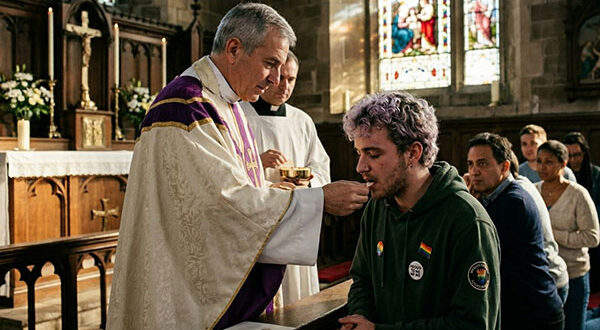
Over recent decades, this canon has appeared especially in debates concerning:
- politicians who publicly support abortion,
- divorced Catholics who have civilly remarried,
- persons in public unions contrary to Catholic morality,
- public figures who actively oppose essential teachings of the Church.
The issue is never merely political.
The issue is sacramental and spiritual.
The Church is not saying:
“This person is worth less.”
She is saying:
“There exists an objective contradiction between this public conduct and visible communion with Christ and His Church.”
Why Must the Church Protect the Eucharist?
Because the Eucharist is the greatest treasure that exists on earth.
The Church can survive persecutions, scandals, poverty, or cultural attacks.
But when she loses the sense of the sacred, a much deeper spiritual decay begins.
Many saints wept when witnessing irreverent Communions.
Thomas Aquinas taught that no sacrament demands as much reverence as the Eucharist.
John Vianney said that if we truly understood what happens at Mass, we would die of astonishment.
And Padre Pio suffered deeply because of sacrilegious Communions.
Today, however, many receive the Eucharist as though it were something routine.
Without examination of conscience.
Without confession.
Without living faith.
Without preparation.
And that has enormous spiritual consequences.
The Pastoral Dimension: How to Apply Canon 915 Correctly
This is where immense prudence, charity, and wisdom are required.
Applying Canon 915 does not mean acting with automatic harshness or with a policing mentality.
The Church’s pastoral tradition has always sought:
- dialogue,
- accompaniment,
- fraternal correction,
- a call to conversion,
- pastoral patience.
Normally, before arriving at a public refusal of Communion, there should be:
- doctrinal instruction,
- pastoral warning,
- an attempt at correction,
- clarity regarding the objective situation.
The goal is never “to punish.”
The goal is to lead to reconciliation with God.
Because the Church does not want to exclude.
She wants to save.
A Current Problem: Doctrinal Confusion
We live in times where even within Catholic environments there is enormous confusion regarding:
- mortal sin,
- the state of grace,
- sacrilege,
- worthiness to receive Communion,
- sacramental confession.
Many have reduced Christianity to merely “feeling welcomed.”
But the Gospel is far deeper:
Christ did not come only to comfort us.
He came to transform us.
And that implies conversion.
Canon 915 reminds us of something countercultural:
Communion is not simply a gesture of social belonging.
It is a visible sign of real union with Christ and with the faith of the Church.
Can Someone Return After Living in a Public State of Sin?
Yes.
And this is the most beautiful part of all.
The Church never closes the door to repentance.
Never.
The same Christ who warns about receiving the Eucharist unworthily is the One who forgave:
- Saint Peter after denying Him,
- Mary Magdalene after her past life,
- the good thief on the cross,
- and so many repentant sinners.
The goal of Canon 915 is not permanent exclusion.
The goal is authentic conversion.
When there is repentance, confession, and amendment of life, the Church joyfully embraces again.
Because the heart of Catholicism is not condemnation.
It is redemption.
Silence About Sin Is Destroying Many Souls
One of the greatest pastoral harms of our time is that almost no one speaks anymore about the spiritual danger of mortal sin.
Many Catholics go years without confession.
They receive Communion automatically.
And no one explains to them the spiritual gravity of receiving unworthily.
That silence is not mercy.
It is spiritual abandonment.
A doctor who hides a serious illness does not help the patient.
A shepherd who never warns about sin does not help souls either.
That is why Canon 915 remains so necessary today.
Because it reminds us of something essential:
God loves us too much to leave us comfortably settled in sin.
True Charity Requires Truth
The modern Church faces a constant temptation:
to be accepted by the world at the cost of softening the truth.
But Christ never promised popularity.
He promised the Cross.
Speaking about Canon 915 today may provoke criticism, discomfort, and even rejection.
But remaining silent about the truth out of fear of conflict has never been authentic Christian charity.
True charity:
- loves,
- accompanies,
- understands,
- listens,
- forgives…
but also calls people to conversion.
Because without truth, authentic love cannot exist.
Conclusion: Canon 915 Is Not a Wall… It Is a Spiritual Alarm
Many see this canon as a barrier.
But in reality it is a warning signal.
The Church does not say:
“We do not want you.”
She says:
“Your soul is far too valuable to trivialize the Eucharist.”
At its core, Canon 915 defends three sacred realities:
- the holiness of Christ present in the Eucharist,
- the moral truth of the Gospel,
- and the eternal salvation of souls.
In a world that trivializes everything, even the sacred, this canon continues to remind us that there are realities which must be treated with holy fear, reverence, and humility.
Because Holy Communion is not an automatic right.
It is an immense encounter with the living God.
And approaching Him requires something that almost nobody today wants to hear… but which remains the very heart of the Gospel:
conversion.