
Related Articles

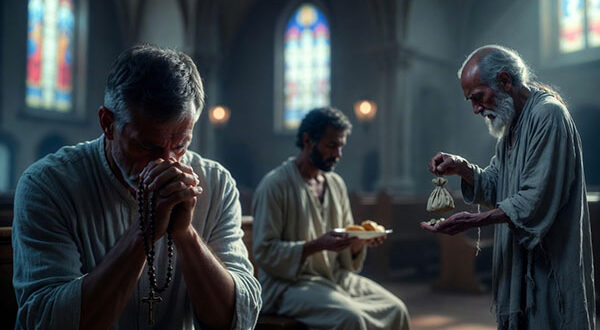
Every year, millions of Christians around the world enter into a special season that is not simply a liturgical tradition, but a profound spiritual school. That season is Lent, and at its heart beats a spiritual principle as ancient as the Gospel itself: the Lenten Triad.
This triad—prayer, fasting, and almsgiving—is not merely a devotional practice or a series of religious obligations. It is, in reality, a complete spiritual method for the conversion of the heart. It constitutes a pedagogical path that the Church has handed down for centuries to help believers return to God, heal their interior life, and renew their relationship with others.
In a society marked by consumerism, constant noise, and individualism, these three practices appear today more relevant than ever. They invite us to pause, purify our desires, and rediscover what is essential.
This article aims to be a deep theological and pastoral guide to understanding the meaning of the Lenten Triad and, above all, to living it concretely in daily life.
The Biblical Origin of the Lenten Triad
The foundation of these three practices is clearly found in the Gospel. In the Sermon on the Mount, Jesus presents precisely these three actions as pillars of spiritual life.
In the Gospel according to Matthew we read:
“When you give alms, do not sound a trumpet before you…
When you pray, do not be like the hypocrites…
When you fast, do not look gloomy…”
(Matthew 6:2,5,16)
What is significant is that Jesus does not say “if” you practice these things, but “when.” This indicates that, for the Judaism from which Christianity emerged, these practices were considered normal in spiritual life.
Jesus does not abolish them; He purifies them. The problem was not the practice itself, but hypocrisy, that is, doing them in order to be seen by others.
That is why He adds a key warning:
“Your Father, who sees in secret, will reward you.”
(Matthew 6:6)
Thus authentic Christian spirituality is born: the interior life lived before God.
The Spiritual Pedagogy of the Church
From the earliest centuries, the Church understood that these three practices formed a perfect spiritual balance.
The Fathers of the Church taught that each of them corrects a fundamental disorder in the human heart:
- Prayer heals our relationship with God.
- Fasting orders our relationship with ourselves.
- Almsgiving purifies our relationship with others.
For this reason, Christian tradition has never separated them. Together they form a spiritual triangle that sustains the growth of the believer.
Saint Peter Chrysologus, a bishop of the fifth century, expressed it masterfully:
“Fasting is the soul of prayer, and mercy is the life of fasting.”
This means that no practice can be lived in isolation. Fasting without charity becomes selfishness.
Prayer without conversion becomes formalism.
Almsgiving without interiority becomes empty philanthropy.
The triad, therefore, is an integral spirituality.
1. Prayer: Returning to the Heart of God
The first pillar of the Lenten Triad is prayer.
Prayer is not simply the recitation of formulas. In the Christian tradition, prayer is a living relationship with God. It is opening the heart and allowing God to enter our concrete history.
Lent invites us to rediscover interior silence.
In a hyperconnected culture, where we live surrounded by constant stimuli and distractions, prayer becomes a true spiritual revolution.
The Catechism defines prayer as:
“The raising of one’s mind and heart to God or the requesting of good things from God.”
But at its deepest level, prayer means standing before God in truth.
Jesus Himself gives us the example. Before important decisions He withdrew to pray. He spent entire nights in dialogue with the Father.
Lenten prayer seeks precisely this:
- to slow down the frantic rhythm of life
- to listen to the voice of God
- to rediscover our identity as children of God
Practical application today
Some simple ways to live prayer during Lent:
- dedicating 10–15 minutes of silence daily
- reading the Gospel of the day
- practicing lectio divina
- praying the Rosary
- participating in Eucharistic adoration
What matters most is not quantity, but faithfulness.
Consistent prayer slowly transforms the heart.
2. Fasting: Freeing the Heart from Idols
Fasting is perhaps the most misunderstood practice today.
Many people reduce it to a religious diet or a simple abstinence from food. But theologically, fasting is much deeper.
Fasting seeks to order the desires of the heart.
Human beings naturally seek immediate satisfaction: food, entertainment, consumption, pleasure. None of these things are bad in themselves, but they can become idols.
Fasting reminds us of a fundamental truth:
not everything I desire is something I truly need.
Jesus Himself fasted for forty days in the desert before beginning His public ministry.
That fast was a spiritual battle against the temptations of power, success, and pleasure.
Today fasting can take many forms.
It is not only about food.
We can fast from:
- social media
- impulsive consumption
- excessive entertainment
- criticism or negative speech
True fasting creates interior space for God.
Saint Basil said:
“True fasting is not merely abstaining from food, but withdrawing from sin.”
3. Almsgiving: The Social Face of Faith
The third pillar of the Lenten Triad is almsgiving, which in a broader sense means concrete charity toward those in need.
Christianity is not a spirituality closed in on interiority. Faith always expresses itself through active love.
Almsgiving breaks one of the great spiritual illnesses of the modern world: individualism.
It reminds us that our neighbor is not an idea, but a concrete person.
Jesus makes this clear in the Gospel:
“Whatever you did for one of the least of these brothers and sisters of mine, you did for me.”
(Matthew 25:40)
Giving alms does not simply mean giving money. It means sharing who we are and what we have.
It can take many forms:
- helping the poor financially
- dedicating time to people who are lonely
- visiting the sick
- collaborating with charitable works
- listening to someone who suffers
Almsgiving purifies the heart from attachment and allows us to participate in the love of God.
The Spiritual Balance of the Triad
When the three practices are lived together, a true process of transformation takes place.
Prayer connects us with God.
Fasting frees us interiorly.
Almsgiving opens us to our neighbor.
This balance prevents spiritual extremes.
- Without prayer, social action loses its spiritual root.
- Without fasting, prayer can become comfortable.
- Without almsgiving, faith becomes self-centered and inward-looking.
The Lenten Triad is therefore a pedagogy of integral conversion.
Lent in the Contemporary World
We live in an era marked by three major crises:
- the crisis of meaning
- the crisis of interior life
- the crisis of solidarity
Interestingly, the Lenten Triad responds precisely to these three wounds.
Prayer restores transcendent meaning.
Fasting recovers interior freedom.
Almsgiving rebuilds fraternity.
For this reason, Lent is not a sad season, but an immense spiritual opportunity.
It is a path toward the renewal of the heart.
A Simple Lenten Plan for Daily Life
To live the Lenten Triad in a concrete way, it can be helpful to follow a simple plan.
Prayer
- 15 minutes daily with the Gospel
- offering the day to God every morning
Fasting
- moderating digital consumption
- choosing one day a week for simple fasting
- giving up a habitual indulgence
Almsgiving
- helping someone each week
- performing a hidden act of charity
- supporting a charitable work
What matters is not perfection, but perseverance.
The Final Goal: A New Heart
Lent does not end in sacrifice. It ends in Easter.
The triad is not an end in itself. It is a path toward the very heart of Christianity: new life in Christ.
The prophet Ezekiel conveys this promise from God:
“I will give you a new heart and put a new spirit within you.”
(Ezekiel 36:26)
That is the true goal of Lent.
Not merely to fulfill rules.
But to allow God to transform our hearts.
And when that happens, prayer becomes life, fasting becomes freedom, and almsgiving becomes love.
Then we understand that the Lenten Triad is not only an ancient tradition.
It is a path that remains ever relevant toward everyday holiness.