Related Articles



There were moments in the history of the Church when the liturgy was not simply “something that was done,” but something that was deeply lived—with the body, with time, and with the whole soul. Palm Sunday is one of those cases.
Today, in many parishes, the celebration may last an hour… perhaps a little more. But there was a time—not so long ago—when this day could extend for hours, becoming a true total spiritual experience, profoundly pedagogical and transformative.
What have we lost? And above all, what can we recover?
1. The original meaning: entering with Christ into Jerusalem… and into His Passion
Palm Sunday is not just any feast. It marks the beginning of Holy Week, the moment when the Church enters into the heart of the Christian mystery: the Passion, Death, and Resurrection of Christ.
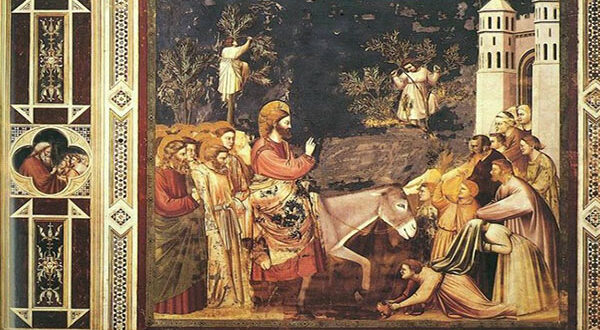
This day commemorates Jesus’ triumphal entry into Jerusalem, acclaimed by the crowd with palms and branches. But here lies a deeply theological paradox:
- The people cry out: “Hosanna!”
- Days later, they will cry: “Crucify Him!”
The liturgy of Palm Sunday is precisely designed to draw us into this tension. It is not merely remembrance—it is participation.
“Blessed is He who comes in the name of the Lord!” (Mt 21:9)
2. When the liturgy was a journey (literally)
In the ancient tradition—especially inspired by Jerusalem—Palm Sunday did not begin inside the church, but outside.
From testimonies such as that of the pilgrim Egeria (4th century), we know that the faithful:
- Gathered in a place different from the church
- Heard the Gospel of the entry into Jerusalem
- Walked in procession, holding branches
- Sang psalms and hymns
- Entered solemnly into the city or the church
This tradition was later adopted and transformed by the Latin Church over the centuries, becoming part of the Roman liturgy.
How long did it last?
It was not unusual for the celebration to include:
- Long processions
- Full chanting of psalms
- Extended readings
- Deep preaching
- The Passion chanted in its entirety
The result: several hours of living liturgy.
3. The traditional structure: a catechesis in motion
The richness of this liturgy was not accidental. Every element had meaning:
1. Blessing of the palms
This was not a quick gesture. It was solemn, with prayers recalling the victory of Christ the King.
2. Procession
Not decorative, but deeply theological:
- It represented following Christ
- It symbolized the soul’s entry into the Paschal mystery
- It was a public act of faith
3. Chant of the Gloria Laus
An ancient hymn proclaiming the kingship of Christ.
4. Entrance into the church
Not merely physical—it symbolized entering into the mystery of Redemption.
5. Proclamation of the Passion
One of the most powerful moments. It was not simply “read”—it was solemnly proclaimed or chanted, often with multiple voices.
4. Why did it last so long? (and why that was good)
Today we are used to speed. But traditional liturgy followed a different logic:
⏳ Time as an offering
Time was not “wasted”—it was given to God.
🧠 Deep catechesis
Every gesture taught something. The liturgy was the first school of theology.
❤️ Total involvement
You were not a spectator. You were part of the event.
🔥 Real preparation for Holy Week
You did not enter the Passion superficially. You were immersed in it.
5. What we have lost… and why it matters
With the liturgical reforms of the 20th century, many rites were simplified. This brought pastoral benefits (greater accessibility), but also consequences:
What has weakened:
- The sense of the sacred as something “great”
- Spiritual patience
- The sacrificial dimension of time
- The experience of community in movement
Today, many Palm Sunday celebrations can feel like:
- A beautiful gesture (the branches)
- A slightly longer Mass
- A cultural tradition
But we risk losing the essential: an existential entry into the Passion of Christ.
6. The great theological lesson: Christ the King… who goes to die
Palm Sunday is profoundly paradoxical:
- Christ enters as King…
- …but toward the Cross
This reveals a central truth of Christianity:
👉 Glory passes through the Cross
There is no Christianity without this tension.
Saint Augustine expressed it this way: “Christ reigns from the wood.”
7. Practical application: how can we live a deeper Palm Sunday today?
We cannot simply return to the past. But we can recover the spirit.
Here is a concrete guide:
🕊️ 1. Arrive early… and prepare yourself
Do not rush in. This day marks the beginning of the most important time of the year.
🌿 2. Live the procession with intention
It is not just a symbolic gesture. It is your “yes” to Christ.
Ask yourself:
Am I willing to follow Him… even to the Cross?
📖 3. Listen to the Passion as if for the first time
Do not just “endure” it. Meditate on it.
Place yourself within the scene:
- Am I Peter?
- Am I Pilate?
- Am I the crowd?
🏠 4. Bring the sign into your home
Blessed palms are not decoration. They are a sacramental reminding you that Christ is King in your home.
⏰ 5. Give real time to God
Recover something we have lost: free time for God.
Even if the liturgy is not hours long… you can extend it yourself.
8. An urgent call for our time
We live in a culture of immediacy, superficiality, and speed.
But the Christian faith cannot be lived that way.
The traditional Palm Sunday reminds us of something essential:
👉 God is not experienced in haste
Long liturgy was not an excess. It was a pedagogy:
- To learn how to love
- To learn how to wait
- To learn how to suffer with meaning
9. Conclusion: this is not about nostalgia, but depth
This is not about idealizing the past.
It is about rediscovering something still necessary today:
👉 A faith that involves time, body, community, and heart
Palm Sunday is not just the beginning of Holy Week.
It is a direct question to your life:
Do you acclaim Christ only when everything goes well…
or are you willing to follow Him also to the Cross?
Because there—and only there—the true Christian life begins.