Related Articles
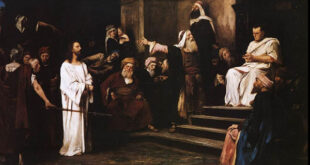
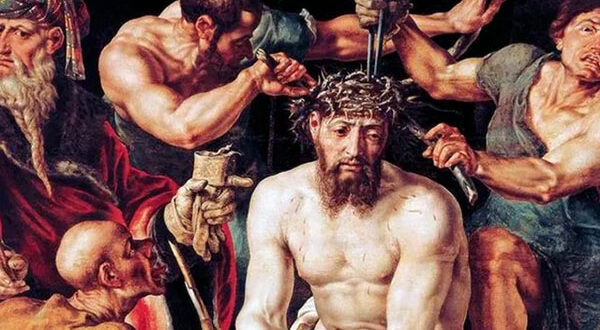
At the heart of Christ’s Passion lie scenes that shake the soul to its depths. They are not merely episodes of physical suffering, but revelations of a love that allows itself to be wounded for us. The flagellation and the crowning with thorns are not just historical events: they are a living catechesis, an incarnate theology, an urgent call to modern man.
Today, in a world that flees from pain, trivializes suffering, and seeks success without the cross, these Gospel scenes stand as an uncomfortable yet necessary light.
1. Historical context: the brutality of the Empire before the silence of the Innocent
After the trial before Pontius Pilate, Jesus Christ is handed over to Roman soldiers. Flagellation was not a minor punishment: it was a torture designed to destroy the body.
The usual instrument, the flagrum, had metal balls or bones attached to its ends. Each blow tore the skin, exposing muscles and sometimes even organs.
Then came the mockery: a cruel parody of kingship. They dressed Him in a cloak, placed a reed in His hand as a scepter… and a crown of thorns pressed into His head.
It is not only violence: it is total humiliation.
2. The Gospel account: a comparative view
The Synoptic Gospels —Gospel of Matthew, Gospel of Mark, and Gospel of Luke— together with Gospel of John present this moment with very significant theological nuances.
Matthew (27:26–31)
Matthew emphasizes the dimension of messianic mockery. Jesus is ridiculed as the “King of the Jews.” There is a strong focus on collective scorn.
Mark (15:15–20)
Mark presents the scene with starkness and speed. His focus is on the real, physical suffering of Christ. There are no embellishments—everything is direct, almost brutal.
Luke (23:16, 22)
Luke mentions the flagellation but does not describe the crowning with thorns as such. His concern is more pastoral: he shows Pilate attempting to avoid the condemnation.
John (19:1–5)
John offers a profoundly theological key. Here, the crowning with thorns becomes a paradoxical revelation of Christ’s kingship.
“Then Pilate took Jesus and had Him flogged… and the soldiers twisted together a crown of thorns and put it on His head… and Jesus came out, wearing the crown of thorns and the purple robe. Pilate said to them, ‘Ecce Homo’ (Behold the man)” (Jn 19:1,5)
Key differences
- Matthew and Mark: emphasis on mockery and physical suffering.
- Luke: softens the account, centered on Christ’s innocence.
- John: interprets the event as a theological revelation (Christ the King in humiliation).
3. Theological meaning: the mystery of redemptive suffering
Here we enter what is essential.
3.1. Christ bears the sin of the world
The flagellation is not merely human violence: it is participation in the mystery of universal sin.
Isaiah had foretold it:
“He was pierced for our transgressions, crushed for our iniquities; the punishment that brought us peace was upon Him, and by His wounds we are healed” (Is 53:5)
Every lash has redemptive value. This is not meaningless suffering: it is love that repairs.
3.2. The crowning with thorns: the inversion of worldly values
The world understands power as domination. Christ redefines it as self-giving.
- Crown → pain
- Throne → cross
- Power → humiliation
Jesus reigns through suffering. This is the great Christian revolution.
3.3. The dignity of man revealed in Christ
When Pilate says “Ecce Homo,” he proclaims something deeper than he understands:
Christ reveals what the true man is—one who loves to the very end.
4. Spiritual dimension: a school of holiness
The Catholic tradition has seen in these mysteries a concrete spiritual path.
4.1. Interior mortification
This is not about seeking pain for its own sake, but about learning to:
- Master passions
- Offer small sacrifices
- Accept daily difficulties
The flagellation teaches us that authentic love costs something.
4.2. Deep humility
The crowning with thorns destroys our pride.
Christ, being King, accepts ridicule.
A key question for the soul:
👉 How do I react when I am humiliated or misunderstood?
4.3. Reparation and offering
Every daily suffering can be united to Christ’s:
- Work problems
- Illness
- Family tensions
Nothing is lost if it is offered with love.
5. Practical applications for today
We live in a culture that:
- Avoids sacrifice
- Idolizes comfort
- Rejects suffering
Christ’s Passion is profoundly countercultural.
5.1. Rediscovering the meaning of suffering
Not all pain is meaningless. In Christ, it can be:
- Redemptive
- Purifying
- Transformative
5.2. Practicing small renunciations
Extraordinary heroism is not required:
- Turning off your phone to pray
- Fasting with intention
- Remaining silent in an argument
These are “small flagellations” that order the soul.
5.3. Living humility in daily life
Accepting:
- Not always being right
- Not being recognized
- Not standing out
This is where true interior freedom begins.
5.4. Contemplating the Passion
Frequent meditation on these mysteries transforms the heart.
Especially through:
- The Stations of the Cross
- The Holy Rosary (Sorrowful Mysteries)
- Eucharistic adoration
6. A final call: from spectacle to commitment
The risk today is to see the Passion as something distant, almost symbolic.
But it is not.
Christ was not flagellated “in theory.” It was for you. For me. For every concrete sin.
The question is not only:
👉 What did they do to Jesus?
But:
👉 What do I do with that love?
Conclusion: the crown the world does not understand
The flagellation and the crowning with thorns teach us that:
- True love gives itself
- Greatness passes through humiliation
- Victory comes through the cross
In a world that flees from pain, Christ shows us that suffering united to God does not destroy… it saves.
And perhaps today, more than ever, we need to hear those words again:
“Behold the man”
Because in that disfigured face… lies the model of what we are called to become.