Related Articles

For centuries, Europe lived under an idea that today may seem almost impossible: that the entire society—politics, economy, culture, art, and daily life—should be organized around God.
This historical model was called Christendom. It was not simply that most people were Christian. It was something much deeper: the Catholic faith constituted the very foundation of the social order.
The Middle Ages, often caricatured as a dark period, were in reality one of the greatest historical experiences of Christian civilization. Cathedrals pointing toward heaven, universities born under the protection of the Church, laws inspired by Christian morality, liturgical feasts marking the rhythm of the year… everything reminded people that their final destiny was not the earth, but God.
Today, in a secularized culture where faith is often relegated to the private sphere, looking back at medieval Christendom is not an exercise in nostalgia. It is an opportunity to rediscover how faith can transform society from its very roots.
1. What Was Medieval Christendom Really?
Christendom was not merely a shared religion, but a project of civilization.
We could define it as:
A society in which the Christian faith inspired laws, culture, institutions, and public life.
It did not mean that everyone was a saint or that conflicts and sins did not exist. But it did mean that the moral and spiritual framework of society was oriented toward God.
In medieval Christendom:
- The Church guided society spiritually.
- Rulers understood themselves as servants of the order willed by God.
- Culture sought to reflect divine beauty.
- Daily life was deeply imbued with faith.
The calendar itself was liturgical: Advent, Christmas, Lent, Easter… time itself was experienced as part of the history of salvation.
This reflected a deeply biblical conviction:
“Seek first the Kingdom of God and His righteousness, and all these things will be added to you.” (Matthew 6:33)
Medieval Christendom tried precisely that: to place God first even in social life.
2. The Theological Foundation: Christ as King of the Universe
Christendom was born from a central idea of Christianity: Jesus Christ is not only Lord of souls, but also Lord of history.
Scripture proclaims this clearly:
“All things were created through Him and for Him.” (Colossians 1:16)
This implies something radical:
human society must also be oriented toward Christ.
Medieval theologians developed this idea with remarkable depth.
For thinkers such as Saint Thomas Aquinas, political order had to pursue the common good, but that common good was not merely material. The true good of the human person includes his eternal destiny.
Therefore, in the classical Christian vision:
- The State deals with temporal order.
- The Church guides humanity toward its supernatural end.
They are not enemies, but two complementary dimensions of the same divine plan.
3. Medieval Society: A Spiritual Architecture
To understand medieval Christendom, we must imagine a society where everything had spiritual meaning.
Cathedrals: Catechisms of Stone
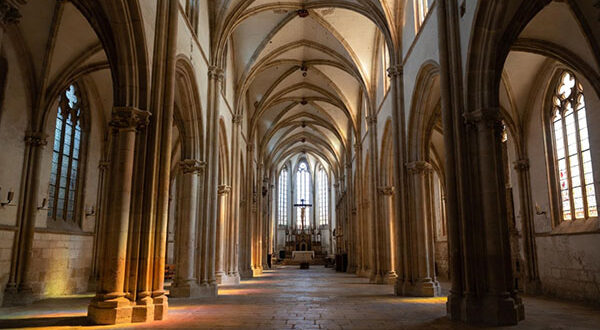
The great Gothic cathedrals were not just buildings.
They were theology expressed through architecture.
Their features reflected the Christian vision of the world:
- Verticality: the soul rises toward God.
- Light filtered through stained glass: symbol of grace.
- Biblical sculptures: teaching for the illiterate.
The cathedral was the spiritual heart of the city.
Universities: Faith and Reason United
The first European universities were born in a Christian context.
In them, scholars studied:
- Theology
- Philosophy
- Law
- Medicine
The goal was not merely to accumulate knowledge, but to understand creation as the work of God.
A famous medieval phrase summarizes this well:
“Faith seeks understanding.”
Work as a Vocation
In the medieval mindset, work was not only about survival.
It was participation in God’s creative work.
Saint Paul expressed it this way:
“Whatever you do, work at it with all your heart, as working for the Lord.” (Colossians 3:23)
This led to the emergence of:
- guilds with patron saints
- religious feasts connected to professions
- a deeply Christian work ethic
The baker, the farmer, the craftsman… all could sanctify their profession.
4. Daily Life: A World Immersed in Faith
One of the most fascinating characteristics of Christendom was that faith was not separated from daily life.
People lived surrounded by religious signs:
- bells marking the Angelus
- processions
- pilgrimages
- blessings of fields
- patronal feasts
Even the civil calendar followed the liturgical calendar.
This helped constantly remind people that human life is a journey toward God.
5. Light and Shadows: A Realistic Vision
It would be naïve to idealize the Middle Ages completely.
There were:
- wars
- abuses of power
- injustices
- personal sins
Christendom was not the perfect Kingdom of God.
It was a society of sinners trying to live under the Gospel.
But even with its flaws, it possessed something that many societies today have largely lost:
a shared spiritual horizon.
Today many societies lack a common vision about good, truth, or the meaning of life.
Christendom, by contrast, offered a coherent moral narrative.
6. Why Did Christendom Collapse?
Beginning in the 14th century, several processes slowly began transforming Europe:
- political crises
- economic changes
- religious conflicts
- cultural secularization
Over the centuries—especially since the Enlightenment—faith was increasingly pushed into the private sphere.
Society stopped organizing itself around God.
Today many describe our era as post-Christian.
7. Does Medieval Christendom Still Have Something to Say Today?
Much more than we might imagine.
The point is not to rebuild the Middle Ages, but to recover certain fundamental spiritual principles.
Among them:
1. God Must Be at the Center of Life
Not only on Sundays.
But also in our decisions, relationships, and work.
2. Faith Must Illuminate Culture
Christians are not called to hide their faith.
We are called to transform the world from within.
Jesus said it clearly:
“You are the light of the world.” (Matthew 5:14)
3. Holiness Is Possible in Ordinary Life
Medieval Christendom understood something that we are rediscovering today:
there are no truly secular jobs for those who live in the grace of God.
Being Christian does not mean escaping the world.
It means sanctifying it.
8. How to Live the Spirit of Christendom Today
Even though our context is different, there are many ways to apply these ideas.
Recover the Spiritual Rhythm of Time
- pray the Angelus
- live Advent and Lent intentionally
- celebrate Christian feasts
Sanctify Work
Offer every task to God.
Even the simplest activity can become a prayer.
Create Christian Culture
At home and in community:
- art
- music
- education
- family traditions
Faith is also transmitted through beauty and shared customs.
9. A Mission for Our Time
Perhaps the great challenge for Christians today is not to rebuild medieval Christendom, but to recreate a new Christian culture in the modern world.
A society where:
- human dignity is respected
- truth is sincerely sought
- the family is protected
- God is once again recognized
This begins in small places:
in the family,
in the workplace,
in the community.
Because every Christian is called to be a small light of Christendom in the midst of the world.
Conclusion: The Christian Dream of a Transformed Society
Medieval Christendom was a unique historical experience: an attempt to build an entire civilization oriented toward God.
Despite its human limitations, it demonstrated something profoundly evangelical:
that faith is not merely a private sentiment, but a force capable of shaping history.
Today, in the midst of a fragmented and often disoriented world, this insight is once again necessary.
The Gospel does not only save souls.
It also transforms cultures.
And everything begins with a personal decision.
To place Christ once again at the center.
Because when God occupies His rightful place, everything else finds its true order.
“Unless the Lord builds the house, the builders labor in vain.” (Psalm 127:1)
And perhaps, precisely in our time, God is calling new builders.