Related Articles

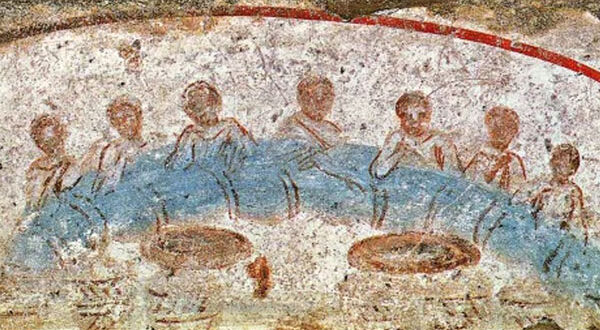
There was a time when Christians could not conceive of their lives without the Eucharist. It was not simply a devotional act or another ritual within their religiosity: it was the absolute center of their existence. They gathered before dawn, risked their lives to participate in it, and were willing to die rather than renounce this mystery.
For them, the Eucharist was not a symbol.
It was the living Christ.
In a pagan, hostile, and often violent world, the first Christians survived spiritually thanks to a deeply Eucharistic spirituality. Understanding how they lived this mystery is not merely an exercise in religious archaeology: it is an urgent call to rediscover the root of the Christian faith in our time.
Because if the early Church teaches us anything, it is this: when the Eucharist occupies the center, everything changes.
1. The Heart of the Early Church: “They Devoted Themselves to the Breaking of the Bread”
The Eucharistic spirituality of the first Christians was born directly from the apostolic experience.
After the Resurrection and Pentecost, the Christian community organized itself around four fundamental pillars described in the Book of Acts:
“They devoted themselves to the apostles’ teaching and to fellowship, to the breaking of the bread and to prayers.”
(Acts 2:42)
This sentence is extraordinarily revealing.
“The breaking of the bread” was the earliest name for the Eucharist. And it appears on the same level as apostolic teaching and prayer.
This shows us something decisive:
the Church was born Eucharistic.
There was no later development that added the Eucharist as a central element. From the very beginning, the Christian community lived gathered around the Eucharistic sacrifice.
Christians were not simply people who believed in Jesus.
They were people who gathered to eat the Body of Christ.
2. The Eucharist as Real Presence: The Faith of the First Centuries
One of the great modern misconceptions is the idea that belief in the real presence of Christ in the Eucharist appeared centuries later. The earliest Christian texts show exactly the opposite.
One of the clearest testimonies comes from St. Ignatius of Antioch, a martyr of the first century.
Writing around the year 107 A.D., he states:
“The Eucharist is the flesh of our Savior Jesus Christ.”
No metaphors.
No ambiguity.
Christians of the first generation firmly believed that in the Eucharist Christ was truly present.
Another fundamental testimony comes from St. Justin Martyr (2nd century), who explains how Christians celebrated the Eucharist:
“This food is called among us the Eucharist… and we do not receive it as common bread or common drink, but as Jesus Christ made flesh.”
It is astonishing to see that Eucharistic theology was already fully developed in the earliest centuries.
For them, the Eucharist was:
- sacrifice
- real presence
- spiritual nourishment
- communion with Christ
- a foretaste of heaven
Exactly what the Church teaches today.
3. They Celebrated the Eucharist Even at the Risk of Death
The Eucharistic spirituality of the first Christians is fully understood when we observe how much they were willing to suffer for it.
During the Roman persecutions, Christians were forbidden to gather. Celebrating the Eucharist could cost them their lives.
And yet, they continued doing it.
One of the most moving testimonies comes from the Martyrs of Abitinae (year 304). When they were arrested for celebrating the Eucharist in secret, they answered the Roman tribunal:
“Sine Dominico non possumus.”
“Without Sunday (without the Eucharist) we cannot live.”
They did not say:
“Without our religion we cannot live.”
They said something much more radical:
without the Eucharist we cannot live.
This reveals how deeply Christian life was structured around the Eucharistic sacrifice.
4. The Eucharist as Sacrifice: Continuity with the Cross
The first Christians had a very clear awareness of something that today is often forgotten:
the Mass is the sacrifice of Christ made present.
It is not a repetition of the Cross, but its sacramental re-presentation.
For this reason, from the earliest centuries, Christians spoke of the Eucharist as sacrifice.
In the Didache (1st century), one of the oldest Christian texts outside the New Testament, we read:
“On the Lord’s Day gather together, break bread and give thanks, after confessing your sins, so that your sacrifice may be pure.”
The word “sacrifice” appears clearly.
For the early Christians, the Eucharist was the fulfillment of the prophecy of Malachi:
“From the rising of the sun to its setting my name is great among the nations, and in every place a pure offering is made to my name.”
(Malachi 1:11)
The Church has always understood that this universal sacrifice is the Eucharist.
5. The Eucharist Transformed Daily Life
The Eucharistic spirituality of the first Christians did not end with the liturgical celebration.
The Eucharist transformed their daily lives.
After receiving the Body of Christ, they felt called to live like Christ.
That is why in the writings of the Church Fathers we constantly find exhortations to:
- love the poor
- forgive enemies
- live in purity
- practice charity
Because whoever receives Christ cannot continue living in the same way.
Saint Paul had already warned:
“Whoever eats the bread or drinks the cup of the Lord unworthily will be guilty of the Body and Blood of the Lord.”
(1 Corinthians 11:27)
For the first Christians, the Eucharist demanded moral coherence and constant conversion.
6. Preparation for Communion
In the early Church, Communion was not received in an automatic or superficial way.
There was a profound spiritual preparation.
Among the common practices were:
- examination of conscience
- public confession of grave sins
- fasting before the Eucharist
- reconciliation with one’s brothers and sisters
The Didache even exhorts:
“Let no one eat or drink of your Eucharist except those who have been baptized in the name of the Lord.”
The Eucharist was considered a sacred mystery that had to be received with reverence.
It was not a social gesture.
It was an encounter with God.
7. The Eucharist and the Unity of the Church
Another fundamental dimension of early Eucharistic spirituality is unity.
Christians understood that the Eucharist not only united them with Christ, but also with one another.
Saint Paul explains it clearly:
“Because there is one bread, we who are many are one body, for we all partake of the one bread.”
(1 Corinthians 10:17)
The Eucharist created communion.
That is why divisions within the community were considered extremely serious.
Receiving the Eucharist meant committing oneself to the unity of the Body of Christ.
8. The Eucharist as a Foretaste of Heaven
For the first Christians, the Eucharist also had an eschatological dimension.
It was a foretaste of the heavenly banquet.
Every Eucharistic celebration recalled the words of Jesus:
“Whoever eats my flesh and drinks my blood has eternal life.”
(John 6:54)
The Eucharist was seen as:
- food of immortality
- spiritual medicine
- pledge of the resurrection
Saint Ignatius of Antioch called it:
“the medicine of immortality.”
In other words:
the Eucharist does not only nourish the soul today, it prepares it for eternal life.
9. What Can We Learn Today from the First Christians?
The Eucharistic spirituality of the early Church raises an uncomfortable question for our time.
Have we lost something of that intensity?
Many Christians today live the Eucharist in a routine way. But for the first believers it was the greatest treasure in the world.
From them we can learn several fundamental lessons:
1. Return to the Center
Christian life does not revolve around many activities, but around Christ present in the Eucharist.
2. Rediscover Reverence
If we truly believe that Christ is present in the Eucharist, our attitude should reflect it.
3. Prepare Better for Communion
The first Christians understood that receiving the Body of Christ requires interior preparation.
4. Live Eucharistically
Whoever receives Christ must become the presence of Christ for others.
10. Recovering the Fire of the Early Church
The Eucharistic spirituality of the first Christians does not belong only to the past.
It is a call for today.
In a world full of noise, relativism, and spiritual superficiality, the Eucharist remains the same mystery that sustained martyrs, saints, and the first Christian communities.
Christ still says:
“I am the living bread that came down from heaven; whoever eats this bread will live forever.”
(John 6:51)
The question is whether we are willing to live like those first Christians:
- placing the Eucharist at the center
- defending its sacredness
- allowing ourselves to be transformed by it
Because when a Christian truly discovers the Eucharist, something extraordinary happens:
his entire life begins to revolve around Christ.
And then the experience of the first believers becomes reality again:
the Eucharist ceases to be merely a celebration… and becomes the very heart of life.