Related Articles
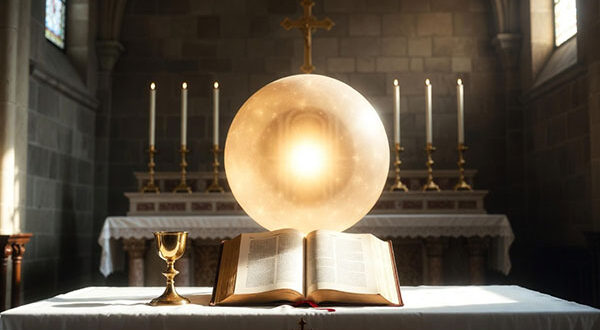
Why reducing it to the Bible impoverishes faith and how the Church has kept it alive for centuries
There are phrases that sound very pious, but hide a deep confusion. One of the most frequently repeated today is this: “The Word of God is the Bible.” For many Christians this seems obvious, almost unquestionable. However, for a Catholic, this statement is incomplete and theologically incorrect.
The Word of God is not reduced to the Bible.
The Bible is the written Word of God, yes. But it is not the totality of the Word of God.
And this distinction is not an academic detail nor a dispute among theologians: it directly affects how we live the faith, how we understand the Church, authority, the liturgy, and our relationship with God today.
This article seeks to help you understand, love, and live the Word of God in all its richness, as the Church has received it, safeguarded it, and handed it on for two thousand years.
1. Before the Bible, the Word already existed
Let us begin with what is essential.
👉 God did not begin to speak when the Bible was written.
👉 God first spoke through actions, through people, through a living history.
Biblical faith is not born from a book, but from an encounter.
“In many and various ways God spoke of old to our fathers by the prophets; but in these last days he has spoken to us by a Son”
(Hebrews 1:1–2)
The Word of God is, first of all, a Person: Jesus Christ.
Jesus did not write any book.
Jesus did not command books to be written.
Jesus founded a Church and entrusted His teaching to concrete men: the Apostles.
2. The Word of God is the living Christ, not just a text
Saint John expresses it with disarming clarity:
“And the Word became flesh and dwelt among us”
(John 1:14)
The Word is not first ink on paper.
The Word is the eternal Word of the Father, made flesh, with a voice, gestures, silences, miracles, death, and resurrection.
📌 The Bible bears witness to the Word, but does not exhaust it.
📌 Confusing the witness with the fullness of the Mystery is to reduce it.
3. Scripture and Tradition: two inseparable forms of the same Word
The Church teaches with absolute clarity —and here there is no ambiguity— that:
The Word of God is contained in Sacred Scripture and Sacred Tradition.
This is not a “Catholic opinion.”
It is solemn doctrine of the Second Vatican Council:
“Sacred Tradition and Sacred Scripture form one sacred deposit of the Word of God, committed to the Church”
(Dei Verbum, 10)
What is Sacred Tradition?
It is not “ancient customs” nor “human additions.”
Tradition is:
- The living teaching of the Apostles
- Transmitted orally, liturgically, doctrinally
- Before, during, and after the writing of the biblical texts
📖 The Bible was born within Tradition, not the other way around.
4. An uncomfortable fact: the Church existed for centuries without the “Bible” as we know it
During the first 300 years, most Christians:
- Could not read
- Had no access to texts
- Did not have a defined “New Testament”
So how did they live the faith?
✔ By listening to apostolic preaching
✔ By participating in the liturgy
✔ By receiving the sacraments
✔ By living according to the Tradition they had received
👉 Faith did not depend on a personal book, but on a living Church.
5. Who decided which books make up the Bible?
A key question.
📌 The Bible did not fall from heaven already bound.
📌 It was the Church who, guided by the Holy Spirit, discerned the canon.
The Councils of Hippo (393) and Carthage (397) established the biblical canon that Catholics use today.
👉 Without Tradition and the Magisterium, we would not know what is Scripture and what is not.
6. Reducing the Word of God to the Bible: a Protestant concept
The idea that:
“The Bible is the only Word of God and the only authority”
is the principle of “Sola Scriptura,” formulated in the Protestant Reformation of the 16th century.
What is the problem?
- The Bible never teaches “Sola Scriptura”
- Interpretation is left to individual judgment
- Faith is fragmented into thousands of contradictory readings
📉 Result: divisions, doctrinal confusion, subjective faith.
Catholic faith, by contrast, rests on an inseparable tripod:
- Sacred Scripture
- Sacred Tradition
- The Magisterium of the Church
7. The Word of God continues to speak today
God is not a retired author.
👉 The Word of God is living and active (cf. Hebrews 4:12).
It speaks today:
- In the liturgy, especially in the Eucharist
- In the authentic Magisterium
- In the lives of the saints
- In the Church’s discernment
📌 When the Church teaches faithfully, Christ continues to speak.
8. A practical theological and pastoral guide
How to live the Word of God in fullness (not just by reading the Bible)
1. Read the Bible within the Church
Not as an isolated book, but:
- With the Fathers of the Church
- With the Catechism
- With the liturgy
2. Listen to the Word at Mass
The proclaimed Word is not private reading, it is a sacramental act.
👉 Christ speaks to His gathered Church.
3. Be formed in Tradition
- Know the councils
- Read the saints
- Study the Magisterium
This does not reduce freedom, it gives roots.
4. Avoid biblicism
Not every verse is interpreted literally or in isolation.
📌 The Bible is understood with the Bible, but from the faith of the Church.
5. Live the Word
The Word is not only memorized:
- It is obeyed
- It is celebrated
- It is incarnated
9. A faith bigger than a book
Loving the Bible is essential.
Reducing faith only to the Bible is to impoverish it.
The Word of God:
- Is the living Christ
- Transmitted by Tradition
- Safeguarded by the Church
- Illuminated by Scripture
Or as Saint Augustine said with striking clarity:
“I would not believe the Gospel unless moved to do so by the authority of the Catholic Church.”
Conclusion: come back home
In a fragmented world, the Catholic faith offers something revolutionary:
a living, complete, coherent Word, embodied in a concrete Church.
Do not settle for a reduced Christianity.
Do not imprison God’s voice within a few pages.
📖 Read the Bible.
🕊 Listen to Tradition.
⛪ Remain in the Church.
There —and only there— the Word of God is revealed in all its fullness.