Related Articles


Introduction: a small symbol… with an eternal message
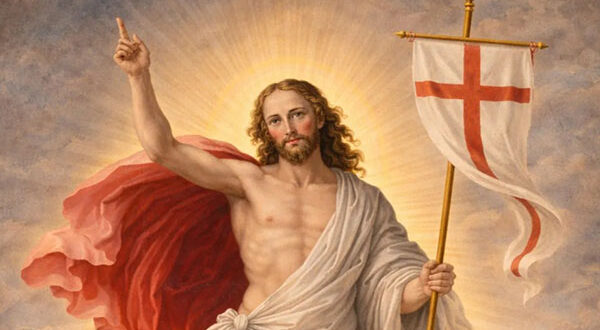
If you have ever contemplated an image of the Risen Christ —in paintings, sculptures, or traditional iconography— you have probably noticed a detail that many overlook: a staff crowned with a cross and a white banner. That object is not a mere artistic ornament. It is the Vesillum, also known as the banner of the Resurrection.
This symbol, deeply rooted in Christian tradition, contains an astonishing theological richness. It is not only a reminder of Christ’s victory: it is a living proclamation, a call to faith, and a program of life for every Christian.
In a world that seems to have forgotten the meaning of spiritual victory, rediscovering the Vesillum is not a cultural luxury… it is a spiritual necessity.
What is the Vesillum? Origin and history of a forgotten symbol
The word Vesillum comes from the Latin vexillum, which means “standard” or “military banner.” In the Roman world, the vexillum was the symbol of a legion: it represented identity, authority, and victory.
Christianity took this language —as it did with so many other things— and transformed it from within. The Christian Vesillum appears especially in medieval and Renaissance art as the standard of the Risen Christ, indicating that:
- Christ is the true King
- He has conquered in the definitive battle
- His victory is not political, but spiritual
In many representations, the Vesillum appears together with the Paschal Lamb (Agnus Dei), which carries the banner with a red cross on a white background. This detail is not accidental: it unites two great Christian mysteries:
- Sacrifice (the Cross)
- Victory (the Resurrection)
The Vesillum in Christ’s hand: the deep meaning of the staff
That “staff” which Christ holds is not a simple support. It is a theological sign loaded with meaning:
1. It is a royal scepter
Christ does not rise as a mere survivor… He rises as a victorious King.
The staff of the Vesillum functions as a royal scepter: it proclaims that Christ reigns not only over death, but over all history.
“All authority in heaven and on earth has been given to me” (Matthew 28:18)
2. It is a transformed spear
Some Church Fathers see in this staff an evocation of the spear that pierced Christ’s side. What was once an instrument of death becomes now a sign of victory.
This reflects a central truth of Christianity:
God does not eliminate evil… He conquers it by transforming it.
3. It is a battle standard
The Vesillum is a military symbol. Christ has fought —and has conquered—:
- Sin
- Death
- The devil
Therefore, His Resurrection is not only a spiritual event: it is a cosmic victory.
“O death, where is your victory?” (1 Corinthians 15:55)
4. It is a sign of gathering
In the ancient world, the standard gathered the soldiers. Where the vexillum was, there was the army.
The message is clear:
Christ raises His banner to gather His own.
Color and form: nothing is accidental
The Vesillum is usually depicted with a white banner bearing a red cross. This too has a profound meaning:
- White → purity, resurrection, glory
- Red → blood, sacrifice, martyrdom
That is to say:
Christ’s victory passes through the Cross; it does not avoid it.
This directly challenges the modern mindset, which seeks triumph without sacrifice. The Vesillum reminds us that:
👉 There is no Resurrection without Good Friday
👉 There is no glory without the Cross
Theological relevance: the Vesillum as a summary of the Gospel
The Vesillum is not a secondary symbol. In a certain sense, it is a visual summary of Christianity:
- Christ fights → Passion
- Christ dies → Cross
- Christ conquers → Resurrection
- Christ reigns → Glory
Everything is there, condensed into one gesture: Christ raising His banner.
We could say that the Vesillum is a visual response to this affirmation:
“If we have died with Him, we will also live with Him” (2 Timothy 2:11)
Practical application: what does this mean for your life today?
Here is where this symbol ceases to be art… and becomes life.
1. You are in a battle (even if you don’t see it)
Christianity is not a calm philosophy: it is a real spiritual struggle.
- Against sin
- Against lukewarmness
- Against the spirit of the world
The Vesillum reminds you that you do not fight alone: there is already a victor.
2. Your cross is not defeat
We live in a culture that flees from suffering. But the Vesillum teaches the opposite:
👉 What seems like defeat… can be victory in God
Your difficulties, if united to Christ, do not destroy you: they transform you.
3. You must choose under which banner you live
There is no spiritual neutrality.
Either you are under Christ’s banner…
or under other “banners”:
- The ego
- Money
- Pleasure
- Power
The Vesillum is a clear call:
choose your King.
4. You are called to be a witness of victory
A Christian does not live as one defeated. He lives as someone who knows that evil does not have the final word.
This changes everything:
- The way you suffer
- The way you work
- The way you love
Pastoral perspective: recovering symbols to recover faith
Today many Christians have lost the language of symbols. And with it, they have lost depth.
The Vesillum is not a decorative detail: it is a silent catechesis. To recover it means:
- Rediscovering the centrality of the Resurrection
- Understanding Christian life as a spiritual battle
- Returning to Christ as King, not merely as a “friend”
Conclusion: lift your eyes… and follow the banner
The Vesillum is not only something Christ holds.
It is something that invites you to follow.
Amid the chaos of the world, doubts, and weariness… there is a banner that still stands.
It is not torn.
It has not been defeated.
It has not disappeared.
It is the banner of the Risen One.
And under it, as Scripture says:
“The Lord is my light and my salvation; whom shall I fear?” (Psalm 27:1)
Final prayer
Lord Jesus Christ,
victorious King over death,
teach me to live under Your banner.
May I not flee from the Cross,
may I not fear the battle,
and may I never forget
that the victory is already Yours.
Amen.