Related Articles

When people speak about medieval military orders, the same names almost always come up: the Templars, the Hospitallers, perhaps the Order of Santiago. However, there is an order far less known in the popular imagination, yet decisive for the history of Europe, evangelization, and the spiritual shaping of the continent: the Order of the Teutonic Knights.
They were not born in the Holy Land surrounded by the legendary aura of the Temple, nor did they disappear wrapped in mystery. Their story is different—more sober, harsher… and deeply Christian. They did not evangelize deserts, but frozen swamps, impenetrable forests, and pagan peoples of the Baltic, carrying the Cross where winter seemed eternal.
This article is an invitation to look beyond the myth, to discover an order that united sword, cross, and hospital, and to ask ourselves what a spirituality forged amid cold, discipline, and mission can teach us today, in the 21st century.
1. Humble origins: an order born to serve, not to shine
The Teutonic Knights were not born as a glorious military force, but as a hospital fraternity.
It was the year 1190, during the Third Crusade, in the city of Acre. A group of German crusaders founded a hospital to care for sick pilgrims and soldiers, especially those who did not speak Latin or French. From the very beginning, their identity was marked by two traits:
- Concrete charity
- Ordered and disciplined spirituality
In 1198, the hospital became a religious military order, approved by Pope Innocent III. Its members professed the three classic vows:
- poverty
- chastity
- obedience
They adopted the Rule of Saint Augustine, with Templar influences in their military organization.
👉 Here a key lesson already appears:
true Christian mission is born not from power, but from service.
2. From the desert to the ice: the great Baltic mission
While other orders focused their action on the Holy Land, the Teutonic Knights were called to a forgotten front: northeastern Europe, where pagan peoples still persisted.
Who were these peoples?
Prussians, Livonians, Lithuanians… Baltic tribes who:
- practiced animistic religions
- worshipped natural forces
- rejected the Christian faith
Europe, in the 13th century, was still not fully evangelized.
The Teutonic Knights accepted an extremely harsh mission:
👉 to proclaim the Gospel where no one wanted to go.
Dark forests, endless winters, disease, isolation. This was not a romantic enterprise. It was a literal cross.
3. Evangelization or conquest? A question that requires nuance
Here it is necessary to be honest and mature in the faith.
Medieval evangelization, especially in contexts of violent resistance, was not always carried out in an ideal way. There were:
- abuses
- impositions
- questionable political alliances
The Church is not naive about her history, and traditional Catholicism does not need to whitewash it.
But reducing the Teutonic Order to “forced Christianization” is an unjust simplification.
The Teutonic Knights:
- founded cities, hospitals, schools
- translated Christian practices into the local context
- established a stable sacramental life
- brought social structures where previously there had only been tribalism
Theologically, this reminds us of something essential:
👉 God writes straight with crooked lines, and Providence acts even in imperfect contexts.
4. Teutonic spirituality: order, sacrifice, and fidelity
Beyond the battles, what is truly fascinating about the Teutonic Knights is their spirituality.
A spirituality marked by three pillars:
1. Order
The world was meant to reflect God’s order. Discipline was not oppression, but a path to interior freedom.
2. Sacrifice
The knight’s life was not comfortable. Fasting, liturgical prayer, strict obedience, combat. Everything offered as an oblation.
3. Fidelity
Fidelity to the Church, to the Pope, to the mission received. In a time of fragmentation, they understood that without obedience there is no mission.
Here a powerful contemporary call resonates:
👉 In a chaotic world, faith needs structure, roots, and coherence.
5. The black cross on white: a profoundly theological symbol
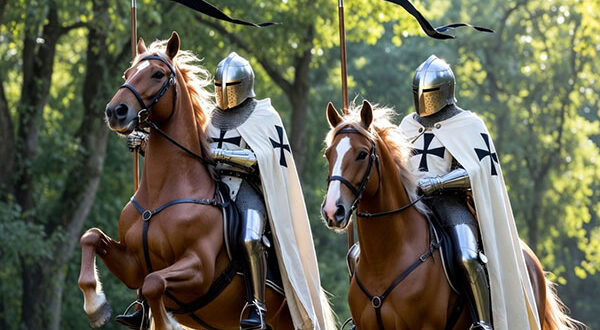
The Teutonic habit—white with a black cross—is not a mere aesthetic detail.
- White symbolizes baptismal purity
- The black cross recalls death to sin and the seriousness of spiritual combat
It was not only about fighting external enemies, but about waging an interior battle.
Saint Paul states it clearly:
“For our struggle is not against flesh and blood…” (Eph 6:12)
The Teutonic Knights understood that without personal conversion there is no authentic evangelization.
6. Decline, secularization, and silent survival
Over the centuries, the Order lost territorial power. The Protestant Reformation struck its domains hard. Many territories were secularized.
But—and this is crucial—the Order did not disappear.
Today, the Teutonic Order still exists, no longer as a military order, but as a religious institution dedicated to charity, pastoral work, and spiritual life.
This contains a beautiful lesson:
👉 the Church does not live from power, but from fidelity.
7. What can the Teutonic Order teach us today?
A great deal. A great deal indeed.
In a world that is:
- relativistic
- comfortable
- allergic to sacrifice
the Teutonic Knights remind us that:
- Faith is lived with body and soul
- Evangelization means leaving the comfort zone
- Charity and truth are not opposed
- Mission requires structure, formation, and discipline
Not all of us are called to wield a sword, but we are called to:
- defend the faith within the family
- pass it on to our children
- live it with public coherence
- resist the spiritual cold of our time
8. Evangelizing today’s “Baltic”
Today, paganism no longer lives in frozen forests, but in:
- indifferent hearts
- cultures without transcendence
- weary Christians
Our “Baltic” is interior and social.
The final question is inevitable:
👉 Are we willing to be winter Christians, not only spring Christians?
The Teutonic Knights were not perfect, but they were brave, faithful, and deeply aware that faith is worth one’s life.
And that, today, remains an urgent lesson.