Related Articles
There are objects that belong to history.
And there are objects that belong to mystery.
The Holy Lance of Longinus is not simply another relic from ancient Christianity. It is the iron that pierced Christ’s side. It is the instrument that opened the Heart of the Redeemer. It is the visible sign of the final humiliation… and at the same time, the visible beginning of the Church.
But what does that lance truly mean for us today?
Is it merely an archaeological memory?
Or is it an urgent spiritual call for our time?
Let us go deeper — with theological rigor and pastoral clarity — into its history, its meaning, and its impact on our daily lives.
1. The Moment That Changed History
The Gospel of St. John recounts the episode with sobriety, yet with immense depth:
“But one of the soldiers pierced His side with a spear, and immediately blood and water came out.”
(Jn 19:34)
That soldier, according to tradition, was Longinus, a Roman centurion who took part in the crucifixion.
Theologically, this verse is explosive.
St. John immediately adds:
“He who saw it has borne witness — his testimony is true.” (Jn 19:35)
Why such insistence?
Because this is not an anecdotal detail. It is a revealing act.
Christ was already dead. There was no need to wound Him. And yet, that wound is providential.
The lance was not an accident. It was a sign.
2. Who Was Longinus?
Scripture does not mention his name. But ancient Christian tradition — transmitted through patristic writings and Eastern liturgy — identifies the soldier as Longinus.
According to that tradition:
- He was a centurion.
- He witnessed Christ’s death.
- After seeing the prodigies and hearing His words, he proclaimed: “Truly this was the Son of God.” (cf. Mk 15:39)
- He converted.
- He left the army.
- He died a martyr.
The Eastern Church venerates him as a saint.
Are all the historical details verifiable? Not entirely. But theologically, his figure expresses a profound truth: the executioner can become a witness.
The one who wounds can become a disciple.
And this is crucial for us.
3. The Wound That Gave Birth to the Church
The Fathers of the Church saw in that open side something far greater than a physical wound.
St. Augustine taught that just as Eve was formed from the side of Adam while he slept, the Church is born from the open side of Christ as He slept in death upon the Cross.
From that wound flow:
- The blood → symbol of the Eucharist.
- The water → symbol of Baptism.
The Church is born from the sacraments.
The lance opens access to the sacramental mystery.
From a theological perspective, the wound is not defeat — it is revelation.
God holds nothing back. He allows Himself to be opened. He allows Himself to be pierced.
The Heart of Christ remains exposed forever.
4. The Relic Throughout History
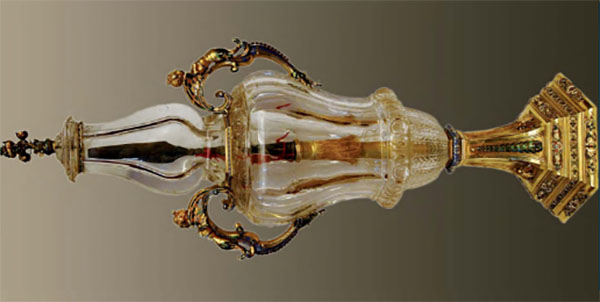
Throughout the centuries, several lances have been venerated as the “Holy Lance.” One of the most well known is preserved in St. Peter’s Basilica.
Another important tradition is linked to the Holy Roman Empire and preserved in Vienna.
Historically, it is difficult to establish with absolute certainty the material authenticity of any one relic. But here we must make a fundamental distinction:
Christian faith does not depend on the physical authenticity of a relic.
It depends on the redemptive event that the relic represents.
The Church venerates relics not out of superstition, but because Christianity is an incarnational faith. God acts through matter. The invisible is communicated through the visible.
5. Why Is It Exposed in the Vatican During Lent?
In St. Peter’s Basilica, the traditional relic of the Holy Lance is preserved in one of the pillars that support the great dome designed by Michelangelo.
Once a year, during the season of Lent, a solemn exposition of the principal relics of the Passion takes place — among them, the Lance.
Why during Lent?
Because Lent is the time to contemplate the Passion.
It is not an object for the curious.
It is an object for penitents.
The Church displays it so that we may remember that our salvation had a physical, real, bloody cost.
The exposition is not a spectacle.
It is an invitation to conversion.
6. The Profound Theological Dimension: The Pierced Heart
Here we reach the spiritual core.
The open side is the revelation of Christ’s Heart.
It is no coincidence that centuries later the devotion to the Sacred Heart flourished. That devotion is not sentimentalism; it is theological contemplation of the wounded love of God.
The lance represents:
- Human sin that wounds.
- Divine mercy that responds with love.
- The definitive opening of access to God.
Christ does not respond by closing Himself off.
He responds by opening Himself.
And here comes the uncomfortable question:
How many times are we the ones holding the lance?
Every sin is a lance.
Every act of indifference is a wound.
Every form of lukewarmness is a piercing of His side.
But every confession is also a return to the open Heart.
7. Practical Application: What Does It Mean Today to Live Before the Holy Lance?
We live in a culture that avoids suffering, anesthetizes pain, and relativizes sin.
The Holy Lance reminds us of three essential truths:
1. Sin is real
It is not a psychological idea. It wounds truly.
2. God’s love is even more real
From the wound flow blood and water. Life flows from it.
3. Conversion is possible
If Longinus could convert, so can you.
8. Three Concrete Spiritual Paths Inspired by the Lance
✦ 1. Contemplate the Open Side
During this Lent, dedicate time to prayer before a crucifix. Do not rush. Look at the wound.
Ask yourself:
Am I fleeing from the Heart of Christ — or entering into it?
✦ 2. Confess Your Lances
Make a serious examination of conscience — not a superficial one.
The lance was not a scratch; it was a penetration.
The sacrament of Reconciliation is the place where our lances are transformed into mercy.
✦ 3. Be a Witness, Like Longinus
In a world that ridicules faith, we need converted centurions.
It is not enough to refrain from wounding Christ.
We must proclaim: “Truly this is the Son of God.”
9. The Final Paradox: The Glorious Wound
In the Resurrection, Christ retains His wounds.
Why?
Because love does not erase its scars.
The wound of His side remains glorified. It is not a sign of defeat, but of victory.
The lance intended to confirm death.
It ended up proclaiming life.
10. A Word for Our Time
We live in times of doctrinal confusion, moral relativism, and spiritual coldness.
The Holy Lance brings us back to the center:
Christ crucified.
Christ pierced.
Christ opened.
We do not need sensational novelties.
We need to return to His side.
For there the Church was born.
There the sacraments were born.
There our hope was born.
Conclusion: What Will You Do With the Lance?
The Holy Lance is not a historical curiosity.
It is a mirror.
It shows us what sin does.
It shows us what love can redeem.
Today, you can be the indifferent soldier.
Or the converted Longinus.
The lance is raised every time we sin.
But the Heart remains open every time we return.
And while the Church exposes it during Lent in the Vatican, the message is clear:
Do not look at the wound as a spectator.
Enter into it as a son.
For from that open side still flows the only medicine capable of healing the world.
Blood and water.
Justice and mercy.
Truth and love.
The iron pierced His side.
But Love pierced history.