Related Articles
We live obsessed with the future. What will happen to the world? Are we near the end? When will Christ return in glory? Social media boils with apocalyptic theories, headlines announce crisis after crisis, and the human heart beats between fear and hope.
But in the midst of that noise, the Church whispers a truth that changes everything: the Parousia has already begun, and it takes place every day upon the altar.
Yes. The Second Coming is not only a future event. It is also a present reality. It is what we can call—with profound theological foundation—the Eucharistic Parousia.
This article is not a pious speculation. It is an invitation to rediscover the heart of the Christian mystery: Christ returns sacramentally at every Holy Mass, anticipating His glorious return and preparing His Bride.
1. What Is the Parousia?
The word “Parousia” comes from the Greek parousía, meaning “presence,” “coming,” “official manifestation.” In the New Testament it is used to refer to the glorious coming of Christ at the end of time (cf. Mt 24:27; 1 Thess 4:16).
Saint Paul writes:
“For the Lord himself, with a cry of command, with the archangel’s call and with the sound of the trumpet of God, will descend from heaven” (1 Thessalonians 4:16).
The Church has always professed this truth in the Creed:
“And He will come again in glory to judge the living and the dead.”
The definitive Parousia will be visible, universal, and majestic. Christ will come as Judge and King. But here is the key point: the history of salvation does not function in sealed compartments between the “now” and the “later.”
In Christianity, the future breaks into the present.
And this happens in a supreme way in the Eucharist.
2. The Eucharist: Real Presence, Not Symbol
From the earliest centuries, the Church has clearly affirmed that in the Eucharist there is no metaphor, but reality.
Christ did not say: “This represents my body.”
He said: “This is my body” (Mt 26:26).
The doctrine of transubstantiation—solemnly defined at the Council of Trent—affirms that the substance of bread and wine is truly converted into the Body and Blood of Christ, while only the external appearances remain.
Here something radical occurs:
The glorified, risen Christ, enthroned at the right hand of the Father, becomes present in time and space.
He is not a Christ of the past.
He is not an emotional memory.
He is the same Lord who will come in glory.
That is why the liturgy proclaims after the consecration:
“We proclaim your Death, O Lord, and profess your Resurrection until you come again.”
The Mass is remembrance, yes.
But it is also a plea for the Parousia.
And even more: it is a real anticipation of it.
3. The Parousia Already Anticipated: Theological Foundation
To understand the Eucharistic Parousia we must grasp a central principle of Catholic theology: the liturgy participates in eternity.
The Letter to the Hebrews presents Christ as the eternal High Priest who offers a single and definitive sacrifice (Heb 9:11–12). That sacrifice is not repeated, but it is made sacramentally present at every Mass.
The Eucharist is not a repetition of Calvary.
It is its unbloody re-presentation.
And the Christ who offers Himself is the same one who will come in glory.
Therefore:
- The Cross belongs to the historical past.
- The Resurrection belongs to the eternal victory.
- The Parousia belongs to the eschatological future.
- But the Eucharist unites past, present, and future in a single sacramental act.
Here is the key:
The Mass is the place where time opens itself to eternity.
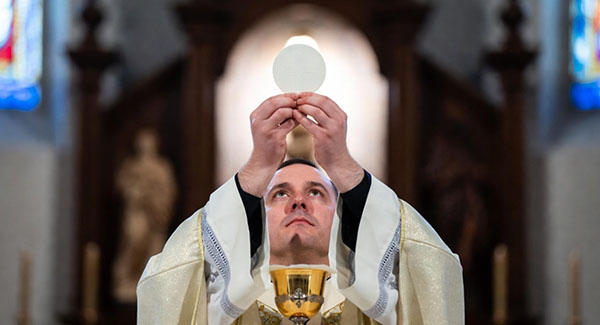
When the priest elevates the Host, heaven touches earth.
When the faithful receive Communion, they already participate in the eternal banquet of the Lamb (cf. Rev 19:9).
4. The Eschatological Dimension of Every Mass
Every Eucharist has a profoundly eschatological dimension.
We do not simply celebrate a communal ritual. We celebrate:
- The redemptive sacrifice.
- The glorious presence.
- The anticipation of judgment.
- The proclamation of the definitive Kingdom.
That is why in the traditional liturgy one could breathe so intensely the sense of the sacred and of judgment. The Mass is not spiritual entertainment. It is the threshold of the end of time.
Every consecration is an irruption of the King.
We could say, with theological rigor:
The Eucharist is a sacramental Parousia, veiled under the species, yet real.
What one day we shall see without veil, today we adore under the appearance of bread.
5. Why Does This Matter Today?
We live in a culture that has lost the sense of transcendence. Many Catholics have reduced the Mass to a fraternal gathering or an emotional experience.
But if we recover the awareness of the Eucharistic Parousia, everything changes:
- It changes the way we attend Mass.
- It changes the way we receive Communion.
- It changes our spiritual preparation.
- It changes our daily life.
If Christ truly comes at every Mass, how can I approach distracted?
If the King is present, how can I live in mortal sin?
If I am already participating in the eternal banquet, how can I live as if this life were all that exists?
The Eucharist is not a symbol of heaven.
It is heaven entering the world.
6. Concrete Pastoral Applications
Here is where this doctrine ceases to be theoretical and becomes transformative.
1️⃣ Serious Preparation Before Mass
If we are going to encounter the Lord who will come in glory, preparation cannot be improvised. Frequent confession, recollection, prayer beforehand.
2️⃣ Recovering the Sense of Adoration
Eucharistic adoration is training for the definitive Parousia. We learn to stand before Him now, so as not to fear Him when He manifests in glory.
3️⃣ Communion in a State of Grace
Saint Paul warns forcefully:
“For anyone who eats and drinks without discerning the body eats and drinks judgment upon himself” (1 Corinthians 11:29).
The Eucharistic Parousia is salvation for the one in grace, but judgment for the one who despises it.
4️⃣ Living in Vigilance
The Mass educates us in active expectation. Not in fear, but in hope.
Every “Amen” when receiving Communion is an act of preparation for the day when Christ will manifest without veils.
7. The Divine Pedagogy: From the Hidden to the Manifest
God acts progressively:
- In Bethlehem He came in humility.
- On the Cross He hid Himself in suffering.
- In the Eucharist He hides Himself under the species.
- In the final Parousia He will manifest in glory.
The Eucharist is the intermediate stage:
neither total concealment nor full manifestation.
It is real presence under sacramental sign.
Whoever learns to recognize Him in the Host will recognize Him in glory.
8. The Eucharistic Parousia and the Current Crisis of Faith
Many speak of the end of the world.
Few speak of the end of sin in their own soul.
The true preparation for the Parousia is not collecting apocalyptic theories, but living eucharistically.
A Catholic who lives centered on the Mass does not fear the end.
Because he already lives united to the One who is coming.
In times of doctrinal confusion, secularization, and loss of the sense of the sacred, the solution is not anxiety, but adoration.
The Church will survive not by human strategies, but by the Eucharist.
9. A Spiritual Guide to Living the Eucharistic Parousia
Let me propose something concrete:
- Attend Mass as if it were the last of your life.
- Receive Communion as if it were your viaticum.
- Adore as if you were already before the heavenly throne.
- Live each day as preparation for the definitive encounter.
Make your day an extension of the altar:
- Work offered.
- Sacrifices accepted.
- Sins confessed.
- Concrete charity.
The Eucharist does not end with “Go forth, the Mass is ended.”
That is where your mission begins.
10. Conclusion: The One Who Is Coming Is Already Here
The Parousia is not only a future date.
It is a Person who is already coming.
And He comes every day.
The same Christ who will one day rend the heavens now allows Himself to be touched in the silence of the tabernacle.
The question is not when He will come.
The question is:
Do you recognize Him now?
For whoever learns to see Him in the Host will not fear seeing Him in glory.
And when at last the trumpet sounds and the Son of Man manifests Himself, the eucharistic soul will not say, “What a surprise!” but:
“At last I see You as I have always adored You.”