Related Articles

Introduction: A Spiritual Gift That Raises Questions
In recent decades it has become common to hear about the so-called “gift of tongues” in Christian environments, especially within certain charismatic movements. Many people have seen or heard prayers consisting of incomprehensible syllables pronounced with spiritual fervor. Some identify it as a manifestation of the Holy Spirit. Others feel confusion or even doubt.
But a fundamental question arises for any Christian who wishes to live their faith faithfully: is this the same gift of tongues that appears in the Bible?
To answer seriously, we must return to the sources: Sacred Scripture, the Tradition of the Church, and theological reflection. Only in this way can we understand what the authentic glossolalia truly was—the gift of tongues granted to the Apostles—and how it differs from the modern phenomenon that is sometimes presented under the same name.
This topic is not merely academic. Understanding it correctly helps discern spiritual gifts, avoid confusion, and grow in a solid faith centered on Christ and guided by the Holy Spirit.
1. The Gift of Tongues in the Bible: The Event of Pentecost
The first and clearest appearance of the gift of tongues is found in the Book of Acts, at the foundational moment of the Church: Pentecost.
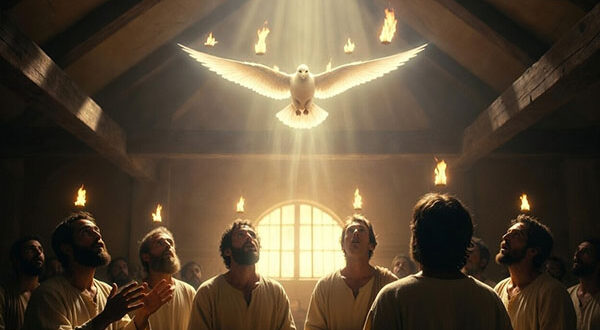
The scene is powerful. The Apostles, gathered in prayer together with the Virgin Mary, receive the outpouring of the Holy Spirit. Immediately something extraordinary happens.
“All of them were filled with the Holy Spirit and began to speak in other tongues as the Spirit enabled them.”
(Acts 2:4)
What is surprising is not only that they speak in other languages, but what happens to those who hear them:
“Each one heard them speaking in his own language.”
(Acts 2:6)
The biblical text mentions specific peoples:
- Parthians
- Medes
- Elamites
- Residents of Mesopotamia
- Jews from Cappadocia, Pontus, and Asia
- Egypt and Libya
- Romans
Each one understood the message perfectly.
A Missionary Miracle
The gift of tongues at Pentecost has a very clear purpose: to proclaim the Gospel to all peoples.
It is not about incomprehensible sounds, but about real languages that the Apostles had never learned.
In theological terms, this is known as xenoglossy, that is, the supernatural ability to speak a foreign language.
This miracle responds to a concrete need: the universality of the Church. The Gospel was not meant for just one people or culture, but for all humanity.
Pentecost is, in a sense, the reversal of the Tower of Babel. Where there had once been confusion of languages, the Spirit now creates communion in diversity.
2. What the Early Church Understood by the “Gift of Tongues”
The first Christians understood the gift of tongues within the framework of the apostolic mission.
The Fathers of the Church reflected on this. For example, St. Augustine explained that this gift had a specific function in the beginnings of the Church: to show that the Gospel was destined for all nations.
In his writings he points out that this gift was not necessary at all times, because once the Gospel had spread among different peoples, the Church already had preachers from many cultures and languages.
In other words:
- The gift was a foundational sign
- It had a concrete missionary purpose
- It was not an emotional or purely private manifestation
For the early Church, the true gift of tongues was always ordered toward evangelization and the understanding of the message.
3. St. Paul and the Discernment of Charisms
The subject of tongues also appears in the First Letter to the Corinthians, where St. Paul addresses certain disorders in the community.
The city of Corinth was a culturally complex and spiritually enthusiastic environment. Some Christians seemed to value certain charisms more for their spectacular nature than for their usefulness.
For this reason, St. Paul establishes clear criteria.
“If anyone speaks in a tongue, two—or at the most three—should speak, one at a time, and someone must interpret.”
(1 Corinthians 14:27)
And he adds something very important:
“In the church I would rather speak five intelligible words to instruct others than ten thousand words in a tongue.”
(1 Corinthians 14:19)
Here we find a fundamental pastoral principle:
A true charism always builds up the community.
If a spiritual manifestation does not help people understand the message, grow in faith, or build up the Church, it loses its meaning.
4. The Modern Phenomenon of “Glossolalia”
In the twentieth century, especially beginning with the Pentecostal movement and later within some charismatic environments, a practice also called “speaking in tongues” became popular.
However, in most cases it consists of:
- spontaneous sounds
- repetitive syllables
- linguistic structures without identifiable meaning
Linguistic studies conducted on this phenomenon have shown that they do not correspond to real languages.
For this reason many theologians distinguish between:
1. Xenoglossy
Speaking real languages unknown to the speaker.
2. Modern glossolalia
Vocal expressions of an ecstatic or emotional character.
The problem arises when both phenomena are identified as if they were the same thing.
From a biblical perspective, they are not equivalent.
5. Key Differences Between the Apostolic Gift and Modern Glossolalia
To better understand the issue, it is helpful to observe some fundamental differences.
1. Understanding of the Message
At Pentecost:
- Everyone understood the message.
In modern glossolalia:
- generally no one understands what is being said.
2. Real Languages
In the apostolic case:
- they were existing human languages.
In the modern phenomenon:
- they do not correspond to identifiable languages.
3. Missionary Purpose
The apostolic gift had a clear purpose:
to preach the Gospel to all nations.
Modern glossolalia often has a devotional or emotional character.
4. Order in the Community
St. Paul insists on order and discernment.
The Holy Spirit does not produce confusion.
“God is not a God of confusion but of peace.”
(1 Corinthians 14:33)
6. The True Center of Christian Life: Not Charisms, but Charity
One of the most common spiritual mistakes is to focus on extraordinary phenomena.
But St. Paul offers a decisive teaching in chapter 13 of the First Letter to the Corinthians.
“If I speak in the tongues of men or of angels, but do not have love, I am only a resounding gong or a clanging cymbal.”
(1 Corinthians 13:1)
The message is powerful.
Charisms may be impressive, but they are not the most important thing.
What lies at the center of Christian life is:
- charity
- holiness
- union with Christ
Many saints never spoke in tongues or performed spectacular miracles, and yet they transformed the world.
7. Spiritual Discernment in Times of Confusion
We live in a time in which spirituality sometimes mixes with intense emotions, subjective experiences, or a search for the extraordinary.
For this reason the Church has always insisted on discernment.
The Holy Spirit acts, yes. Charisms exist. But they must be evaluated according to three classic criteria:
1. Fidelity to Scripture
No spiritual experience can contradict biblical teaching.
2. Communion with the Church
True charisms build unity.
They never generate division or spiritual superiority.
3. Spiritual Fruits
Jesus gave a clear criterion:
“By their fruits you will recognize them.”
(Matthew 7:16)
The fruits of the Spirit are:
- peace
- humility
- charity
- obedience to God
8. Practical Applications for Christian Life
Understanding this topic does not mean despising the gifts of the Holy Spirit. On the contrary: it means seeking the true gifts necessary for our sanctification.
1. Asking for the Gifts of the Holy Spirit
The Church teaches seven fundamental gifts:
- wisdom
- understanding
- counsel
- fortitude
- knowledge
- piety
- fear of the Lord
These gifts are far more important for daily life.
2. Prioritizing Deep Prayer
Rather than seeking extraordinary experiences, the Christian is called to cultivate:
- daily prayer
- reading the Bible
- the sacraments
It is there that the Spirit acts in a quiet but powerful way.
3. Living the Faith with Balance
Christian spirituality is not spectacle or fleeting emotion.
It is a real relationship with God that transforms the heart and life.
9. The True Miracle of the Holy Spirit
Perhaps the greatest miracle of the Spirit is not speaking unknown languages.
The greatest miracle is transforming the human heart.
Turning:
- pride into humility
- selfishness into love
- fear into trust
That is the most authentic sign of God’s action.
The Apostles did not change the world through extraordinary phenomena, but because they lived the Gospel radically.
Conclusion: Returning to the Spirit of Pentecost
The true gift of tongues in the Bible was not a mystical spectacle. It was a missionary sign that allowed Christ to be proclaimed to all peoples.
The Holy Spirit continues to act today, but His principal work is not to produce striking phenomena—it is to form saints.
For that reason, today’s Christian is called to ask for something much deeper:
- a firm faith
- a humble heart
- a burning charity
When this happens, the miracle of Pentecost continues in another way: the Gospel becomes understandable to the world once again.
And then, without the need for incomprehensible words, the life of the Christian itself becomes a universal language that everyone can understand: the language of the love of God.