Related Articles
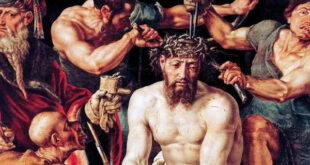
There are scenes in the Gospel that are not merely read: they are contemplated, felt, prayed. The arrest of Jesus in the Garden of Gethsemane is one of them. It is the moment when Infinite Love allows itself to be bound by human hands; when Light permits itself to be surrounded by darkness; when God Himself enters, willingly, into the logic of redemptive suffering.
This episode is not simply the beginning of the Passion. It is a mirror in which every Christian can recognize himself: in Judas’ betrayal, in the fear of the disciples, in the violence of the soldiers… and also —and above all— in the sovereign meekness of Christ.
1. The context: Gethsemane, the place of surrender
After the Last Supper, Jesus goes to the Garden of Gethsemane, at the foot of the Mount of Olives. There He prays intensely, to the point of sweating blood, accepting the will of the Father:
“Father, if you are willing, take this cup from me; yet not my will, but yours be done.” (Luke 22:42)
This detail is key: the arrest is not a surprise for Jesus. It is the culmination of a free self-offering. He is not captured because He cannot avoid it, but because He has chosen to love to the very end.
2. The moment of the arrest: a scene full of symbols
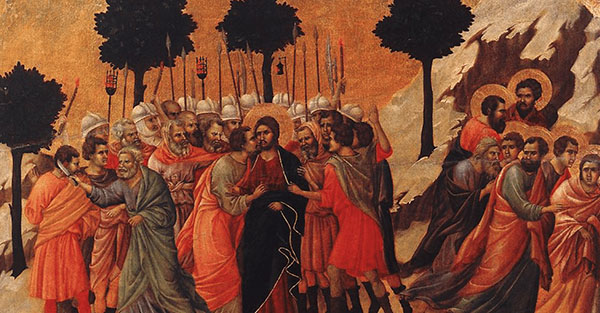
Suddenly, the night is broken by torches, swords, and clubs. Judas arrives, one of the Twelve, leading the soldiers. The agreed sign is shocking: a kiss.
“Judas, are you betraying the Son of Man with a kiss?” (Luke 22:48)
The kiss, a sign of friendship and love, becomes an instrument of betrayal. Here one of the great dramas of the human heart is revealed: the possibility of using good for evil.
Peter, impulsive, tries to defend Jesus and cuts off the ear of the high priest’s servant. But Christ stops him:
“Put your sword back in its place… for all who draw the sword will die by the sword.” (Matthew 26:52)
And, in a profoundly divine gesture, He heals the wounded man. Even at the moment of His arrest, Jesus continues to heal.
3. Differences between the Synoptic Gospels (and John)
The arrest appears in all four Gospels, but each offers important theological nuances.
Gospel of Matthew (26:47–56)
- Emphasizes the fulfillment of Scripture: everything happens “so that the writings of the prophets might be fulfilled.”
- Highlights Judas and the kiss as the sign of betrayal.
- Shows the disciples fleeing: human fragility in the face of suffering.
Gospel of Mark (14:43–50)
- The most sober and direct account.
- Introduces a curious detail: a young man who flees naked (possibly a symbol of total abandonment).
- Emphasizes the speed and rawness of the events.
Gospel of Luke (22:47–53)
- Highlights the mercy of Jesus: the only Gospel that recounts the healing of the ear.
- Adds a spiritual dimension: “this is your hour—when darkness reigns.”
- Presents Jesus as fully aware of the spiritual meaning of the moment.
Gospel of John (18:1–11)
- Offers a more theological and majestic tone.
- Jesus is not identified by Judas, but steps forward and says: “I am he” (ego eimi), echoing the divine name.
- At these words, the soldiers draw back and fall to the ground: a sign of His divine authority.
- The kiss of Judas is not mentioned.
Theological conclusion:
The Synoptics emphasize Christ’s suffering humanity and the betrayal; John highlights His sovereign divinity. Together they offer a complete vision: Jesus is true God and true man, who freely gives Himself out of love.
4. Deep theological meaning: Love that allows itself to be bound
The arrest reveals several essential truths of the Christian faith:
a) The freedom of Christ
Jesus is not a passive victim. He Himself says:
“No one takes it from me, but I lay it down of my own accord.” (John 10:18)
He allows Himself to be arrested because He loves. His surrender is not weakness, but divine strength.
b) The mystery of evil
Evil appears in multiple forms:
- Betrayal (Judas)
- Violence (the soldiers)
- Cowardice (the disciples)
But God does not eliminate it magically: He assumes it and redeems it from within.
c) Obedience to the Father
Christ repairs Adam’s disobedience with His perfect obedience. Where man said “no,” Christ says “yes.”
5. Practical applications: what does the arrest mean for you today?
This passage is not only history: it is life. It is a concrete call for the Christian today.
1. Examine our “silent betrayals”
We do not need to be Judas to betray Christ. Every time we:
- Deny our faith out of shame
- Consciously give in to sin
- Use good for selfish purposes
…we are, in some way, repeating that kiss.
2. Learn to accept God’s will
Jesus’ “yes” in Gethsemane is the model of every Christian life. We do not always understand suffering, but we can trust.
3. Reject inner violence
Peter represents our impulsive reactions. Christ shows us another path: meekness, patience, charity even in the face of injustice.
4. Remain faithful in trials
The disciples fled. But the Gospel’s call is clear: remain with Christ even when everything seems dark.
6. A spiritual key: allowing ourselves to be “seized” by Christ
There is a beautiful paradox: while Jesus is bound, He is in fact liberating the world. And the Christian is called to the opposite: to allow himself to be “bound” by the love of God.
Saint Paul expresses it this way:
“For Christ’s love compels us.” (2 Corinthians 5:14)
To be seized by Christ means:
- To live united to Him
- To accept His will
- To love to the very end
Conclusion: the night that changed history
The arrest of Jesus is not the triumph of evil, but the beginning of its defeat. In that dark night, the redemption of the world begins.
Christ does not respond with violence, but with love. He does not flee, but gives Himself. He does not accuse, but saves.
And today, in a world marked by betrayal, fear, and confusion, this scene remains profoundly relevant.
Because the question still resounds in every heart:
Will you respond like Judas, like Peter… or like Christ?