Related Articles

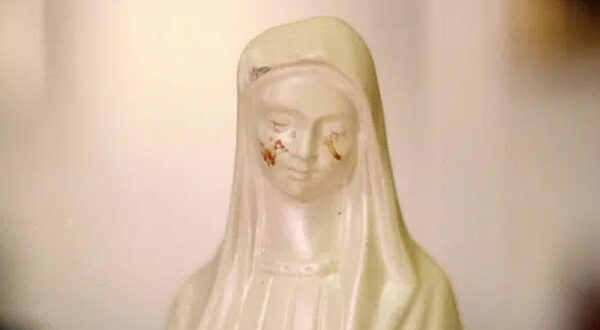
At various moments in history, images of Christ or the Virgin Mary have been associated with a phenomenon that both moves and unsettles: the so-called “tears of blood.” For some, it is a shocking sign. For others, a reason for skepticism. For the Church, it is a matter that requires discernment, prudence, and deep theological reflection.
But beyond the extraordinary phenomenon—which may be authentic, misunderstood, or even fraudulent—there exists a far more important spiritual truth: God suffers because of human sin, and His Heart asks for reparation.
This article does not seek to feed curiosity, but to form the soul. It does not aim to focus on the spectacular, but on what is essential: the theology of redemptive suffering, the mysticism of reparation, and the urgent call of the Magisterium to console the Sacred Heart of Jesus in a wounded world.
1. What Are “Tears of Blood”? History and Discernment
Throughout the centuries, there have been reports of images that seemingly shed tears, some described as “of blood.” Among the most well-known are episodes linked to Marian devotions such as those of Civitavecchia in 1995, or the messages associated with Akita in the 1970s.
The Church, faithful to her mission, never rushes. She investigates, analyzes, rules out natural explanations, and studies the spiritual fruits. Only after a serious process can she issue a prudent judgment. In many cases, the Church does not affirm supernatural origin, but may still allow devotion if nothing contrary to the faith is found.
However, even when a phenomenon is not officially recognized, the spiritual message that usually accompanies such events is strikingly consistent: penance, conversion, reparation.
And here we reach the heart of the matter.
2. Can God “Weep”? Theological Foundations of Divine Sorrow
From a strictly theological point of view, God in His divine nature is impassible: He does not suffer as we do. Yet in the Incarnation, the eternal Son assumed a true human nature.
Jesus Christ wept.
The Gospel tells us so with one of the shortest and most profound verses in all of Scripture:
“Jesus wept.” (Jn 11:35)
Before the tomb of Lazarus, the Lord manifests genuine sorrow. It is not theater. It is not empty symbolism. It is the human Heart of God moved by suffering and unbelief.
Therefore, when we speak of “tears of blood,” we are not inventing a sentimental image. We are contemplating a real mystery: the Heart of Christ wounded by the sins of the world.
3. The Sacred Heart: Love Pierced, Love Rejected
The spirituality of the Sacred Heart found its most well-known mystical expression in the revelations to Saint Margaret Mary Alacoque in the 17th century. In them, Christ shows her His Heart surrounded by thorns and speaks these striking words:
“Behold the Heart which has loved men so much, and which receives from them nothing but ingratitude…”
Here we find the key to understanding tears of blood: they are not spectacle, but supplication. Not threat, but a loving lament.
The Magisterium of the Church has confirmed the centrality of this devotion. Pope Pius XII, in his encyclical Haurietis Aquas (1956), taught that devotion to the Sacred Heart is not a secondary practice, but a profound expression of the mystery of redemptive love.
The pierced Heart of the Lord—from which blood and water flowed (cf. Jn 19:34)—is the visible symbol of invisible love.
4. Reparation: A Forgotten Word in the 21st Century
In our contemporary culture, speaking of “reparation” sounds strange. We live in a society that avoids guilt, relativizes sin, and trivializes offense against God.
But Catholic theology is clear: sin is not merely a psychological mistake; it is a real wound in communion with God.
Saint Paul expresses it this way:
“I complete in my flesh what is lacking in Christ’s afflictions for the sake of His Body, which is the Church.” (Col 1:24)
Christ has fully redeemed the world, yet He invites us to participate in His redemptive work through prayer, sacrifice, and reparation.
Reparation does not mean “adding” something to the Cross, but uniting ourselves to it.
5. Mysticism of Tears: When the Soul Understands God’s Pain
Many saints have experienced a profound compassion for the Heart of Christ.
Saint Faustina Kowalska wrote in her Diary that the greatest suffering of the Lord was not the nails, but indifference.
Saint Pio of Pietrelcina spoke of “consoling the Heart of Jesus” through penance and the Eucharist.
Here a fundamental mystical dimension is revealed: true love desires to console the beloved.
If the world wounds the Heart of Christ through blasphemies, sacrileges, contempt for life, and religious indifference, the faithful soul responds with adoration, purity, and fidelity.
6. Tears of Blood in the Present Context
And today?
We live in times of profound moral confusion: attacks on the family, the banalization of abortion, cultural dechristianization, scandals within the Church herself.
It is not surprising that many faithful interpret certain signs as “tears from heaven.”
But the danger lies in remaining at the emotional level.
The real question is not:
“Is the phenomenon authentic?”
But rather:
“Am I living a life of reparation?”
7. Practical Applications: How Can We Console the Sacred Heart Today?
Here we arrive at what matters most. Theology must be translated into concrete life.
1️⃣ An Intense Sacramental Life
Frequent confession. Holy Communion received in a state of grace. The Eucharist is the supreme act of reparation.
2️⃣ The Holy Hour
A practice requested by the Lord Himself through Saint Margaret Mary: one hour of adoration on Thursdays, in union with Gethsemane.
3️⃣ Offering Daily Sacrifices
Fatigue, inconveniences, humiliations—offered with love.
4️⃣ Reparation for Public Sins
When you hear blasphemies or witness attacks against the faith, respond interiorly:
“Lord, I love You for those who do not love You.”
5️⃣ Consecration to the Sacred Heart
Enthroning His image in the home not as decoration, but as a spiritual center.
8. A Pastoral Perspective: Avoiding Superstition, Embracing Conversion
As pastors and faithful, we must avoid two extremes:
- Apocalyptic sensationalism.
- Cold rationalism that denies any supernatural dimension.
The Church walks the path of prudent discernment.
Tears—whether real or symbolic—remind us of an undeniable truth:
God is not indifferent.
And if the Heart of Christ is wounded, it is not for lack of power, but because of an excess of love.
9. A Final Examination of Conscience
Perhaps the deepest question this topic poses to us is this:
- Am I indifferent to sin?
- Do I pray for those who offend God?
- Do I offer sacrifices for the conversion of the world?
- Do I console the Heart of Jesus, or do I ignore Him?
Tears of blood do not seek to frighten us. They seek to awaken us.
Conclusion: When Wounded Love Calls Us
Christianity is not a religion of extraordinary phenomena, but of crucified Love.
If heaven ever weeps, it does not do so to fascinate, but to save.
The Heart of Christ remains open. Still pierced. Still waiting.
And in the midst of this 21st century marked by spiritual coldness, each one of us can become balm for that Heart.
Because in the end, the greatest “tear of blood” is not the one that flows from an image, but the one that flows from the open side of the Redeemer.
And there, in that Heart, your name is written as well.