
Related Articles


The man who saved the beauty of the faith
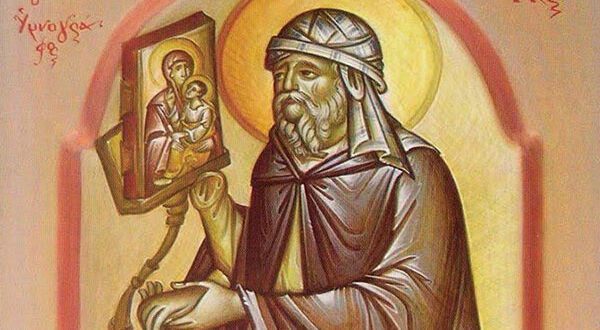
In a time when Christianity seemed to waver amid political tensions, heresies, and internal persecutions, a firm, lucid figure deeply in love with God emerged: San Juan Damasceno.
His name is not as widely known as that of other Church Fathers, but his legacy is immense. He was a theologian, poet, monk… and above all, a tireless defender of a truth that remains fundamental today: God has made Himself visible in Christ, and therefore He can be represented.
In today’s world, where images dominate everything—social media, visual culture, aesthetics—his teaching is not only relevant… it is urgent.
1. A Christian in Muslim lands
Saint John of Damascus was born around the year 675 in Damasco, when the city was already under Muslim rule. His family was Christian and held important administrative positions.
Far from living in a religious bubble, he grew up in an environment where Christianity coexisted with Islam and other currents. This gave him a unique ability to dialogue, discern, and defend the faith with intelligence and depth.
Later, he abandoned his privileged position and withdrew to the monastery of Monasterio de San Sabas, where he lived as a monk. There he wrote much of his work.
👉 This already gives us a first lesson:
holiness does not depend on circumstances… but on fidelity.
2. The great battle: sacred images
Why did they want to destroy them?
In his time, a brutal crisis erupted: iconoclasm, that is, the rejection and destruction of sacred images.
Many argued that venerating images was idolatry, relying on the commandment:
“You shall not make for yourself a graven image…” (cf. Exodus 20:4)
But this is where Saint John of Damascus made a decisive theological turn.
His answer: the Incarnation changes everything
Saint John of Damascus argued something revolutionary and deeply Christological:
👉 Before, God was invisible. Now, in Christ, He has made Himself visible.
Therefore:
- Before, images of God could not be made
- But after the Incarnation… they can
Because:
“The Word became flesh and dwelt among us” (Evangelio de San Juan 1:14)
And if God has assumed a human face in Jesucristo, then representing His image is not idolatry… it is an affirmation of faith in the Incarnation.
Key distinction: adoration vs. veneration
Here lies one of his most important contributions:
- Adoration (latria) → due to God alone
- Veneration (dulia) → given to saints and images
We do not adore wood or paint…
👉 we venerate what they represent
This remains crucial today, when many—even within Christianity—confuse these concepts.
3. The theologian of synthesis: clear faith for confusing times
His most important work
Saint John of Damascus wrote a monumental work: The Fount of Knowledge, whose core is De fide orthodoxa.
In it, he accomplished something extraordinary:
👉 he systematically organized all prior Christian theology
We could say he produced one of the first “complete catechisms” in history.
His key teachings
1. God is mystery… but not absurd
God cannot be fully comprehended, but He can be truly known.
2. Christ is true God and true man
He clearly defends the doctrine of the Incarnation against the errors of his time.
3. Tradition matters
Not only Scripture, but also the living teaching of the Church.
👉 This directly connects with today’s debates about authority in the faith.
4. A surprisingly modern saint
He may seem like a distant theologian… but he is not.
In the age of digital imagery
We live surrounded by images. But:
- many are empty
- others distort reality
- some even degrade human dignity
Saint John of Damascus reminds us:
👉 images can be a path to God… or to idolatry
It depends on how we use them.
In the crisis of Christian identity
Today many Christians:
- doubt doctrine
- reduce faith to emotions
- lose the sense of the sacred
Saint John of Damascus responds with clarity:
👉 faith must be understood, loved, and defended
In liturgy and beauty
He defended icons… but ultimately he was defending something deeper:
👉 beauty as a path to God
This directly challenges our churches, our celebrations, and our spiritual life.
5. Practical applications for your life
1. Rediscover the value of sacred images
They are not decoration. They are windows to heaven.
2. Be careful what you look at
If images influence the soul…
👉 what are you allowing into your heart?
3. Be formed in the faith
Saint John of Damascus was not superficial.
👉 to love God implies knowing Him
4. Defend the truth with charity
Not with aggression, but not with silence either.
5. Seek beauty that elevates
In art, in liturgy, in prayer.
6. A deep spirituality: contemplating the visible God
Saint John of Damascus invites us to something very concrete:
👉 to contemplate Christ
Not as an abstract idea…
but as a real, visible, incarnate Person.
And this changes everything:
- prayer
- liturgy
- our relationship with God
Conclusion: the saint who taught us to see
Saint John of Damascus did not merely defend images…
👉 he taught us how to look
To look at Christ.
To look with faith.
To discover that God is not a distant idea, but a close and visible face.
In a world saturated with superficial images, his message resounds powerfully:
Not everything visible is true… but the truly divine has made itself visible.
And you…
what are you contemplating each day?