Related Articles
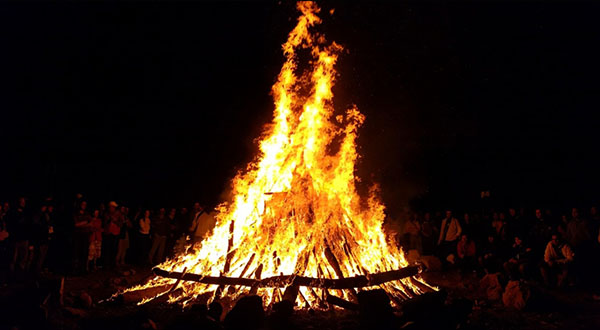
Every year, when the night of June 23rd to 24th arrives, fire once again takes over squares, beaches, and fields. Bonfires, ritual jumps, wishes written on paper, words like energy, solstice, rebirth, magic. Many believe they are celebrating something ancient, pre-Christian, almost “appropriated” by the Church. However, the historical, theological, and spiritual reality is just the opposite: the Night of Saint John has a deeply Christian and biblical origin, and it is modern neopaganism that has tried to empty it of its true meaning.
This article aims to do three things: to debunk the myth, to recover the Catholic truth, and to offer a current spiritual guide to live this feast for what it truly is: a celebration of Saint John the Baptist, the last of the prophets and the one who prepared the way of the Lord.
1. Saint John the Baptist: the only saint whose birth the Church celebrates
There is a fact that many people do not know and that should already make us suspicious of neopagan narratives:
👉 the Church liturgically celebrates the birth of only three persons: Jesus Christ, the Virgin Mary… and Saint John the Baptist.
Why? Because John is not just another saint. He is the bridge between the Old and the New Testament, the voice crying out in the desert, the friend of the Bridegroom.
The Gospel of Saint Luke narrates his birth in detail, full of signs, prophecy, and joy:
“When Elizabeth heard Mary’s greeting, the child leaped in her womb” (Lk 1:41).
And later:
“Now the time came for Elizabeth to give birth, and she bore a son. Her neighbors and relatives heard that the Lord had shown great mercy to her, and they rejoiced with her” (Lk 1:57–58).
From the very beginning, John’s life is associated with joy, light, and preparation for the encounter with Christ.
2. Why June 24th? The key is in the Gospel
Here lies one of the most beautiful—and most forgotten—arguments of Christian tradition.
The birth of Saint John is celebrated six months before the birth of Jesus, exactly as the Gospel tells us:
“In the sixth month the angel Gabriel was sent from God to a town of Galilee called Nazareth…” (Lk 1:26).
But there is something even deeper:
📉 From June 24th onward, the days begin to shorten.
📈 From December 25th onward, the days begin to lengthen.
Coincidence? Not at all.
Saint John explains it with a phrase that sums up his entire spirituality:
“He must increase, but I must decrease” (Jn 3:30).
The physical light of the sun begins to diminish after John’s birth, because he is not the Light, but the one who bears witness to the Light. And light begins to grow again after the birth of Christ, the Sun rising from on high (cf. Lk 1:78).
This is not paganism: it is theology embodied in the cosmos.
3. The fire of Saint John: a Christian symbol, not ancestral magic
Fire has always been a biblical symbol. From the burning bush to Pentecost, God often manifests Himself through fire:
- Fire that purifies
- Fire that enlightens
- Fire that protects
- Fire that consumes what is not of God
Saint John the Baptist clearly announces this symbolism:
“I baptize you with water, but one who is more powerful than I is coming… He will baptize you with the Holy Spirit and fire” (Lk 3:16).
The bonfires of Saint John arise from this Christian understanding:
🔥 fire as preparation, not as idolatry.
🔥 fire that announces Christ, not that replaces Him.
Bonfires were not lit to “honor the sun,” but to remember that John came to prepare hearts, to burn away sin, to call people to conversion.
4. The myth of the “solstice stolen by the Church”
One of the great modern narratives says: “the Church Christianized a pagan solstice festival.” This claim has several serious problems:
- There is no solid historical evidence of a universal pagan festival on June 24th with bonfires like those we see today.
- Many so-called “ancestral” practices are romantic recreations from the 19th or 20th century.
- The early Church did not have enough cultural power to “impose” feasts; what it did was give Christian meaning to the real life of peoples, not erase it.
What happened was the opposite:
👉 Christianity gave deep meaning to natural symbols, integrating them into the history of salvation.
Modern neopaganism, on the other hand, does the reverse: it removes Christ from the symbols and leaves them without a transcendent horizon.
5. Saint John the Baptist: an urgently relevant message
In an age that flees from silence, repentance, and truth, Saint John the Baptist is uncomfortable… and therefore necessary.
His message was not “positive energy,” but conversion.
It was not “connecting with the universe,” but preparing the heart for God.
It was not self-affirmation, but radical humility.
“Repent, for the kingdom of heaven is at hand” (Mt 3:2).
Celebrating Saint John today means asking ourselves once again:
- What do I need to burn away in my life?
- What attitudes distance me from God?
- Am I preparing the way for the Lord, or putting myself at the center?
6. How to live the Night of Saint John today as a Christian
Far from rejecting the feast, the Christian is called to rescue it.
Some simple yet profound proposals:
- 🔥 Light a candle or a small bonfire with a prayer—not as a magical rite, but as a symbol of purification.
- 📖 Read the Gospel passages about Saint John the Baptist (Luke 1 or John 3).
- ✍️ Write down what you need to leave behind and offer it to God in prayer.
- 🙏 Give thanks for life, faith, and the call to conversion.
- 👨👩👧 Live it as a family, explaining to children who Saint John was and why he is so important.
This is not about “Christianizing” what is pagan, but about reconnecting with what was always Christian.
7. Conclusion: returning the fire to its true light
Saint John is not an excuse for a night of excesses nor an empty ritual.
He is a prophetic cry that still resounds today.
“Prepare the way of the Lord, make his paths straight” (Mt 3:3).
The bonfires are not magic.
Fire is not a god.
The night is not an energetic portal.
Everything points to Christ.
And perhaps, amid the noise, the smoke, and the false lights of our time, Saint John the Baptist is still pointing with his finger and repeating, as he did then:
“Behold, the Lamb of God” (Jn 1:29).
May this feast, far from being stolen, be recovered.
May the fire once again illuminate, not confuse.
And may we, like John, learn to decrease… so that Christ may increase. 🔥✝️