Related Articles

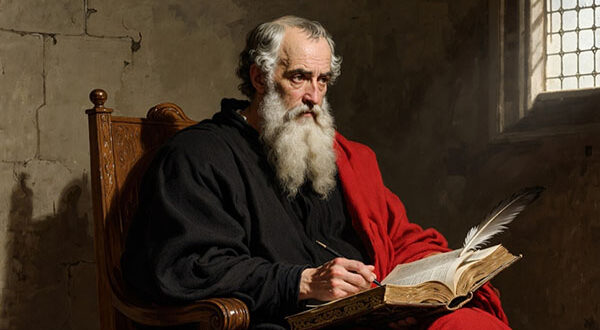
In an age of noise, quick opinions, and superficial spirituality, the figure of Saint Jerome stands as a demanding and radiant beacon. He was not a comfortable saint. He was a man of strong character, prodigious intelligence, and an almost burning passion for truth. His life was not easy… and precisely for that reason, it remains profoundly relevant today.
If you are seeking clarity, depth, and a faith rooted in truth, you need to know Saint Jerome.
1. A Restless Man in Search of Truth
Saint Jerome was born around the year 347 in Stridon, a city on the border of the Roman Empire. From a young age, he showed extraordinary intellectual ability. He was sent to Rome, where he received an outstanding classical education in rhetoric, philosophy, and literature.
But his youth was far from exemplary. He himself confesses in his writings to inner struggles, temptations, and a life that oscillated between the search for God and the pleasures of the world.
And here we find the first great lesson:
holiness is not born from initial perfection, but from radical conversion.
At a decisive moment, Jerome hears an inner call that would mark his entire life. In a vision, he is reproached for being “more Ciceronian than Christian.” This spiritual blow transforms him deeply.
He decides to leave everything behind.
2. The Desert: Where the Word Purifies the Soul
Jerome withdraws into the Syrian desert. There he begins a life of penance, prayer, and study of Sacred Scripture. He learns Hebrew—something extremely rare in his time—in order to access the original texts directly.
This was not a romantic retreat. He himself recounts his struggles:
“In the midst of the desert, my heart burned with memories of Rome.”
Here we find a profoundly relevant lesson for today:
it is not enough to change your surroundings; the heart must be transformed.
Jerome’s desert is also ours: distractions, passions, disordered thoughts… but also the place where God speaks.
As Scripture says:
“Your word is a lamp to my feet and a light to my path” (Psalm 119:105).
3. The Great Mission: Translating the Bible (the Vulgate)
The work for which Saint Jerome would go down in history is his translation of the Bible into Latin: the Vulgate.
In his time, there were multiple deficient or contradictory translations. The Church needed a reliable and unified version.
Pope Damasus I entrusted this monumental task to Jerome.
And he did not simply translate.
He returned to the sources.
He compared manuscripts.
He learned the original languages.
He corrected errors accumulated over centuries.
It was a work of precision, rigor, and absolute fidelity to the Word of God.
For more than a thousand years, the Vulgate would be the official Bible of the Church.
4. A Difficult Character… and Deeply Holy
Saint Jerome was not a “gentle” saint. He was polemical, ironic, and at times harsh in his words. He entered into multiple theological controversies, especially against the heresies of his time.
He firmly defended doctrine against errors such as those of Pelagius, who denied the necessity of divine grace.
He also had personal conflicts with other Christian intellectuals, which earned him both admirers and critics.
But here lies a fundamental key:
holiness does not eliminate temperament; it orders it toward truth.
Jerome did not fight out of ego. He fought for revealed truth.
In a world where charity is often confused with relativism, his figure reminds us that:
👉 to love the truth also requires firmness.
5. Living Theology: A Radical Love for Scripture
Saint Jerome left us a phrase that echoes through the centuries:
“Ignorance of the Scriptures is ignorance of Christ.”
This statement is not rhetorical. It is deeply theological.
For Jerome, the Bible is not just another book. It is the living voice of God.
His approach has direct implications for our lives today:
- It is not enough to have a Bible at home.
- It is not enough to hear it superficially at Mass.
- It is necessary to study it, meditate on it, and live it.
In a context where many Christians live a superficial faith, Jerome challenges us:
👉 Do you truly know the Word of God… or do you only have a vague idea of it?
6. Bethlehem: Where Everything Comes Together
Jerome eventually settles in Bethlehem, near the place where Christ was born. There he founds a monastery and dedicates himself to his intellectual and spiritual work until his death in the year 420.
This is no coincidence.
The translator of the Word ends his life in the place where the Word became flesh.
Here a profound truth is revealed:
Scripture is not an end in itself, but a path toward Christ.
7. Controversies and Tensions: Fidelity Has a Cost
Saint Jerome was not understood by everyone. His work of translation generated criticism. Some considered it dangerous to modify traditional texts.
He was also criticized for his rigor, his direct style, and his firm positions.
But history has been clear:
👉 without his work, the faithful transmission of the Bible would have been far more fragile.
This leaves us with a very concrete pastoral lesson:
- Defending the truth may generate rejection.
- Fidelity to God will not always be applauded.
- Mission requires courage.
8. Practical Applications for Today
The life of Saint Jerome is not just history. It is a guide.
1. Love truth above comfort
Do not settle for a superficial or self-made faith.
2. Study the Bible seriously
Dedicate real time to knowing it—not just isolated phrases.
3. Care for your interior life
Jerome’s desert reminds us that conversion is ongoing.
4. Defend your faith with charity… but with firmness
Not everything is valid. Truth matters.
5. Accept your struggles
Holiness is not the absence of battle, but fidelity in the midst of it.
9. Saint Jerome and the 21st-Century Christian
Today we live in a culture that relativizes truth, simplifies faith, and avoids intellectual effort.
Saint Jerome is uncomfortable… but necessary.
He reminds us that:
- Faith requires intelligence.
- Truth requires effort.
- Holiness requires conversion.
And above all, that God speaks… but we must learn to listen.
Conclusion: The Fire That Never Dies
Saint Jerome was not an easy saint.
He was a true saint.
A man who loved the Word to the extreme.
Who struggled against himself.
Who defended the truth without fear.
And who still cries out to us today, from the silence of the centuries:
👉 “Return to Scripture. Return to Christ.”
Because in a world full of noise…
only the Word of God has the power to transform the human heart.