Related Articles


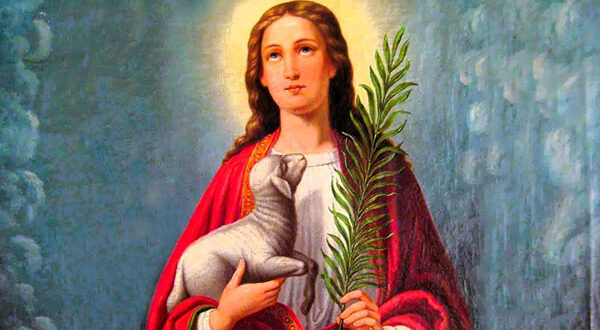
In the history of Christianity, there are figures who appear as spiritual giants: apostles, bishops, great theologians, or missionaries. Yet from time to time, God writes pages of astonishing beauty using instruments that seem fragile and insignificant. One of those pages is the life of Saint Agnes of Rome, a teenage girl who, at barely thirteen years old, challenged one of the most powerful empires in human history.
In a world dominated by force, politics, and violence, this young Roman girl prevailed with a weapon that the world often despises: fidelity to Christ.
Her story is not merely an ancient narrative. It is a powerful call for our own time.
The Context: Being Christian in the Roman Empire
To understand the greatness of Saint Agnes, we must place ourselves in the historical context.
During the third century and the beginning of the fourth, the Roman Empire was experiencing a deep political and religious crisis. Emperors sought to strengthen the unity of the empire through the worship of traditional gods and of the emperor himself.
But Christians refused to participate in these cults.
Not out of political rebellion, but out of fidelity to God.
The Christian faith proclaimed something revolutionary:
- There is only one true God.
- Only He deserves worship.
- No human power can take the place of God.
This fidelity cost the lives of thousands of believers during persecutions such as those carried out under the emperor Diocletian.
It is in this hostile environment that the figure of Saint Agnes emerges.
A Roman Teenager
Saint Agnes was born in Rome around the year 291 A.D., into a wealthy Christian family.
Her name, Agnes in Latin, means “pure” or “chaste.” Interestingly, it is also associated with the Latin word agnus, meaning lamb. It is no coincidence that Christian iconography often depicts her holding a lamb.
From a very young age, she decided to consecrate her virginity to Christ.
Today it may be difficult to understand how radical that decision was.
In Roman society:
- marriage was considered a social duty,
- families sought political or economic alliances,
- and women had very little autonomy.
Yet Agnes chose something completely different: to belong entirely to Christ.
The Conflict: When Faith Becomes a Challenge
Tradition recounts that several young men from influential families fell in love with her beauty and wished to marry her.
But Agnes always gave the same answer:
“I already have a spouse far more noble.”
That spouse was Christ.
One of the rejected suitors, humiliated by her refusal, reported her to the authorities as a Christian.
At that time, such an accusation was extremely serious.
The judge gave her two options:
- Renounce Christ and offer sacrifices to the Roman gods.
- Or face punishment.
The young girl’s response was firm.
She preferred death to betraying her Lord.
Public Humiliation
Her persecutors believed that a teenage girl would break if her honor were destroyed.
According to tradition, they attempted to force her into a brothel in order to publicly humiliate her.
But ancient accounts say that no one dared touch her. Many were seized by a kind of reverential fear.
Eventually she was condemned to death.
She was martyred around the year 304 A.D., most likely during the persecution under Diocletian.
She was barely thirteen years old.
The Strength of the Martyrs
For Christianity, martyrdom is not an absurd tragedy.
It is a supreme testimony of love.
The word martyr literally means witness.
Saint Agnes showed through her life that Christ was worth more than life itself.
Here one of the most radical sayings of the Gospel is fulfilled:
“Do not be afraid of those who kill the body but cannot kill the soul.”
— Matthew 10:28
Martyrs did not seek death.
But when earthly power demanded that they renounce Christ, they responded with a freedom that deeply unsettled the Empire.
How a Teenager Disarmed the Empire
The question naturally arises.
How could a young girl without political power, without an army, and without influence challenge the Roman Empire?
The answer lies in a completely different logic from that of the world.
The Empire functioned on three pillars:
- military force
- political authority
- religious control
The martyrs undermined these pillars… without violence.
They demonstrated that imperial power could not dominate the human conscience.
A Christian could obey the emperor in everything that was just, but never in anything that contradicted God.
This testimony was devastating to the logic of absolute power.
Centuries later, Christianity would profoundly transform the Roman world.
The Theology of Consecrated Virginity
One of the deepest aspects of Saint Agnes’s witness is her consecrated virginity.
In Christian theology, virginity for the sake of the Kingdom of God carries profound meaning.
It is not a rejection of marriage.
Rather, it is a prophetic sign.
It proclaims that the definitive love of the human person is not found in this world, but in God.
Saint Paul explains it this way:
“The unmarried woman is concerned with the things of the Lord, how she may please the Lord.”
— 1 Corinthians 7:32
The virginity of Saint Agnes proclaimed that Christ is the true Bridegroom of the soul.
The Silent Revolution of Christianity
The martyrdom of Saint Agnes was not an isolated event.
Thousands of young people, women, and men died for the same faith.
Yet their sacrifice had an unexpected impact.
Pagans witnessed something they could not explain:
- children who were not afraid of death,
- women who rejected advantageous marriages for Christ,
- slaves who spoke with the dignity of free men.
Their blood became a seed.
As Tertullian famously said:
“The blood of the martyrs is the seed of Christians.”
The Veneration of Saint Agnes
Very soon her tomb in Rome became a place of pilgrimage.
Later, a church was built over that site: the
Basilica of Saint Agnes Outside the Walls.
Each year, on her liturgical feast day (January 21), two lambs are blessed. Their wool is used to weave the pallium, a liturgical vestment that the Pope grants to archbishops.
It is a beautiful symbolic gesture.
The lamb represents the purity and self-offering of Saint Agnes.
Saint Agnes and Today’s Youth
Her story might seem to belong to a distant world.
Yet in reality it is surprisingly relevant.
Today there is also strong cultural pressure to abandon the faith.
Not always through bloody persecution, but through:
- social ridicule
- moral relativism
- ideological pressure
- cultural cancellation
Many young Christians feel that they must hide their faith to avoid being singled out.
Saint Agnes reminds us of something fundamental:
faith does not need a majority to be true.
Three Spiritual Lessons from Saint Agnes
1. True freedom is found in Christ
The Empire had power over her life, but not over her conscience.
That is true Christian freedom.
The freedom to say:
“I would rather lose everything than lose Christ.”
2. Purity is a revolutionary force
We live in a hypersexualized culture where purity often seems ridiculous.
Yet Christianity has always seen chastity as a profound form of interior freedom.
Saint Agnes shows that purity is not weakness.
It is a form of self-mastery for the love of God.
3. Young people are also called to holiness
Sometimes we think holiness is reserved for adults, priests, or religious.
Saint Agnes was thirteen years old.
That means no one is too young to love God radically.
Practical Applications for Daily Life
The story of Saint Agnes can inspire us in very concrete ways.
Defending the faith with serenity
We may not always face violent persecution, but we will experience moments of social pressure.
To be a Christian today means:
- speaking with respect,
- not hiding our faith,
- living coherently.
Guarding the heart
Saint Agnes protected her relationship with Christ as her greatest treasure.
This invites us to ask ourselves:
- How is my prayer life?
- Do I truly dedicate time to God?
Living purity in today’s world
Purity is not repression.
It is ordering love.
It means learning to love with respect, generosity, and responsibility.
A Saint for Difficult Times
Saint Agnes demonstrates something the world often forgets:
true strength is not always visible.
An empire with armies, laws, and power could not overcome the fidelity of a teenage girl.
That is the mystery of Christianity.
God acts through what is small.
As Saint Paul says:
“God chose what is weak in the world to shame the strong.”
— 1 Corinthians 1:27
Conclusion: The Power of Radical Faith
More than seventeen centuries later, the Roman Empire has disappeared.
But the name of Saint Agnes continues to be remembered throughout the world.
Her life reminds us of a fundamental truth:
fidelity to Christ always transforms history.
Power, fame, or influence are not required.
Sometimes all it takes is the courageous heart of a young girl who decides to love God above all things.
And that seemingly small decision can change the world.