Related Articles

In an age of short videos, simplified phrases, and “easy” explanations about God, it is not surprising that ancient theological confusions resurface. One of them—apparently harmless, even well-intentioned—is modalism.
It may sound technical. It may seem like something from the past. But it is not.
Modalism is not merely a third-century heresy. It is a permanent temptation: the temptation to simplify the mystery of God until it becomes manageable. And when we simplify the mystery of the Holy Trinity, we do not merely make an intellectual mistake—we distort the very heart of Christianity.
Today we will dismantle this heresy with theological rigor, pastoral clarity, and concrete application to your daily life.
Because understanding who God is… changes everything.
1️⃣ What Is Modalism?
Modalism teaches that God is one single Person who manifests Himself in different ways or “modes”: sometimes as Father, sometimes as Son, and sometimes as Holy Spirit.
According to this position:
- There are not three real Persons.
- There is one divine subject who adopts different “roles” or “masks” throughout history.
In other words, the Father, the Son, and the Holy Spirit would not exist simultaneously as distinct Persons, but would instead be different manifestations of the same divine individual.
It may sound logical. It even appears to defend the unity of God.
But it is profoundly incompatible with the Catholic faith.
2️⃣ Historical Origins: From Sabellius to Our Time
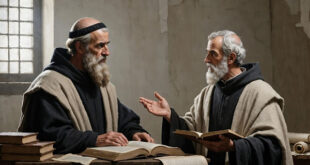
The principal promoter of modalism was Sabelio, a third-century theologian. For this reason, the heresy is also known as Sabellianism.
In his attempt to defend monotheism against interpretations that seemed to divide God into three gods, he ended up denying the real distinction between the divine Persons.
The Church responded with clarity. Fathers such as Tertuliano and Hipólito de Roma fought this doctrine, defending that:
- God is one in essence.
- But three in Persons.
Later, the Concilio de Nicea (A.D. 325) and the Concilio de Constantinopla (A.D. 381) solemnly defined Trinitarian faith against various heresies.
The Catholic formula became clear:
One God in three truly distinct, consubstantial, and eternal Persons.
3️⃣ Why Is Modalism a Heresy?
Because it destroys the central mystery of Christianity: the Trinity.
The Catholic faith affirms that:
- The Father is God.
- The Son is God.
- The Holy Spirit is God.
- They are not three gods.
- They are not one Person wearing three disguises.
- They are three distinct Persons who share one single divine nature.
If modalism were true, the Gospels would be incoherent.
📖 The Baptism of Christ
At the baptism of Jesus we see:
- The Son in the Jordan.
- The Spirit descending like a dove.
- The voice of the Father from heaven.
“This is my beloved Son, with whom I am well pleased” (Matthew 3:17).
There is no successive “mode” here. There is real simultaneity.
If God were one Person changing masks, this scene would be a divine theater. But God does not play roles: God is eternal communion.
4️⃣ The Deeper Theological Problem
Modalism eliminates something essential: the eternal relationship within God.
In Catholic theology:
- The Father eternally begets the Son.
- The Son is eternally begotten.
- The Holy Spirit proceeds from the Father and the Son as subsisting Love.
God is not solitude.
God is communion.
God is relationship.
As Saint John writes:
“God is love” (1 John 4:8).
But love requires otherness. If there is no real distinction of Persons, there is no eternal love within God. And then God would have needed to create the world in order to love.
That would be theologically unacceptable.
5️⃣ Why Does Modalism Reappear Today?
Because we live in a culture that:
- Rejects mystery.
- Seeks simplified explanations.
- Prefers easy metaphors.
Many Christians today explain the Trinity like this:
- “God is like water: ice, vapor, and liquid.”
- “God is like a man who is father, son, and husband.”
These analogies, though well-intentioned, tend toward modalism.
Because in those examples there is one single person or substance that adopts different states—not three real subjects in eternal relationship.
The Trinity is not a logical puzzle to solve.
It is a revealed mystery.
6️⃣ Spiritual Consequences of Modalism
This is not merely an academic debate.
If God is one single Person acting in different modes:
- Prayer loses depth.
- Liturgy loses meaning.
- The Incarnation is trivialized.
In the Catholic faith, when you pray to the Father through Christ in the Holy Spirit, you are entering into the intimate life of the Trinity.
It is not a formality.
It is real participation.
The Mass is not a symbolic representation of a God changing roles.
It is the actualization of the sacrifice of the Son offered to the Father in the Spirit.
If we deny the personal distinction, we break the entire architecture of sacramental life.
7️⃣ Dogmatic Development: Theological Precision
From the standpoint of classical theology:
- In God there is one ousia (essence).
- Three hypostases (Persons).
- Real distinction by relations of origin.
- No division of substance.
The Father is not the Son.
The Son is not the Spirit.
The Spirit is not the Father.
But none is more God than another.
None is prior.
None is inferior.
This precision was magnificently developed by figures such as San Agustín de Hipona, especially in his work De Trinitate.
8️⃣ Practical Application: What Changes in Your Life?
Everything.
🔹 1. Your Way of Loving
If God is Trinity, ultimate reality is communion.
Therefore:
- Individualism is a lie.
- Love is ontologically superior to selfishness.
- The family reflects the Trinitarian mystery.
🔹 2. Your Way of Praying
You do not pray to an impersonal force.
You pray to a Father.
Through the Son.
In the Spirit.
Every authentic Christian prayer is Trinitarian.
🔹 3. Your Identity
You were baptized “in the name of the Father, and of the Son, and of the Holy Spirit.”
Not in the “names.”
In the name—singular—of one Triune God.
Your life is marked by the Trinity.
Your soul is a dwelling place of the Most Holy Trinity.
9️⃣ How to Safeguard Your Faith Today
- Avoid simplistic explanations of the Trinity.
- Study the Creed.
- Pray the Gloria with theological awareness.
- Meditate on the Gospels, observing the relationships between Father, Son, and Spirit.
- Live communion in your family and community.
Orthodoxy is not rigidity.
It is fidelity to the real God.
🔟 Conclusion: Do Not Reduce God
Modalism is born from the desire to simplify.
But mystery is not simplified.
It is adored.
The Trinity is not a logical problem to solve.
It is the heart of Christianity.
If God were one Person with different modes, the Gospel would be a metaphor.
But if God is Father, Son, and Holy Spirit in eternal communion, then:
- Love is eternal.
- Relationship is divine.
- And your vocation is to enter into that communion.
The heresy of modalism is not merely an error of the past.
It is a permanent temptation to domesticate God.
Do not do it.
Adore.
Contemplate.
Go deeper.
Because in the mystery of the Holy Trinity there is no confusion…
there is communion.
And there lies your eternal destiny.