
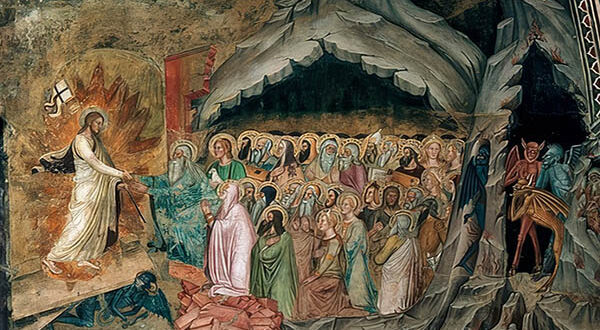
Related Articles


In the vast ocean of Catholic theology, there are concepts that, while not part of the central dogma, have sparked intense debates and reflections over the centuries. One such topic is limbo, an idea that has aroused curiosity, controversy, and at times, confusion among the faithful. What exactly is limbo? Is it a doctrine abandoned by the Church, or does it remain a relevant theological mystery? In this article, we will explore the origin, history, and current status of limbo, aiming to educate, inspire, and offer clear and profound spiritual guidance.
The Origin of Limbo: Between Theology and Speculation
The term limbo comes from the Latin limbus, meaning “edge” or “border.” In Catholic theology, limbo refers to an intermediate state between heaven and hell, where souls who have not committed grave personal sins but have not received baptism reside in a state of natural happiness, though without the beatific vision of God.
The idea of limbo emerged in the Middle Ages as a theological solution to a complex problem: What happens to children who die without being baptized? According to traditional teaching, baptism is necessary for salvation, as Jesus affirms in the Gospel of John: “Unless one is born of water and the Spirit, he cannot enter the kingdom of God” (John 3:5). However, the Church has always believed in God’s infinite mercy, which led theologians to seek an answer that balanced divine justice with compassion.
Saint Augustine, one of the Church Fathers, was among the first to address this issue. Although he did not use the term “limbo,” he suggested that unbaptized children could not enter heaven but also did not suffer the eternal punishment of hell. This idea was later developed by theologians such as Saint Thomas Aquinas, who described limbo as a place of natural happiness, though without the fullness of the vision of God.
The History of Limbo: From Acceptance to Revision
For centuries, limbo was widely accepted in Catholic theology as a plausible, though non-dogmatic, explanation for the fate of unbaptized children. However, it was never defined as a dogma of faith, which allowed the Church to maintain some flexibility in its teaching.
In the 20th century, the Second Vatican Council (1962-1965) marked a turning point in theological reflection on limbo. The council fathers emphasized God’s universal mercy and the hope of salvation for all, leading many theologians to question the need for limbo. In 2007, the International Theological Commission published a document titled “The Hope of Salvation for Infants Who Die Without Being Baptized,” which stated that the Church hopes these children may be saved by God’s mercy, though the idea of limbo was not entirely dismissed.
This document did not officially abolish limbo but relegated it to the background, emphasizing that salvation is a mystery known fully only to God. As Pope Benedict XVI said: “Limbo was never a defined truth of faith but a theological hypothesis. What matters is to trust in God’s mercy, which is greater than our human categories.”
The Current Status of Limbo: A Mystery That Invites Hope
Today, limbo no longer occupies a central place in the Church’s teaching, but it remains a topic of theological and spiritual interest. The Church prefers to focus on God’s mercy and the hope that all, especially the smallest and most innocent, may participate in salvation.
The Catechism of the Catholic Church, published in 1992, addresses this issue with delicacy and depth. In paragraph 1261, it states: “As regards children who have died without Baptism, the Church can only entrust them to the mercy of God, as she does in her funeral rites for them. Indeed, the great mercy of God, who desires that all men should be saved, and Jesus’ tenderness toward children, which caused him to say: ‘Let the children come to me, do not hinder them’ (Mark 10:14), allow us to hope that there is a way of salvation for children who have died without Baptism.”
This approach reflects a more mature and compassionate understanding of the mystery of salvation, which is not limited to human categories but opens to God’s infinite goodness.
Limbo in the Current Context: An Invitation to Trust in God
In a world where the suffering and death of the innocent remain painful realities, limbo raises profound questions about God’s justice and mercy. Although the Church no longer insists on this idea, limbo remains a reminder that there are mysteries that transcend our understanding and that we must trust in God’s love and wisdom.
Limbo also invites us to reflect on the importance of baptism, not as a mere rite, but as a sacrament that incorporates us into the life of Christ and opens the doors of heaven. As Saint Paul said: “For all of you who were baptized into Christ have clothed yourselves with Christ” (Galatians 3:27).
Conclusion: A Call to Hope and Faith
Limbo, though no longer a central doctrine in the Church’s teaching, remains a fascinating topic that invites us to delve deeper into the mystery of salvation. It reminds us that God is just but also infinitely merciful and that His plan of salvation is broader and deeper than we can imagine.
Rather than worrying about human categories like limbo, we should trust in God’s goodness and His desire for all to be saved. As Jesus said: “In my Father’s house there are many dwelling places” (John 14:2). These words fill us with hope and encourage us to live our faith with confidence and joy, knowing that God has a place for each of us in His Kingdom.
May Mary, Mother of Mercy, guide us on this path of faith and hope, so that, as beloved children of God, we may live in the certainty of His love and salvation. Amen.


1. “Original Sin” Lacks a Clear Biblical Foundation
Catholicism often uses Genesis 2–3 as the starting point for the doctrine of Original Sin. However, the narrative itself contains internal tensions that make it difficult to support a core doctrine concerning the salvation of all humanity.
The Logical Contradiction Between the Tree of Life and the Tree of Knowledge
Genesis 2:17 and 3:22 suggest a paradox: if the fruit of the Tree of Knowledge causes one to “surely die,” while the fruit of the Tree of Life allows one to “live forever,” the simultaneous existence of these two trees creates a “self-contradictory” dilemma. It is like the fable of the “spear that pierces anything” and the “shield that resists everything.” Even if the first parents did not eat from both trees simultaneously, this inherent contradiction exists within the system and cannot be resolved simply by saying “they didn’t do it.”
Does the Serpent’s Prophecy Outperform God’s?
The serpent said: “You will not certainly die… your eyes will be opened, and you will be like God, knowing good and evil” (Gen 3:4–5). Every part of this came true. Meanwhile, God’s warning that they would “surely die [that day]” was not realized in a literal sense.
Note: While traditional interpretations claim a “spiritual death” occurred, the text does not explicitly state this; in fact, Adam and Eve were still able to converse with God (Gen 3:8–10). This narrative tension suggests that Genesis 3 is better understood as symbolic myth rather than literal history or legal dogma.
Just as no one believes the Milky Way was literally created by a goddess’s hairpin (as in the Chinese myth of the Cowherd and the Weaver Girl), the story of the forbidden fruit is a myth. It is filled with contradictions. To preach this story as absolute truth or a core doctrine—and to require all believers to accept it—is logically inconsistent.
Argument: Man Was Destined to Die Before Eating the Fruit
A: The Tree of Life
B: The Tree of Knowledge of Good and Evil
Premises (Logic and Text)
Logical Axiom (Law of Excluded Middle): Before eating A or B, man’s ultimate state must be one of two things: either naturally immortal or naturally mortal.
Textual Rules:
Eating A → Living forever (Gen 3:22).
Eating B → Surely dying (Gen 2:17).
Man ultimately died (Gen 5:5).
After man ate B, God prevented him from eating A, because “he might reach out his hand and take from the tree of life and eat, and live forever” (Gen 3:22–24).
The Deduction
Scenario 1: If man was naturally immortal before eating A or B.
This state is equivalent to having “already eaten A.”
However, God later worried that man might “eat A and live forever” and took action to prevent it.
If man were already immortal, eating A would add nothing. God’s concern and the act of guarding the tree would be entirely unnecessary.
Contradiction: This contradicts the text, where God treats the efficacy of A with great seriousness. Therefore, this scenario is invalid.
Scenario 2: If man was naturally mortal before eating A or B.
This state is equivalent to having “already eaten B.”
But man had not yet actually eaten B at that point.
According to Genesis 5:5, man eventually died, which matches this “naturally mortal” state.
Therefore, death was predestined before eating B.
The act of eating B was not the cause of death, but merely a formality. God attributed death to eating B, even though the outcome was already certain.
Result: B is redundant; eating B was not a necessary cause for death.
Conclusion
Both possibilities lead to a contradiction:
If naturally immortal → A is a useless prop; God’s intervention is meaningless.
If naturally mortal → B is a useless prop; eating it was unnecessary for the outcome.
However, the text shows:
God treats A seriously (preventing access).
God attributes death to B (judgment for eating).
Since man eventually died and never ate A, the only hypothesis consistent with the result is: Man was already destined to die before eating A or B. Thus, eating B was not the “cause,” but merely the occasion for God to execute a predetermined end. Human choice does not change fate; it only moves along a set track.
Final Proposition
The state of life or death was determined before man ever touched A or B. Because man ultimately died, that state was “mortal.” This is equivalent to man having “already eaten B” from the start. Therefore, the actual act of eating B is redundant, and the concept of “free choice” in this context is an illusion.
Validation: This inference is based entirely on formal logic (excluded middle, equivalent substitution) and the textual facts of Genesis (man died, did not eat A, and God blocked A).
2. Jesus’ Teachings Contradict the Logic of Original Sin
The doctrine of Original Sin leads to the conclusion that “everyone is born separated from God and requires a sacrament for forgiveness.” However, Jesus’ attitude toward children was entirely different.
Jesus Held Children as the Model for the Kingdom of Heaven
Jesus repeatedly emphasized:
“Let the little children come to me, and do not hinder them, for the kingdom of God belongs to such as these.” (Mark 10:14; Luke 18:16)
“Truly I tell you, anyone who will not receive the kingdom of God like a little child will never enter it.” (Mark 10:15; Luke 18:17)
“Father… you have hidden these things from the wise and learned, and revealed them to little children.” (Matthew 11:25)
→ These words indicate that the state of a child (simplicity, trust, and sincerity) is not one of “being in sin and needing cleansing,” but is rather the ideal model for being “close to the Kingdom.” If they were born in a state of Original Sin and “separated from God,” Jesus could not have claimed that the Kingdom “belongs to them.”
Children are Endowed with Divine Value
Jesus said: “Whoever welcomes one of these little children in my name welcomes me; and whoever welcomes me does not welcome me but the one who sent me.” (Mark 9:37; Luke 9:48)
→ Equating the welcoming of a child with the welcoming of Christ and the Father grants children an almost divine status. This is difficult to reconcile with the notion that they are “born with sin and need baptism.”
The Link Between Baptism and Forgiveness Did Not Originate with Jesus
Jesus commanded: “Go and make disciples of all nations, baptizing them in the name of the Father and of the Son and of the Holy Spirit” (Matthew 28:19). However, he never stated that baptism forgives “Original Sin” or “personal sin.”
Linking baptism to the forgiveness of sins began with the theological constructs of Augustine, who proposed it to explain “why infants need to be baptized.”
→ Since infants possess neither consciousness nor the capacity for moral action, they cannot “sin” in the biblical sense, where sin refers to conscious rebellion (cf. Ezekiel 18:20: “The child will not share the guilt of the parent”). Therefore, baptizing infants to “forgive Original Sin” is a doctrine invented to solve a non-biblical problem (the custom of infant baptism).
“No Salvation Without Baptism” Conflicts with the Spirit of Jesus
If “salvation” is tied to a specific ritual (like baptism), it implies that only sinners who complete this ritual can be saved. This contradicts Jesus’ behavior in reaching out to the unbaptized, such as tax collectors, prostitutes, Samaritans, and Gentile centurions.
Consider the criminal crucified alongside Jesus. Before dying, he confessed and trusted in Jesus: “Jesus, remember me when you come into your kingdom.” Jesus replied: “Truly I tell you, today you will be with me in paradise.”
This man was not baptized.
He did not express a wish to be baptized.
He had no chance to participate in any Christian ritual.
He wasn’t even part of the Jewish “orthodox” group (he was a criminal).
Yet, Jesus declared him saved on the spot.
This proves that the key to salvation is faith and repentance, not the completion of an external ritual.
3. Conclusion: Original Sin is a Departure from Jesus’ Gospel
In summary:
Genesis 2–3, used as the basis for Original Sin, is a text full of symbolism and tension; it should not be interpreted as literal dogma.
Jesus’ affirmation, acceptance, and elevation of children strongly imply that infants are not born separated from God. Universalizing “sinfulness” to include incapable infants contradicts Jesus’ core declaration that “the Kingdom belongs to little children.”
The doctrine of Original Sin and its resulting sacramental logic (infant baptism, Limbo, “no salvation outside the church,” the Immaculate Conception) reflect later theological and institutional needs rather than the original teachings of Jesus.
Therefore, starting from the Gospel of Jesus, a more reasonable understanding is: God has special mercy for those unable to bear moral responsibility. Their destiny is determined by God’s grace, not by Original Sin. While the theory of Original Sin attempts to explain the evil in human nature, it inadvertently obscures the loving Heavenly Father revealed by Jesus—the Father who actively seeks out and embraces children.