Related Articles


In a world marked by haste, constant noise, and the search for deep answers, the liturgical season that stretches from Lent to Easter constitutes a true spiritual school. It is not merely an ancient tradition or a cultural custom: it is a journey of conversion, death to sin, and rebirth in Christ.
Each year, the Church proposes this path as a process of interior transformation that touches every dimension of human life: the heart, the family, society, and one’s relationship with God. Understanding what Lent is, what we celebrate during Holy Week, and why Easter is the center of Christianity allows these days to be lived not as empty rituals, but as living experiences of encounter with God.
This article seeks to be a formative and catechetical guide that explains their origin, theological meaning, and practical application in contemporary life.
What Is Lent? The Time to Return to God
The historical origin of Lent
Lent is the liturgical period of forty days that prepares Christians for Easter. Its roots go back to the first centuries of Christianity, when catechumens underwent intense preparation to receive Baptism at the Easter Vigil.
The number forty carries deep biblical symbolism:
- The 40 days of the Flood.
- The 40 years of the people of Israel in the desert.
- The 40 days of Moses on Sinai.
- The 40 days of Jesus’ fasting before His public ministry.
The Gospel expresses it this way:
“Jesus fasted forty days and forty nights” — Gospel of Matthew 4:2.
From the 4th century onward, the universal Church structured this period as a spiritual preparation for Easter through three fundamental pillars.
The three pillars of Lent
1. Prayer: returning to dialogue with God
Prayer reorders the heart and restores God to first place. It is not merely about praying more, but about praying better: with interior silence, attentive listening, and sincerity.
Today, in a culture dominated by digital distraction, prayer becomes a revolutionary act of interiority.
Practical application:
- Dedicate time each day to silence.
- Read the Word of God.
- Pray the Rosary.
- Participate in weekday Eucharistic celebrations.
2. Fasting: freedom from attachment
Fasting is not merely abstaining from food but training the heart. It teaches self-mastery, detachment, and solidarity with the poor.
In a consumerist society, fasting takes on a particularly relevant meaning: learning that not every desire must be satisfied.
Practical application today:
- Limit the use of mobile devices or social media.
- Renounce harmful habits.
- Simplify one’s lifestyle.
- Practice self-control.
3. Almsgiving: loving concretely
Almsgiving expresses love for one’s neighbor. It is not limited to money; it includes time, listening, service, and mercy.
Lent reminds us that Christian faith always translates into concrete charity.
The theological meaning of Lent
Theologically, Lent represents:
- Conversion of the heart.
- Purification from sin.
- Preparation for new life.
- Union with Christ’s sacrifice.
It is a time of spiritual combat and interior renewal. Its aim is not sadness, but transformation.
Holy Week: the heart of the Christian mystery
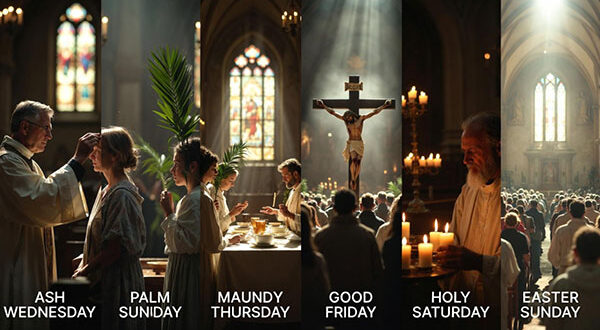
If Lent is the journey, Holy Week is the culminating moment of God’s love manifested in Christ’s Passion, Death, and Resurrection.
Here we celebrate the core of the Christian faith.
What does Holy Week commemorate?
The Church liturgically relives the final days of Jesus:
- His entry into Jerusalem.
- The Last Supper.
- His Passion and crucifixion.
- His death.
- His burial.
- His resurrection.
It is not a symbolic remembrance, but a sacramental re-presentation of the mystery of salvation.
The principal moments of Holy Week
Palm Sunday — Christ is received as King
Jesus enters Jerusalem riding on a donkey. The people acclaim Him, yet only days later they will call for His crucifixion.
It reveals the fragility of the human heart and the fidelity of Christ.
Holy Thursday — love that gives itself
Three fundamental gifts are commemorated:
- The institution of the Eucharist.
- The priesthood.
- The commandment of love.
Jesus washes the feet of His disciples, revealing that true authority is service.
“Love one another as I have loved you” — Gospel of John 13:34.
Good Friday — the mystery of the Cross
This is the day of Christ’s redemptive sacrifice. God gives Himself completely for humanity.
The Cross reveals:
- The gravity of sin.
- The immensity of divine love.
- The redemption of the world.
Christian theology sees in the Cross the triumph of love over evil.
Holy Saturday — the silence of God
It is the day of great silence. Christ lies in the tomb. It represents those moments when God seems absent, yet is at work.
Spiritually, it teaches patience, hope, and trust.
Easter: the definitive victory of life
The central event of Christianity
Easter celebrates the Resurrection of Christ. Without it, Christianity would not exist.
Saint Paul expresses this clearly:
“If Christ has not been raised, your faith is in vain” — First Letter to the Corinthians 15:14.
The Resurrection is not a symbol but a historical and transcendent event that inaugurates a new creation.
The theological meaning of Easter
Easter signifies:
- Victory over sin.
- Victory over death.
- Renewal of humanity.
- Eternal hope.
- The beginning of new life in Christ.
It is the most important feast of the Christian calendar, even surpassing Christmas.
The Easter Vigil: the holiest night
The Church celebrates the Resurrection during the Easter Vigil through deeply symbolic signs:
- The new fire.
- The Paschal candle.
- The proclamation of salvation history.
- Baptism.
- The Eucharist.
Everything points to Christ as the light of the world.
One single spiritual journey: dying in order to live
Lent, Holy Week, and Easter are not three separate celebrations but a single spiritual process:
| Stage | Meaning |
|---|---|
| Lent | Conversion and purification |
| Holy Week | Contemplation of Christ’s sacrifice |
| Easter | New life and resurrection |
It is the path of every Christian:
- To die to sin.
- To unite oneself with Christ.
- To be reborn to grace.
Contemporary relevance: why this journey is more necessary than ever
In contemporary society we encounter:
- A crisis of meaning.
- Individualism.
- Existential anxiety.
- A culture of consumption.
- Spiritual emptiness.
The paschal journey offers profound answers:
- Lent teaches interiority.
- The Cross teaches sacrificial love.
- Easter offers hope.
This message responds to the wounds of modern humanity.
How to live this spiritual journey today
In personal life
- Examine one’s life with sincerity.
- Go to confession.
- Dedicate time to God.
- Practice forgiveness.
In the family
- Pray together.
- Participate in liturgical celebrations.
- Practice reconciliation.
In society
- Serve those in need.
- Defend human dignity.
- Bear witness to hope.
The deeper dimension: the mystery of interior transformation
The Lenten and paschal journey reveals an essential truth of Christianity:
God does not merely teach — He transforms.
The believer participates in the mystery of Christ:
- Dies with Him.
- Suffers with Him.
- Rises with Him.
This process is repeated each year because the human heart needs constant renewal.
Conclusion: a path that changes life
Lent calls for conversion.
Holy Week reveals God’s love.
Easter proclaims the definitive victory of life.
This journey does not belong to the past; it is a living proposal for the modern person. Whoever walks it sincerely discovers that Christianity is not merely doctrine, but an experience of profound transformation.
The invitation remains open every year:
to die to selfishness, to be reborn in love, and to live in hope that does not disappoint.