Related Articles


In an age marked by the search for spirituality, the esoteric and the “mysterious” attract more and more people. Social media, self-help books, “new age” movements, and certain pseudo-spiritual proposals present Kabbalah as a path to enlightenment, inner power, or access to hidden divine secrets.
But what is Kabbalah really? What is its historical origin? What value does it have from a Christian theological perspective? How should a Catholic discern these currents? What authentic spiritual search responds to the deep desire that leads many toward it?
This article aims to offer a profound, clear, and pastoral response from the Catholic tradition, helping readers understand, discern, and orient the human desire to know God toward its true fulfillment.
What is Kabbalah?
Kabbalah (from the Hebrew qabbalah, “received tradition”) is a stream of mystical thought within Judaism that seeks to interpret the hidden meaning of God, the universe, and Scripture through symbols, numbers, and spiritual structures.
It is not a separate religion, but an esoteric tradition that seeks to explain:
- The nature of God.
- The creation of the world.
- The relationship between the divine and the human.
- The secrets hidden in Sacred Scripture.
- The paths of spiritual elevation.
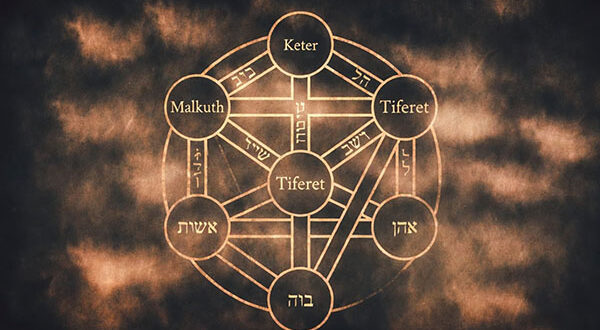
Its central teaching revolves around the Tree of Life, a symbolic structure composed of ten divine emanations (sefirot), which describe how God manifests Himself in the world.
However, Kabbalah is not a public or universal revelation, but knowledge traditionally reserved for initiates.
The historical origin of Kabbalah
Ancient roots
Its elements appear in ancient Jewish mystical currents (1st–6th centuries), especially in traditions of speculation about creation and heavenly visions.
But Kabbalah as an organized system emerged in the Middle Ages.
Medieval development
Among its principal texts stands out:
- Zohar — the fundamental work of Kabbalistic mysticism.
- Traditionally attributed to Simeon bar Yochai, though historically associated with Moses de León (13th century).
In the 16th century, Kabbalistic thought developed further with:
- Isaac Luria, who introduced ideas such as the “contraction of God” (tzimtzum) and the restoration of the world (tikkun).
The heart of Kabbalah: a vision of God and the cosmos
Kabbalah describes God as infinite and unknowable (Ein Sof), from whom levels of spiritual reality emanate.
Its main ideas include:
- God as impersonal infinite energy (in contrast to the personal God of Christian faith).
- Divine emanations structuring the universe.
- Secret interpretations of Scripture through numbers and symbols.
- Spiritual ascent through hidden knowledge.
Here a crucial difference with Christian faith appears.
The Christian vision: God reveals Himself, He does not hide
Catholic theology teaches that God does not communicate through secret codes reserved for spiritual elites, but through public, historical, and universal revelation.
Christianity proclaims:
- God reveals Himself in history.
- God reveals Himself in a Person.
- God reveals Himself for all.
That revelation culminates in Jesus Christ.
As Scripture teaches:
“In many and various ways God spoke of old… but in these last days he has spoken to us by his Son” (Hebrews 1:1–2).
The theological difference is profound:
| Kabbalah | Christianity |
|---|---|
| Hidden knowledge | Public revelation |
| Reserved initiation | Universal salvation |
| Ascent through knowledge | Salvation by grace |
| God as energy or emanation | Personal and Trinitarian God |
The spiritual risk of esotericism
The fascination with Kabbalah responds to real human desires:
- to know the meaning of life,
- to access the divine,
- to understand mystery,
- to experience transcendence.
However, pastoral danger arises when:
- spiritual power is sought instead of conversion,
- one attempts to dominate the divine,
- faith is replaced by techniques,
- Christian revelation is relativized.
The Catechism warns against practices that seek to “control hidden forces” or access secret knowledge (cf. CCC 2116).
Christian tradition has always taught that the path to God does not pass through control of the mystery, but through humility before it.
Why does Kabbalah attract so many today?
We live in an era marked by:
- crisis of meaning,
- secularization,
- distrust toward religious institutions,
- individualized spiritual searching.
Kabbalah seems to offer:
- spirituality without demanding moral commitment,
- exclusive knowledge,
- immediate mystical experience,
- a sense of control over reality.
But Christian faith proposes something deeper: a living relationship with God.
The Christian response to the desire for mystery
The Church does not reject mystery. On the contrary, she fully embraces it.
Christianity is profoundly mystical:
- the mystery of the Trinity,
- the Incarnation,
- the Eucharist,
- the union of the soul with God.
But these mysteries are not elitist secrets, but gifts of grace.
As Jesus says:
“I am the way, the truth, and the life” (John 14:6).
True knowledge of God is not esoteric, but relational.
Authentic Christian mysticism versus esoteric mysticism
The Catholic tradition possesses immense mystical richness:
- union with God through love,
- contemplation,
- sacramental life,
- interior purification,
- transformation of the heart.
The great Christian mystics teach:
- the path is humility,
- the means is grace,
- the end is love.
They do not seek hidden secrets, but communion with God.
Pastoral discernment for the believer
Today a Christian may encounter Kabbalistic proposals in:
- spiritual courses,
- self-help books,
- energy practices,
- “new age” movements,
- pseudo-Christian reinterpretations.
Criteria for discernment
- Does it lead to Christ or replace Him?
- Does it promise power or invite conversion?
- Does it seek control or trust in God?
- Is it universal or elitist?
- Is it based on revelation or on secrets?
Discernment is essential in our time.
Practical applications for the reader’s spiritual life
Reflection on Kabbalah invites us to interior purification and an authentic spiritual path.
1. Cultivate the desire for truth
The desire to know God is good. It must be oriented toward authentic revelation.
2. Rediscover the richness of Christianity
Many seek outside what they do not know within their own faith:
- contemplation,
- interior silence,
- prayerful reading of Scripture,
- sacramental life.
3. Avoid consumer spirituality
Faith is not a technique to feel good, but a relationship with God.
4. Embrace mystery with humility
Not everything must be understood; everything can be entrusted.
The Christian mystery: God who approaches humanity
The deepest difference between Kabbalah and Christian faith is this:
- In Kabbalah, man seeks to ascend toward the divine.
- In Christianity, God descends toward man.
The Incarnation reveals a God who is near, personal, who loves and saves.
As Scripture says:
“The Word became flesh and dwelt among us” (John 1:14).
Here lies the true mystery.
A call for our time
The current popularity of Kabbalah reveals something important: modern humanity still hungers for God.
That desire should not be suppressed, but purified and properly directed.
The Church proposes:
- truth instead of secrecy,
- grace instead of technique,
- love instead of power,
- Christ instead of impersonal symbols.
Conclusion: from hidden knowledge to personal encounter
Kabbalah represents one of the great expressions of the human desire to understand the divine mystery. But from the Christian perspective, the path to God is not based on secret knowledge or hidden symbolic structures, but on a living relationship with Him.
Christianity proclaims something extraordinary: the supreme mystery is not hidden, but revealed in Christ.
The authentic spiritual path is not to decipher codes, but to allow oneself to be transformed by God’s love.
And that is true wisdom.