Related Articles

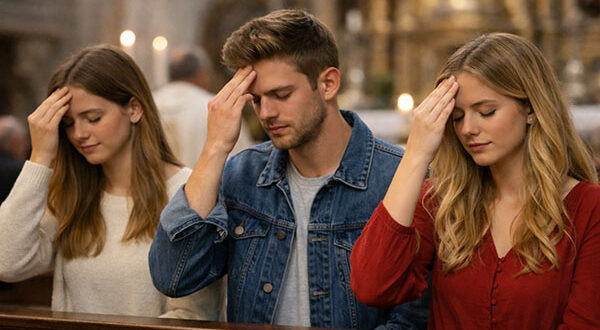
There are gestures in the Mass that we repeat almost without thinking… and yet they contain a spiritual depth capable of completely transforming our relationship with God. One of them is that small but powerful act we perform just before the proclamation of the Gospel: tracing three small crosses on the forehead, the lips, and the chest.
Many do it out of habit. Few understand what it really means. And even fewer truly live it.
Today we are going to pause there. Because what happens in that moment is not a simple ritual: it is a total consecration to the Word of God.
✝️ A small gesture with ancient roots
The sign of the cross is one of the oldest signs in Christianity. Already in the early centuries, Christians marked their bodies with the cross as a sign of belonging to Christ.
The great Father of the Church Tertullian expressed it this way:
“In all our travels and movements, in coming in and going out, when dressing, bathing, sitting at table… we mark our foreheads with the sign of the cross.”
However, the specific gesture of tracing three crosses before the Gospel became established in medieval liturgy, as an expression of interior preparation:
it is not enough to hear the Gospel… one must receive it with one’s whole being.
📖 What does this gesture really mean?
When the priest (and the faithful) make the three small signs of the cross before the Gospel, they are making a silent, profound, and demanding prayer.
It is not magic. It is a commitment.
1. ✝️ On the forehead: “May it be in my mind”
By tracing the cross on the forehead, we ask God:
👉 To enlighten our understanding
👉 To help us comprehend the Word
👉 To prevent us from distorting it with our own ideas
Because the Gospel is not meant to adapt to us…
we are the ones who must be transformed by it.
Here lies an uncomfortable truth: many hear the Gospel, but few truly understand it deeply, because they do not allow God to renew their way of thinking.
As Scripture says:
“Do not be conformed to this world, but be transformed by the renewal of your mind” (Romans 12:2)
2. ✝️ On the lips: “May it be on my lips”
By marking the lips, we ask:
👉 To proclaim the truth
👉 To speak according to the Gospel
👉 To avoid lies, gossip, and judgment
Because it is useless to hear the Word… if our words constantly contradict Christ.
Here, the sign of the cross becomes an examination of conscience:
do I speak as a Christian… or as the world does?
The Lord Himself warns us:
“Out of the abundance of the heart the mouth speaks” (Luke 6:45)
3. ✝️ On the chest: “May it be in my heart”
This is the center of everything.
By tracing the cross on the chest, we ask:
👉 To love the Word
👉 To keep the Gospel deep within us
👉 To let it transform our decisions
Because Christianity is not an idea… it is a life.
And the Word of God cannot remain in the mind or on the lips:
it must descend into the heart, where our actions are born.
As the psalmist says:
“I have stored up your word in my heart, that I might not sin against you” (Psalm 119:11)
🔥 A powerful synthesis: thinking, speaking, and living the Gospel
This gesture contains an extraordinary spiritual logic:
- Forehead → Think like Christ
- Lips → Speak like Christ
- Chest → Love and live like Christ
It is, ultimately, a total consecration of the human person to the Gospel.
It is not enough to listen.
It is not enough to know.
It is not enough to repeat.
👉 It must be embodied.
⛪ How is it properly done in the liturgy?
This moment takes place just before the proclamation of the Gospel during Holy Mass.
Step by step:
- The priest announces:
“A reading from the Holy Gospel according to…” - At that moment, everyone (priest and faithful) makes:
- A small cross with the thumb on the forehead
- A small cross on the lips
- A small cross on the chest
- While doing so, they pray interiorly:
👉 “May the Lord be in my mind, on my lips, and in my heart”
- Then the Gospel is proclaimed… in an attitude of faith, attention, and reverence.
⚠️ The danger of doing it without thinking
Here lies the great problem today:
routine has emptied the gesture of its meaning.
It is done quickly. Without awareness. Without intention.
But an empty gesture… does not transform.
The liturgy is not theater. It is a real encounter with God.
And every sign is designed to touch the soul.
If this gesture is lived well, it changes the way you listen to the Gospel.
If it is lived poorly… it goes unnoticed.
🕊️ Practical applications for your daily life
This gesture should not remain only in the Mass. It has concrete consequences.
1. Before reading the Bible at home
Do the same:
✝️ Forehead
✝️ Lips
✝️ Heart
And ask God to transform you through His Word.
2. Before making important decisions
Ask yourself:
- Is this in line with the Gospel? (mind)
- Can I defend it in truth? (lips)
- Am I doing it with right intention? (heart)
3. In your daily life
Turn this gesture into a daily examination:
- What have I thought today?
- What have I said?
- What have I loved and done?
✝️ A call to coherence
The world today needs coherent Christians.
Not perfect… but authentic.
This small gesture is, in reality, a radical declaration:
👉 I want the Gospel to transform everything in me.
It is not just a ritual.
It is a decision.
🔚 Conclusion: what you do in two seconds… can mark your eternity
The next time you hear the Gospel at Mass, do not make this gesture automatically.
Pause. Be aware. Truly pray.
Because in that moment you are saying:
👉 “Lord, may Your Word enter my mind, come forth from my lips, and dwell in my heart… so that my whole life may belong to You.”
And if that becomes true, even a little…
your life will never be the same.