Related Articles


A story of faith, culture, and hope for our time
When we walk through Europe today—from a small rural church to a great cathedral—we rarely think that much of our civilization survived thanks to communities of men and women who chose silence, prayer, and humble work.
Yet for centuries of crisis after the fall of the Roman Empire, it was precisely the Christian monasteries that preserved faith, culture, knowledge, and even the foundations of European social life. In the midst of chaos, monks built oases of prayer and wisdom that eventually shaped Western civilization.
The story of monasteries is not merely a medieval curiosity. It is a deeply relevant spiritual lesson: when the world seems to be falling apart, God often acts through small faithful communities.
This article explores that story from a historical, theological, and pastoral perspective, inviting us to ask an important question:
What can we learn today from the monastic spirit?
1. Europe after Rome: a world on the edge of collapse
In the 5th century, the Western Roman Empire collapsed under the weight of invasions, political crises, and internal decay. Cities were depopulated, commercial networks disappeared, and education virtually vanished in many regions.
In this context, the Church remained the only stable institution that survived the collapse of the Roman world.
Among all the institutions of the Church, monasteries became authentic centers for cultural and spiritual reconstruction.
Inside them something extraordinary was happening.
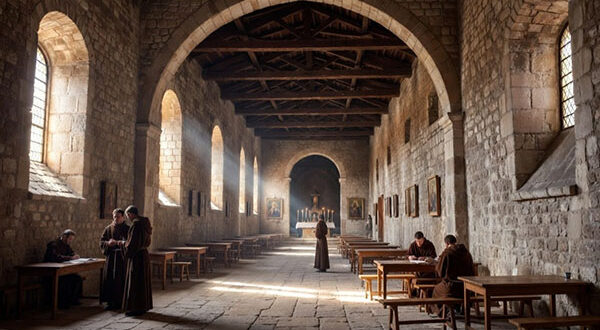
While wars and migrations ravaged the outside world, inside monasteries the psalms were being prayed, books were being copied, and fields were being cultivated.
The monks were not trying to save civilization.
They simply wanted to seek God.
And precisely because of that, they ended up saving it.
2. The birth of monasticism: seeking God above all
Christian monasticism began long before the Middle Ages. Its roots go back to the first centuries of Christianity.
Many believers desired to live the Gospel radically, imitating Christ in poverty, chastity, and obedience. Some withdrew into the desert to dedicate their lives to prayer.
One of the most influential figures would be Saint Benedict of Nursia, considered the father of Western monasticism.
His famous rule of life proposed a balance that would shape the history of Europe:
“Ora et labora”
(“Pray and work”).
The Benedictine Rule organized daily life around:
- liturgical prayer
- manual labor
- spiritual reading
- community life
This structure spread throughout Europe and became the model of monastic life for centuries.
But the most important thing was not the organization.
It was the spiritual goal:
to seek God above all things.
3. Monasteries as guardians of culture
One of the most extraordinary contributions of monasteries was the preservation of knowledge.
In monasteries there were special rooms called scriptoria, where monks copied manuscripts by hand.
They copied:
- the Bible
- writings of the Church Fathers
- works of Greek philosophy
- Roman scientific treatises
- historical texts
If we still know authors such as Cicero, Virgil, or Aristotle today, it is largely thanks to that silent work.
A famous example was the Abbey of Monte Cassino, founded by Saint Benedict.
Its library came to include works of medicine, science, and literature from many civilizations, which monks translated and copied to pass on to future generations.
While Europe was burning, monasteries preserved the memory of the ancient world.
4. The monks who evangelized Europe
But monasteries did not only copy books.
They also evangelized.
From Ireland and Great Britain emerged an extraordinary missionary movement known as the Hiberno-Scottish mission.
Irish monks traveled throughout Europe founding monasteries and bringing the Gospel to Germanic and Celtic peoples.
These monasteries became:
- centers of evangelization
- schools of learning
- hospitals
- refuges for travelers
We could say that monasteries were the first universities, hospitals, and social centers of Europe.
5. Monasteries transformed everyday life
The impact of monasteries went far beyond religion.
They also influenced:
Agriculture
Monks reclaimed abandoned land, introduced new agricultural techniques, and organized rural labor.
Technology
Many advances in mills, irrigation systems, and agricultural production emerged in monastic environments.
Medicine
Medical treatises were copied in monasteries, and the sick were cared for there.
Local economy
Monasteries created networks of hospitality and commerce.
For this reason, some historians describe medieval monasteries as “microcosms of Christendom,” small models of a Christian society.
6. The theological vision behind monasteries
From a theological perspective, monasticism was not simply a social organization.
It was a radical response to the Gospel.
Jesus had said:
“Seek first the Kingdom of God and His righteousness.”
(Matthew 6:33)
Monks took this command literally.
Their lives were oriented toward:
- continuous prayer
- conversion of heart
- community life
- obedience to God
Monastic theology saw the monastery as a foretaste of heaven.
A place where life is ordered entirely toward God.
7. The monastery as a school of holiness
Monasteries were also schools of virtue.
In the Rule of Saint Benedict, fundamental virtues were cultivated:
- humility
- obedience
- silence
- hospitality
- interior discipline
These virtues were not meant only for monks.
Over time, they became ideals that shaped Christian European culture.
Even today, many principles of modern leadership are inspired by monastic organization.
8. Why can we say monasteries saved Europe?
Historians and theologians agree that monasteries played a decisive role in the reconstruction of Europe after the collapse of Rome.
They did so in several ways:
1. They preserved ancient knowledge
By copying manuscripts for centuries.
2. They evangelized the continent
Through missionary networks.
3. They stabilized society
By creating organized communities.
4. They developed the rural economy
Through agriculture and technology.
5. They kept the Christian faith alive
As the spiritual heart of Europe.
For this reason, some historians refer to this period as “the monastic centuries,” when monastic life profoundly shaped European society.
9. The spiritual lesson for our time
Today we also live in a time of cultural crisis.
Many people feel that faith is weakening, that culture is losing its roots, and that society is passing through a period of uncertainty.
In some ways, our time resembles the 5th century.
And what did Christians do back then?
They did not try to dominate the world.
They built faithful communities.
Christian families.
Monasteries.
Living parishes.
From these small centers of faith a new civilization was born.
10. How to live the monastic spirit today
Even if we are not monks, we can apply monastic wisdom to our daily lives.
1. Recover silence
We live surrounded by digital noise.
Monks remind us that silence is necessary to hear God.
2. Establish a rhythm of prayer
Monks prayed several times each day.
We can begin with:
- prayer in the morning
- a brief spiritual pause at midday
- an examination of conscience at night
3. Sanctify work
For monks, work was not merely economic.
It was prayer.
“Ora et labora.”
4. Create small Christian communities
Family, friends, parish.
Faith is sustained much better when it is lived in community.
11. The interior monastery
The great saints taught something profound:
every Christian is called to build an interior monastery.
A place in the heart where God dwells.
Saint Paul expressed it this way:
“Do you not know that you are God’s temple?”
(1 Corinthians 3:16)
When we cultivate prayer, silence, and charity, that interior monastery begins to grow.
And from it, the world can be transformed.
Conclusion: the silent revolution of the monks
The story of monasteries reminds us of something surprising:
The great transformations of history do not always arise from power.
Sometimes they arise from silence.
From men who pray.
From communities that work humbly.
From people who seek God with fidelity.
The monks did not intend to save civilization.
They only wanted to be faithful to Christ.
And precisely because of that, they ended up changing the world.
Perhaps today God is asking something similar from us.
Not to conquer culture.
But to live the faith deeply.
Because when a small group of Christians truly lives the Gospel…
the whole course of history can change.