Related Articles



There are songs that are heard… and there are songs that pierce the soul.
Gloria, laus et honor belongs to the second kind.
It is not just a liturgical hymn. It is a proclamation. It is a procession turned into music. It is the voice of the Church which, for more than a thousand years, continues to cry out to the world: Christ is King, even when He enters humbly, riding on a donkey!
In a time where faith is easily diluted amid the noise of the world, rediscovering the profound meaning of this hymn is to relearn how to receive Christ into our lives.
1. What is “Gloria, laus et honor”?
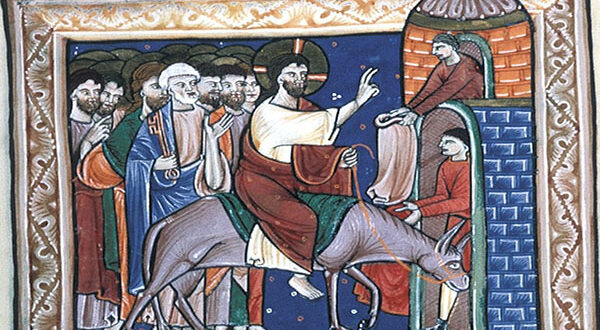
Gloria, laus et honor tibi sit, Rex Christe, Redemptor is a traditional Catholic liturgical hymn, especially linked to Palm Sunday, the moment when the Church commemorates Christ’s triumphant entry into Jerusalem.
It is sung during the procession of palms, recalling that moment when the people received Jesus with joy, spreading garments and branches:
“Hosanna! Blessed is he who comes in the name of the Lord!” (cf. Matthew 21:9)
This hymn is not merely a historical remembrance. It is a liturgical re-presentation:
Christ enters your life again today… and you decide whether to receive Him or reject Him.
2. Historical origin: a hymn born in trial
The author of Gloria, laus et honor was Theodulf of Orléans, a 9th-century bishop of Hispano-Visigothic origin, who lived during the reign of Charlemagne.
Tradition tells us that Theodulf composed this hymn while imprisoned by order of Louis the Pious, Charlemagne’s son.
From his cell, on Palm Sunday, upon hearing the procession passing beneath his window, he began to sing this hymn. The beauty and power of his words moved the emperor so deeply that he ordered his release.
Beyond the exact historicity of the story, the message is clear and profoundly Christian:
👉 Praise to Christ is often born in the midst of suffering.
👉 True liturgical song flows from a tested heart, not a superficial one.
3. The text: theology in song
The hymn begins as follows:
Gloria, laus et honor tibi sit, Rex Christe, Redemptor,
cui puerile decus prompsit Hosanna pium.
Translation:
Glory, praise, and honor be to You, Christ King, Redeemer,
to whom the children offered their devout “Hosanna.”
Theological keys of the text
✦ Christ the King… but not as the world understands
The hymn insists on calling Christ “King.” But not a political king—rather, a King who reigns from the Cross.
Here lies a central paradox of Christianity:
👉 The One who is acclaimed with palms will be crucified just days later.
This speaks directly to us:
How often do we also acclaim Christ… only to deny Him with our actions?
✦ Children as a spiritual model
The hymn recalls that it was children who proclaimed the “Hosanna.”
This connects with Christ’s teaching:
“Unless you become like children, you will never enter the kingdom of heaven.” (Matthew 18:3)
The liturgy is telling us:
👉 True praise flows from a simple heart, not a sophisticated one.
✦ All creation praises Christ
In its verses, the hymn includes the Hebrew people, the disciples, and all creation.
This expresses a profound theological truth:
👉 Christ is not only Lord of believers, but of all creation.
4. Palm Sunday: between glory and the Cross
Gloria, laus et honor is not an isolated hymn. It is part of a deeply pedagogical liturgy.
Palm Sunday is marked by dramatic tension:
- It begins with joy
- It ends with the reading of the Passion
Thus, the Church teaches us:
👉 There is no true glory without the Cross
👉 There is no Resurrection without the Passion
This hymn, therefore, is not naive. It is fully aware of the drama that is to come.
5. Curiosities you may not know
✦ It was sung in alternation between choir and people
Traditionally, the hymn was performed in a dialogical way, symbolizing the encounter between Christ and His people.
✦ It was sung before closed doors
In some ancient rites, the procession stopped before the closed doors of the church. The hymn became like a supplication… until the doors were opened.
👉 A powerful symbol:
Christ knocks… and the heart must open.
“Behold, I stand at the door and knock…” (Revelation 3:20)
✦ It is one of the oldest hymns still in use
More than a thousand years later, it is still sung—not out of nostalgia, but because it expresses an eternal truth.
6. Spiritual application today: how to live the “Gloria, laus”
This is where the hymn ceases to be history… and becomes life.
1. Consciously receive Christ
It is not enough to “celebrate” Palm Sunday.
The real question is:
👉 Am I allowing Christ to enter every area of my life?
2. Avoid superficial faith
The same crowd that cried “Hosanna” later cried “Crucify Him.”
This confronts us:
👉 Does my faith depend on emotions… or on a firm decision?
3. Praise even in difficulty
Remembering Theodulf:
👉 True praise does not depend on circumstances.
Praising God when everything goes well is easy.
Doing so in trial… that transforms the soul.
4. Return to simplicity
The modern world pushes us toward complexity, noise, and pride.
Gloria, laus reminds us:
👉 God allows Himself to be found by simple hearts.
7. A deeply relevant message today
In a society that has relativized truth, forgotten the kingship of Christ, and often lives turned away from God, this hymn is almost countercultural.
To proclaim today:
👉 “Christ is King”
is not just a religious statement… it is a declaration of life.
It means:
- That He has the final word
- That His truth does not change
- That His love demands a response
Conclusion: when the hymn becomes life
Gloria, laus et honor is not just meant to be sung once a year in a procession.
It is an attitude of the soul.
It is to say each day:
- Glory… even when it is difficult
- Praise… even in silence
- Honor… even when the world mocks
Because in the end, the great question is not whether you sing this hymn…
👉 The real question is:
Is Christ truly entering your life as King… or only as an occasional guest?
Gloria, laus et honor
Gloria, laus et honor tibi sit, Rex Christe, Redemptor:
Glory, praise, and honor be to You, Christ King, Redeemer:
Cui puerile decus prompsit Hosanna pium.
To whom the beauty of children proclaimed a devout Hosanna.
Israel es tu Rex, Davidis et inclita proles:
You are the King of Israel, the noble offspring of David:
Nomine qui in Domini, Rex benedicte, venis.
O blessed King, who comes in the name of the Lord.
Coetus in excelsis te laudat caelicus omnis,
The whole heavenly host praises You on high,
Et mortalis homo, et cuncta creata simul.
And mortal man, and all created things together.
Plebs Hebraea tibi cum palmis obvia venit:
The Hebrew people came to meet You with palms:
Cum prece, voto, hymnis, adsumus ecce tibi.
With prayers, vows, and hymns, behold we stand before You.
Hi tibi passuro solvebant munia laudis:
They offered You praises as You were about to suffer:
Nos tibi regnanti pangimus ecce melos.
We now sing our song to You who reign.
Hi placuere tibi, placeat devotio nostra:
Those pleased You; may our devotion also please You:
Rex pie, Rex clemens, cui bona cuncta placent.
O gracious King, O merciful King, to whom all good things are pleasing.