Related Articles

The mystery that unsettles… and transforms
There are scenes in the Gospel that we understand… and others that must simply be contemplated in silence. Gethsemane belongs to the latter.
In that garden, in the darkness of night, the Son of God experiences something that shakes us: fear, anguish, solitude… and total obedience to the Father.
But when we open the Gospels, a troubling question arises:
👉 Why do the Gospel of Matthew, Gospel of Mark, Gospel of Luke, and Gospel of John narrate this scene differently?
Do they contradict each other?
Or are we facing a deeper mystery?
The answer not only resolves an apparent biblical difficulty…
👉 it can change the way you pray forever.
1. Gethsemane: the place where God trembled
Before examining the differences, we must understand the context.
Gethsemane (from the Hebrew gat-šĕmānîm, “oil press”) is not just any setting. It is symbolic:
- Olives are pressed there…
- There, Christ is “pressed” under the weight of the world’s sin
Saint John Paul II expressed it powerfully:
“In Gethsemane begins the interior Passion of Christ.”
Here we see no miracles, no crowds, no sermons.
Here we see the Heart of Christ laid bare.
2. The four Gospels: four views of the same abyss
📖 Matthew and Mark: the anguish that shakes us
In the Gospel of Matthew (26:36–46) and the Gospel of Mark (14:32–42), we find the most raw version.
Jesus says:
“My soul is sorrowful even unto death.”
And He pleads:
“My Father, if it be possible, let this cup pass from me; nevertheless, not as I will, but as you will.”
Here we see:
- The true humanity of Christ
- A real, not symbolic, suffering
- The interior struggle between the horror of suffering and obedience
Theologically, this is crucial:
👉 Jesus has two wills (divine and human), as defined by the Council of Chalcedon.
And in Gethsemane, His human will freely submits to the divine.
📖 Luke: the physician who describes invisible pain
The account of the Gospel of Luke (22:39–46) adds two unique details:
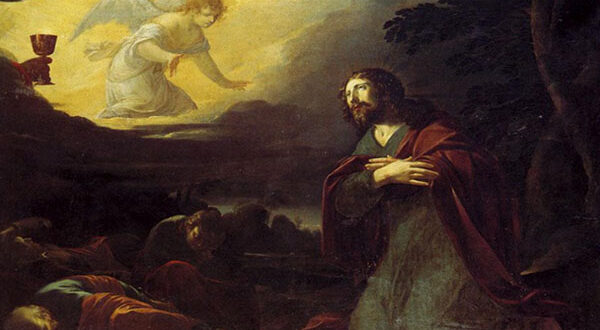
- An angel who strengthens Him
- The famous sweating of blood:
“And his sweat became like great drops of blood falling down to the ground.”
This is not poetic language: it is what medicine today calls hematidrosis, an extreme phenomenon caused by intense anguish.
Luke, a physician, shows us something profound:
👉 Christ suffers not only spiritually, but physically even before the Cross.
But he also introduces an important nuance:
- Jesus appears more composed
- More centered in prayer
- Less dramatic in words, yet equally intense
📖 John: the silence… that reveals glory
The Gospel of John surprises us… because it does not narrate the agony as such.
There is:
- No explicit sorrow
- No sweating of blood
- No plea about the cup
Instead, we see another scene:
When they come to arrest Him, Jesus says:
“I am He.”
And the soldiers draw back and fall to the ground (Jn 18:6).
What is John doing?
👉 Showing that Christ is not a victim… He is Lord even in His surrender.
John does not deny the agony. He has already revealed it earlier:
“Now is my soul troubled” (Jn 12:27)
But in Gethsemane, he emphasizes another truth:
👉 The Passion is not defeat—it is a sovereign act of love.
3. Contradiction or divine richness?
Here is the key:
The Gospels are not modern journalistic reports.
They are inspired testimonies that reveal different dimensions of the same mystery.
We could say:
- Matthew and Mark → the human drama
- Luke → the medical and spiritual suffering
- John → the divine majesty
They do not contradict each other.
👉 They complement one another like four faces of the same diamond.
4. The deep theology of Gethsemane
Gethsemane answers an essential question:
👉 How does Christ save the world?
Not only by dying… but by obeying.
Saint Paul the Apostle summarizes it:
“He humbled himself, becoming obedient unto death” (Phil 2:8)
The original sin was disobedience in a garden (Eden).
Redemption begins with obedience in another garden (Gethsemane).
Here Christ does something decisive:
- He takes upon Himself the sin of the world
- He freely accepts the cup
- He loves to the end
5. Mystical visions: when heaven allows us to glimpse the suffering
Some mystics have contemplated this scene with astonishing depth.
✨ Anne Catherine Emmerich
She describes Jesus:
- Seeing all the sins of humanity
- Suffering not only physical pain, but ingratitude
- Being consoled… yet also abandoned by His disciples
She even speaks of such intense anguish that:
👉 Christ experiences a kind of “anticipated abandonment”
✨ Padre Pio of Pietrelcina
He mystically lived the Passion, especially the interior agony.
He said:
“In Gethsemane one understands what it costs to save a soul.”
✨ Teresa of Avila
She encouraged not to flee from this scene:
👉 “Look at Him in the garden… and accompany Him.”
Because there we learn how to truly pray.
6. Practical application: how to pray in your own Gethsemane
This is not only a topic to study.
It is meant to be lived.
We all have a Gethsemane:
- An illness
- A betrayal
- An inner anguish
- A cross we do not understand
And there we often pray poorly:
- We want to escape
- We demand answers
- We lose peace
Christ teaches us another way:
1. Tell God the truth
“My Father, if it be possible…”
👉 Do not suppress your pain.
2. Do not impose your will
“…yet not as I will.”
👉 Trust is greater than relief.
3. Persevere in prayer
Jesus insists three times.
👉 Do not give up.
4. Accept God’s consolation
Even when it comes in unexpected ways (like the angel in Luke).
7. Gethsemane today: the drama of modern man
We live in a culture that flees from suffering:
- Emotional anesthesia
- Constant search for pleasure
- Rejection of sacrifice
But Gethsemane tells us something uncomfortable:
👉 There is no redemption without the Cross… but no Cross without love.
Christ does not eliminate suffering.
👉 He transforms it from within.
Conclusion: the place where we learn to truly love
Gethsemane is not just a prelude to the Cross.
It is the place where:
- Christ decides to save you
- Love conquers fear
- Obedience repairs sin
And where you can learn the most difficult—and most powerful—prayer:
“Thy will be done.”
If you ever do not know what to say in prayer…
if you feel broken inside…
if you are afraid of the future…
👉 Return to Gethsemane.
And remain there.
Not to understand everything…
but to be with Him.