Related Articles

Introduction: He Didn’t Build Buildings, He Raised Prayers
Antoni Gaudí was not merely a brilliant architect. He was, above all, a believer who thought with his hands, an artist who understood that beauty is not an aesthetic luxury, but a path toward God. In a world that separates faith from culture, Gaudí did exactly the opposite: he fused them until they became inseparable.
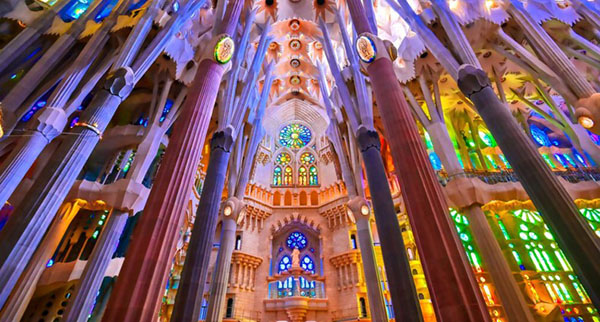
Today, when many seek spirituality without religion and art without truth, Gaudí stands as a surprisingly contemporary figure. His works—especially the Sagrada Familia—are not understood only with the eyes, but with the soul. They are Gospels in stone, three-dimensional catechisms, silent liturgies that continue preaching day and night.
This article aims to help you read Gaudí spiritually, understand his Catholic symbolism, discover the theological depth of his creativity, and, above all, learn to live your faith with the same radical coherence with which he raised his temples.
1. Gaudí and His Time: A Countercultural Catholic
Antoni Gaudí (1852–1926) lived in a time of enormous tensions:
- Accelerated industrialization
- Scientific positivism
- Growing secularization
- A crisis of Christian identity in Europe
While many intellectuals abandoned the faith or confined it to the private sphere, Gaudí did the unthinkable: he placed it at the very center of his work.
He was not a sociological or merely aesthetic Catholic. He was a deeply sacramental man, convinced that:
“Originality consists in returning to the origin.”
And the origin, for him, was clear: God the Creator.
2. Gaudí’s Creativity: Imitating the Creator
From a theological perspective, creativity is not a human whim. It is participation in God’s creative act.
Scripture states this clearly:
“God saw everything that he had made, and behold, it was very good.” (Genesis 1:31)
Gaudí understood this radically. That is why he:
- Rejected rigid straight lines
- Embraced organic geometry
- Imitated trees, bones, shells, mountains
He did not copy nature: he interpreted it theologically. For him, nature was:
- God’s work
- A divine language
- An open book of revelation
His architecture is a natural theology in stone.
3. The Sagrada Familia: A Monumental Catechism
The Basilica of the Sagrada Familia is not merely a church: it is a complete spiritual itinerary.
🔹 Nativity Façade
- An explosion of life, light, and hope
- Celebrates the Incarnation
- God enters history, the small, the humble
🔹 Passion Façade
- Harsh, austere, almost violent
- Shows the cost of sin
- The redemptive suffering of Christ
“He was pierced for our transgressions.” (Isaiah 53:5)
🔹 Glory Façade
- Still under construction
- Represents eternal life, judgment, heaven, and hell
- Reminds us that history has an end
Gaudí conceived the temple as a Bible for modern illiterates, where even those who do not believe receive a message—whether they realize it or not.
4. Catholic Symbolism: Nothing Is Accidental
In Gaudí’s work, everything means something:
- Tree-like columns → the Church as a living forest
- Light → symbol of Christ, “the Light of the world” (John 8:12)
- Numbers → Trinitarian, apostolic, sacramental
- Height → the soul’s ascent toward God
Even acoustics, orientation, materials—everything is designed to educate the soul.
Gaudí did not build to impress, but to convert.
5. Gaudí and the Liturgy: Architecture at the Service of Worship
One of the most strikingly current aspects of Gaudí is his deep understanding of the liturgy.
For him:
- The temple is not an auditorium
- It is not a museum
- It is not a social center
It is the house of God and the gate of Heaven.
That is why he designed spaces that:
- Lift the gaze
- Foster silence
- Lead to adoration
In times of liturgical trivialization, Gaudí reminds us that:
Form itself evangelizes.
6. Personal Conversion: The Hidden Gaudí
In his youth, Gaudí was worldly, proud, and brilliant. But over the years something decisive happened: he underwent a profound conversion.
- He lived austerely
- He fasted
- He prayed daily
- He confessed frequently
At the end of his life, he resembled a monk more than an architect.
He died poor, struck by a tram, mistaken for a beggar. Paradoxically, this was his final sermon.
“Blessed are the poor in spirit.” (Matthew 5:3)
7. Practical Guide: Living Like Gaudí Today
✦ From a Theological Perspective
- Rediscover beauty as a path to God
Faith is not only moral truth; it is splendor. - Integrate faith and life
Do not live a compartmentalized faith. Gaudí did not. - Return to nature
Learn to read it as creation, not merely as an object.
✦ From a Pastoral Perspective
- Educate faith through art
Churches, homes, catechesis: beauty forms. - Care for sacred spaces
What the temple says reveals what we believe. - Be a silent witness
Gaudí evangelized without speeches, through coherence.
8. Gaudí Today: A Prophet for a Wounded Church
In a world that is:
- Noisy
- Superficial
- Fragmented
Gaudí teaches us that:
- Faith can be profoundly intellectual
- Radically beautiful
- Absolutely current
This is not nostalgia. It is prophecy.
Conclusion: When Beauty Saves
Gaudí did not canonize ideas: he canonized beauty. His work still speaks because it springs from Truth.
Perhaps today God does not ask you to raise a basilica. But He asks of you the same thing He asked of Gaudí:
To build your life as a work offered to Him.
Because when faith becomes flesh, even stone can pray.