Related Articles



In an age when many equate holiness with spotless perfection, the story of Saint Andrew Wouters breaks in like lightning, shattering our assumptions. He was not exemplary in everything. He was not an irreproachable ascetic. He was not a famous preacher. And yet he died a martyr for the Catholic faith.
And that changes everything.
His famous words, spoken to those who pressured him to renounce the faith, have echoed through the centuries:
“Fornicator I always was; heretic I will never be.”
Scandalous. Uncomfortable. Profoundly Catholic.
Today more than ever, when so many Christians live amid weaknesses, interior struggles, and contradictions, this 16th-century martyr offers us a lesson in living theology: fidelity to the truth can coexist with human misery… and grace can triumph even at the final hour.
1. The historical context: blood and Reformation
To understand his story, we must place ourselves in the 16th century, in the Netherlands, amid the religious upheaval following the Protestant Reformation. In 1572, a group of Calvinist rebels known as the “Sea Beggars” captured the town of Brielle.
There they arrested 19 Catholic religious—diocesan priests and Franciscans—who would later be known as the Martyrs of Gorcum.
Among them was Andrew Wouters, parish priest of Hoogmade.
He was not arrested for moral misconduct.
He was not executed because of scandal.
He was killed for refusing to deny two fundamental truths:
- The real presence of Christ in the Eucharist.
- The authority of the Pope.
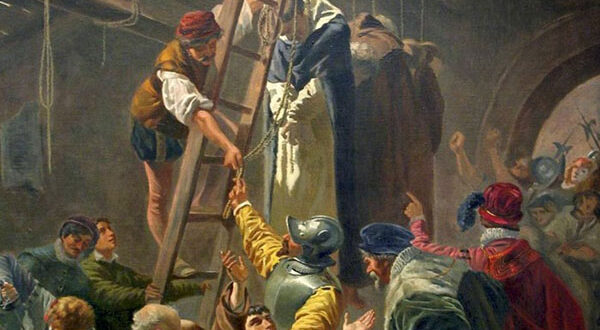
He died on July 9, 1572, hanged alongside his companions.
They were later canonized by Pope Pius IX in 1867.
2. A priest with real weaknesses
Here comes the surprising part.
Andrew Wouters did not have a reputation for heroic holiness during his life. Historical accounts suggest that his moral conduct was not exemplary. He was reproached for sins against chastity. He was not a disciplined cleric nor an ascetical model.
And yet…
When the decisive moment arrived, he did not deny the faith.
He could have saved his life with a simple public renunciation of Catholic doctrine. Many did so in that era to survive. He did not.
Here a profound theological truth shines forth:
grace does not act only in the perfect; it acts in the faithful.
3. The theology of martyrdom: what it truly means
Martyrdom is not simply dying violently. It is dying out of hatred for the faith (odium fidei), while maintaining fidelity to Christ and revealed truth.
Jesus said it clearly:
“Do not fear those who kill the body but cannot kill the soul.” (Matthew 10:28)
Wouters feared losing the faith more than losing his life.
And this is crucial:
A sinner can repent.
A formal heretic breaks with the truth.
His statement, though provocative, expresses a correct spiritual hierarchy:
moral weakness is grave, but the conscious denial of revealed truth is a direct rupture with God.
At a time when many relativized doctrine to survive, he did not.
4. The theological distinction many forget
From a doctrinal standpoint, the Church distinguishes between:
- Moral sin (even grave sin)
- Formal heresy (the obstinate denial of a revealed truth)
Heresy breaks communion with the Church.
Sin, though it wounds the soul, does not necessarily separate it entirely if there is repentance.
Andrew Wouters understood—perhaps more by supernatural instinct than by academic formulation—that denying the Eucharist or the authority of the Pope meant betraying Christ Himself.
In an age when many were diluting doctrine, he refused.
5. Mercy at the final hour
Here we find one of the most moving aspects of his story.
We do not know with certainty whether he experienced a full moral conversion before his death, but tradition holds that he faced martyrdom with a spirit of faith and repentance.
And here we hear echoes of the parable of the Prodigal Son (Luke 15).
We hear the voice of the Good Thief on the Cross:
“Today you will be with me in Paradise.” (Luke 23:43)
When the Church canonized him, she did not canonize his sins. She canonized his final fidelity.
And this carries a powerful message for our time.
6. Contemporary relevance: a Church of weak but faithful believers
We live in a culture that demands absolute consistency or else cancels without mercy. If you fail in one area, you are discarded.
But the Gospel does not operate this way.
The Church is not a club of the perfect, but a hospital of sinners who refuse to deny Christ.
Many Catholics today live real struggles:
- Repeated moral falls
- Addictions
- Doubts
- Spiritual fatigue
Saint Andrew Wouters teaches us something essential:
You may be struggling with your weaknesses… but do not surrender the truth.
Do not negotiate the faith.
Do not relativize doctrine.
Do not dilute the Eucharist.
Do not adapt the Gospel just to fit in.
7. Practical applications for daily life
1️⃣ Do not confuse weakness with betrayal
Falling is not the same as renouncing.
Struggle, go to confession, rise again.
The Church has always taught that the sacrament of Reconciliation restores the soul.
2️⃣ Defend the truth, even when it costs you
At work, in your family, on social media.
You do not need aggressiveness.
But you do need firmness.
3️⃣ Love the Eucharist
Andrew Wouters died defending the real presence of Christ in the Blessed Sacrament.
Today many receive it without living faith.
Pray before Communion.
Make thanksgiving afterward.
Remember that it is Christ Himself.
4️⃣ Live with an eternal horizon
Martyrdom reminds us that life does not end here.
Modern relativism fears death.
The Christian passes through it with hope.
8. A pastoral lesson for priests and faithful alike
This saint speaks especially to priests.
Not because he justifies inconsistency, but because he reminds us that ministry is sustained not by human perfection, but by fidelity to Christ.
He also speaks to the laity:
- Do not idealize your pastors.
- Pray for them.
- Support their fidelity.
- Do not reduce them to their failures.
9. A spirituality for our time
Saint Andrew Wouters proposes a realistic spirituality:
- Humility before one’s own sin
- Firmness in the face of doctrinal error
- Radical love for Christ
- Absolute trust in divine mercy
It is the spirituality that says:
“Lord, I am weak… but I am Yours.”
And that is enough.
10. Conclusion: What would you do?
If tomorrow you were asked to publicly deny that Christ is truly present in the Eucharist…
Would you?
If you were offered stability, employment, or social acceptance in exchange for diluting your faith…
Would you accept?
Andrew Wouters was not perfect.
But he chose well when everything was at stake.
And that is holiness.
Because in the end, what saves is not having been impeccable, but having remained faithful.
May his example help us repeat each day:
“Lord, I am weak…
but heretic never.”