Related Articles

There are books that are read.
And there are books that are lived.
The Book of Exodus is not simply an ancient account of a people fleeing Egypt. It is the ongoing story of your soul. It is the story of every Christian. It is the spiritual map of every man and woman who desires to move from slavery to an encounter with God.
If Genesis speaks to us about beginnings, Exodus speaks to us about liberation. And without liberation there is no holiness. Without departure there is no covenant. Without the desert there is no Promised Land.
Today more than ever, Exodus is relevant.
We live surrounded by new forms of slavery: normalized sin, a culture without God, moral relativism, the idolatry of money, pleasure, and power. Yet the question remains the same as in the time of Moses:
“I have seen the affliction of my people… I have heard their cry… and I have come down to deliver them” (Exodus 3:7–8).
God is not indifferent. God descends. God liberates.
And He wants to liberate you.
1. Historical Context: When Faith Is Put to the Test
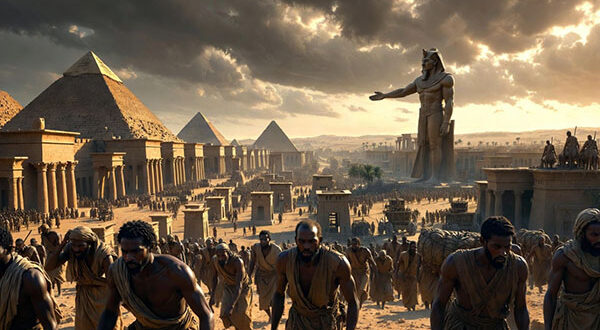
The Book of Exodus begins with a people who grow in Egypt until they become a political threat. Pharaoh, driven by fear, imposes slavery, forced labor, and the death of newborn male children.
Here we find a fundamental key:
Worldly power always fears God’s plan.
Egypt represents a brilliant, powerful, organized civilization… but built upon oppression. It is no coincidence that in spiritual tradition Egypt symbolizes the world without God.
Israel, on the other hand, is the people of the promise—yet reduced to slavery.
Theologically, this already reveals something profound:
The chosen people are not exempt from suffering. Election does not eliminate the Cross.
2. Moses: The Imperfect Man Chosen by God
Moses is one of the most extraordinary figures in all of Scripture. Rescued from the waters (a figure of Baptism), educated in the Egyptian court, forced to flee after killing an Egyptian, he ends up as a shepherd in the desert.
And there, in solitude, God reveals Himself.
The burning bush is one of the most theological moments in the Bible:
“I AM WHO I AM” (Exodus 3:14).
Here God reveals His Name: YHWH, the absolute Being, the One who exists by Himself. He is not just another tribal deity. He is the eternal God.
But what is most moving is not His ontological greatness… but His closeness.
God presents Himself as:
- The God of Abraham
- The God of Isaac
- The God of Jacob
In other words: the God faithful to His covenant.
And when Moses feels incapable, stuttering, insecure… God does not seek a perfect hero. He seeks obedience.
This is profoundly pastoral:
God does not call the qualified. He qualifies the called.
3. The Plagues: Judgment Against False Gods
The ten plagues are not arbitrary punishments. They carry strong theological meaning.
Each plague dismantles an Egyptian deity:
- The Nile turned into blood → defeat of the river god.
- The darkness → humiliation of the sun god.
- The death of the firstborn → judgment upon Pharaoh’s absolute power.
God demonstrates that idols have no power.
In our time, idols have changed names:
- Science without ethics
- Progress without morality
- Freedom without truth
- Technology without a soul
Exodus reminds us that every idol eventually falls.
4. The Passover: The Heart of Exodus (and of Christianity)
The central moment of the book is the institution of the Passover.
A lamb without blemish.
Its blood on the doorposts.
A meal celebrated within the family.
Liberation through blood.
“The blood shall be a sign for you… and when I see the blood, I will pass over you” (Exodus 12:13).
This is pure sacrificial theology.
The Church has always seen in this episode a clear figure of Christ:
- The Lamb without blemish
- Blood that saves
- Liberation from sin
- Passage from death to life
The word “Exodus” means “departure.”
But the word “Passover” means “passage.”
Christ is our true Exodus.
The Mass is our true Passover.
Here we understand the unity between the Old and New Testaments. Traditional liturgy profoundly preserves this continuity.
5. The Red Sea: The Baptism That Sets Us Free
When Israel crosses the Red Sea, it is not merely a strategic escape. It is a salvific act.
Saint Paul interprets it this way:
“All were baptized into Moses in the cloud and in the sea” (1 Corinthians 10:2).
The sea is a figure of Baptism.
Egypt is left behind.
Slavery drowns.
A free people is born.
But pay attention: freedom is not the end. It is the beginning.
6. The Desert: God’s Pedagogy
Many Christians want liberation without the desert. But the desert is indispensable.
In the desert:
- One learns to trust.
- The manna is received (a figure of the Eucharist).
- Water flows from the rock (a figure of Christ).
- The heart is purified.
- The Law is revealed.
The desert is not punishment. It is formation.
Today we live in a culture that flees silence, sacrifice, and waiting. But without the desert there is no holiness.
Pastorally, this is crucial:
Personal crises, spiritual dryness, trials… can be deserts where God is shaping our soul.
7. Sinai and the Law: Freedom Needs Norms
On Mount Sinai, God gives the Ten Commandments.
Many see them as restrictions. But in reality, they are the manual of freedom.
The Law is not oppression.
The Law protects love.
In a society that preaches absolute autonomy, Exodus reminds us that true freedom is not doing what I want, but doing what is good.
“I am the Lord your God, who brought you out of the land of Egypt” (Exodus 20:2).
The commandments begin by recalling liberation. First grace. Then law.
Theologically, this is fundamental:
Christian morality is a response to saving love, not a precondition for being loved.
8. The Golden Calf: The Eternal Temptation
While Moses is on the mountain, the people make a golden calf.
This episode is brutally relevant.
When God seems to delay, man creates a visible god.
When faith requires patience, man seeks immediate security.
The golden calf today can be:
- Money
- Ideology
- Comfort
- Success
- Politics elevated to religion
The sin of the calf was not explicitly denying God. It was replacing Him.
9. The Tabernacle: God Desires to Dwell Among His People
The book ends with the construction of the Tabernacle.
This detail is profoundly theological.
The transcendent God chooses to dwell among His people.
This foreshadows:
- The Incarnation
- The Church
- The Real Presence in the Eucharist
God does not only liberate. God desires to dwell.
10. Practical Applications for Today
Exodus is not just history. It is a spiritual itinerary.
Ask yourself:
- What is my Egypt?
- What enslaves me?
- Have I listened to God’s voice?
- Am I willing to cross my Red Sea?
- Do I accept the desert?
- Have I built any golden calves?
- Do I live the commandments as a path of love?
Concrete Application:
- A serious examination of conscience: Identify real forms of slavery.
- Frequent confession: Cross the Red Sea of forgiveness.
- Faithfulness to the Mass: Live the true Passover.
- Accept trials as formative deserts.
- Daily prayer life: Listen to the voice of the burning bush.
11. Exodus and the Modern World
We live in an era that seeks to erase Christian memory. But without Exodus, Redemption cannot be understood.
Contemporary culture promises freedom… but generates new forms of slavery:
- Addictions
- Existential emptiness
- Radical individualism
- Loss of transcendent meaning
The message of Exodus is countercultural:
True liberation does not come from political power.
It does not come from technological progress.
It does not come from material well-being.
It comes from God.
Conclusion: Your Life Is an Exodus
You were not created for Egypt.
You were created for the Promised Land.
But the path passes through:
- The blood of the Lamb
- The crossing of the sea
- The desert
- The Law
- Purification
- The presence of God
Exodus does not end in the book. It continues in your story.
God still says:
“Let my people go” (Exodus 5:1).
And perhaps today He is saying:
Let your soul go.
Leave lukewarmness.
Leave sin.
Leave fear.
Walk.
For the God who liberated Israel is still the same.
And His promise still stands.