Related Articles
There are stories that never grow old. Not because they are childish, but because they are eternal. The scene of a young shepherd facing a fully armed giant is not simply a heroic tale: it is an X-ray of the human soul. It is your story. It is mine. It is the story of the Church in every century.
The episode of David and Goliath, narrated in the First Book of Samuel (1 Samuel 17), is not a moral fable or an isolated epic account. It is a profound theological revelation about faith, divine election, humility, grace, and spiritual combat.
And today, more than ever, we need to understand it.
1. The Context: When Fear Governs the People of God
Israel is paralyzed. The army of the Lord trembles before a Philistine enemy who has a champion: Goliath of Gath, armed with spear, javelin, and an impressive suit of armor. For forty days he challenges Israel:
“Choose a man for yourselves, and let him come down to me… If he is able to fight with me and kill me, then we will be your servants; but if I prevail against him and kill him, then you shall be our servants” (1 Sam 17:8–9).
Forty days. In Scripture, the number forty indicates trial, purification, preparation. Israel is being tested. But it responds not with faith, but with fear.
Here appears the first theological lesson:
the enemy’s greatest victory is not strength… it is fear.
Goliath has not yet attacked. He only speaks. He intimidates. He humiliates. And that is enough to paralyze God’s chosen people.
Does it sound familiar?
We live in a culture that constantly shouts against the faith. It ridicules Christian morality. It intimidates those who want to live chastely. It presents sin as progress. And many believers fall silent, retreat, or feel ashamed.
The modern giant does not always carry a sword. Sometimes he carries a microphone.
2. David: The Chosen One Who Did Not Seem Fit
While trained soldiers tremble, a young shepherd appears. He is not a professional warrior. He has no armor. He has no prestige. He has not even been summoned to battle.
David comes simply to bring food to his brothers.
But he hears the Philistine’s blasphemy and burns with zeal:
“Who is this uncircumcised Philistine, that he should defy the armies of the living God?” (1 Sam 17:26).
Here is the central point:
David is not offended by wounded pride. He is indignant for the honor of God.
Theologically, this is fundamental. Spiritual combat does not arise from a wounded ego, but from love for divine glory.
David had already been anointed by the prophet Samuel in secret (1 Sam 16). No one publicly knew. But God did. And that was enough.
First great spiritual lesson:
God prepares in hiddenness those He will use in public.
3. The False Solution: Saul’s Armor
King Saul tries to dress David in his armor. It seems reasonable. If he is going to fight, let him do so with proper human means.
But David cannot even walk in it. And he rejects it.
This gesture carries immense spiritual depth.
Saul’s armor represents the constant temptation to trust in what the world considers effective: power, strategy, image, outward strength.
David chooses something else.
He takes his staff, his sling, and five smooth stones from the brook.
“You come to me with a sword, with a spear, and with a javelin. But I come to you in the name of the Lord of hosts” (1 Sam 17:45).
Here is the theological heart of the narrative:
victory belongs to God, not to human means.
This is not spiritual romanticism. It is doctrine.
Saint Paul will express it centuries later:
“God chose what is foolish in the world to shame the wise; God chose what is weak in the world to shame the strong” (1 Cor 1:27).
4. The Combat: One Stone That Changed History
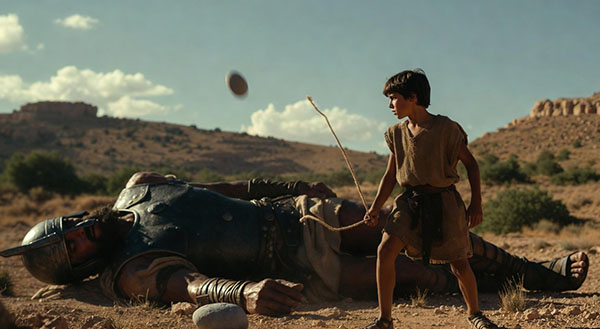
David does not improvise. He has experience tending sheep. He has defended his flock from lions and bears. Faithfulness in small things has prepared him for great things.
One stone.
One strike.
The giant falls.
The sword that decapitates him is his own.
Here is a profound spiritual key:
God often defeats the enemy with his own weapons.
The devil’s pride becomes his condemnation. The Cross—an instrument of Roman torture—becomes the instrument of redemption in the Gospel according to John 19.
David is a figure of Christ.
Goliath is a figure of sin, of Satan, of every power that defies God.
The true and definitive “David” is Jesus Christ, who conquers not with military force, but with obedience unto death.
5. Christological Interpretation: David as a Type of Christ
The patristic tradition has seen in this episode a clear prefiguration of the mystery of Redemption.
- David is the anointed one (messiah).
- He is initially rejected.
- He is the smallest among his brothers.
- He defeats the enemy in the name of the Lord.
- He saves the people who were paralyzed.
Christ is the true Anointed One.
Christ is the despised Son.
Christ defeats the “giant” of sin.
And He does so from apparent weakness.
Here we understand something essential for the spiritual life:
Christian strength is not aggressiveness; it is fidelity.
6. Pastoral Application: Who Is Your Goliath?
We cannot remain at the level of admiration for the story. Scripture is not given to us to entertain, but to transform.
Ask yourself honestly:
- What giant paralyzes you?
- An addiction?
- A recurring sin?
- Fear of what others think?
- Spiritual lukewarmness?
- Despair over the situation of the world or the Church?
Many believers live like the army of Israel: they know God, but they do not truly trust Him.
The modern giant may be:
- Moral relativism.
- Cultural pressure.
- Ideologies that ridicule faith.
- Spiritual comfort and complacency.
And the temptation is to wait for someone else to fight.
But perhaps God is calling you.
7. Five Stones for Your Spiritual Combat
If we want to apply this teaching today, we need our own “five stones.” I propose five concrete weapons:
1. Daily prayer
Without prayer, you are a soldier without weapons.
2. Frequent confession
Unconfessed sin feeds the giant.
3. The Eucharist
Strength does not come from you. It comes from Christ.
4. Doctrinal formation
David knew who his God was. Many Christians today do not know their faith.
5. Humility
Pride can turn even the believer into a Goliath.
8. A Necessary Warning: Not All of Us Are David… Until We Are
At certain moments in life we are David. At others, we are Israel paralyzed. And sometimes—if we are not vigilant—we may behave like Goliath, mocking, despising, trusting in our own strength.
The spiritual life is dynamic.
But there is one consoling certainty:
God does not choose the strongest.
He chooses the one who trusts.
9. Contemporary Relevance: A Church Facing Cultural Giants
Today the Church faces enormous challenges: aggressive secularization, moral crisis, attacks on the family, doctrinal confusion.
Many speak of decline. Others of defeat.
But the story of David reminds us that the size of the enemy does not determine the outcome.
Fidelity does.
In every age, God raises up “Davids”: hidden saints, faithful families, devoted priests, courageous young people.
They do not need applause. They need faith.
10. Conclusion: The True Combat
David did not fight for fame. He fought for fidelity.
The Christian does not fight for cultural victory. He fights for holiness.
And here is the final teaching:
The giant is not greater than grace.
Fear is not stronger than faith.
Sin is not more powerful than the Cross.
When you feel small, remember:
the history of salvation is not written by giants.
It is written by those who trust in God.
For in the end, as the psalmist says:
“Some trust in chariots and some in horses, but we trust in the name of the Lord our God” (Ps 20:7).
When your moment comes—because it will come—do not hide among the fearful soldiers.
May you be able to say, like David:
“The Lord who delivered me from the paw of the lion and from the paw of the bear will deliver me from this Philistine” (1 Sam 17:37).
And then you will understand that the real battle was never against an external giant…
but against the fear within.
And that battle, by the grace of God, is already won.