Related Articles

The Crucified One who teaches us how to die… in order to learn how to live
In an age marked by fear of death, the rejection of suffering, and the obsession with prolonging life at any cost, a profoundly countercultural image emerges with force: the Christ of the Good Death, popularly known as the Christ of Mena.
It is not just a sculpture. It is not merely a Holy Week tradition. It is, in fact, a living catechesis, a silent preaching that spans generations and that, today more than ever, needs to be rediscovered.
Because speaking of a “good death” in the 21st century sounds uncomfortable… yet deeply necessary.
1. History: between devotion, tragedy, and restoration
The original image of the Christ of the Good Death is attributed to the great Baroque sculptor Pedro de Mena, one of the most important masters of Spanish religious imagery in the 17th century.
That sculpture, of overwhelming beauty and serenity, depicted Christ already dead on the cross, with His body surrendered and His soul entrusted to the Father.
However, the history of this devotion has not been without suffering:
- The original image was destroyed during the unrest of 1931 in Spain.
- Years later, the sculptor Francisco Palma Burgos created the current image, preserving the spirit of the original.
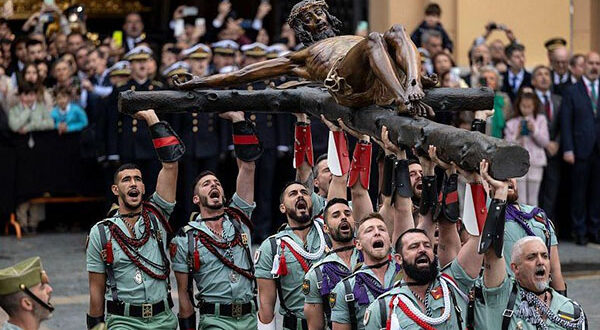
- The devotion was deeply embraced by the Spanish Legion, which each year leads one of the most emblematic moments of Holy Week in Málaga: the transfer and enthronement of the Christ.
This connection with the Legion is not anecdotal. It is profoundly symbolic: men prepared for death who find in Christ the ultimate meaning of their self-giving.
2. What does “Good Death” mean? A forgotten theological key
Speaking of a “good death” may sound strange today. But in Christian tradition it is a deeply rich concept.
It is not about dying without pain. Nor about an “easy” death.
It is about dying in the grace of God, reconciled, trusting, abandoned into His hands.
The Christ of Mena represents precisely that moment:
- Christ has expired.
- There is no exaggerated drama.
- There is no despair.
- There is total surrender.
As the Gospel says:
“Father, into your hands I commend my spirit” (Gospel of Luke 23:46)
This is the heart of the “good death”: filial trust in God even in the final moment.
3. The theological aesthetics of the Christ of Mena
The image is not only art. It is theology in wood.
Every detail speaks:
• The lifeless yet serene body
There is no extreme tension. Christ has fulfilled His mission.
This reminds us that death, in Christ, is not defeat… but fulfillment.
• The inclined head
It is not desperate abandonment, but rest in the Father.
• The absence of excessive dramatism
Unlike other crucifixes, peace prevails here.
It is an invitation to look at death through faith, not fear.
4. Christ and death: a spiritual revolution
The great drama of modern man is not only dying… but not knowing what he lives for or how to die.
Today’s culture:
- Avoids speaking about death
- Hides it
- Medicalizes it
- Dehumanizes it
But Christ does exactly the opposite:
- He faces it
- He embraces it
- He transforms it
Saint Paul expresses this with striking force:
“Where, O death, is your victory?” (First Letter to the Corinthians 15:55)
The Christ of the Good Death does not deny death.
He redeems it.
5. The Legion and the Christ: spirituality of sacrifice
The bond between the Spanish Legion and the Christ of Mena is deeply spiritual.
The famous hymn “The Bridegroom of Death” is not a superficial glorification of death, but an expression—albeit imperfect—of a Christian truth:
Life finds its fullness when it is given away.
The legionaries, as they carry the Christ, remind us of something essential:
- Death is not the end if there is love
- Sacrifice has meaning when it is united to Christ
- Self-giving transforms fear into mission
6. Practical applications: learning to live well… in order to die well
Here lies the pastoral core of the Christ of the Good Death.
It is not about obsessing over death.
It is about living in such a way that we do not fear dying.
1. Live in grace
The “good death” begins today:
- Frequent confession
- Sacramental life
- Ongoing conversion
2. Reconcile
Do not leave wounds open:
- Forgive
- Ask for forgiveness
- Heal relationships
3. Put life in order
Ask yourself:
- What is essential?
- What will I bring before God?
4. Accept the daily cross
Suffering, united to Christ, does not destroy… it transforms.
5. Cultivate hope
The Christian does not await death… but eternal life.
7. An urgent message for today
In a society where the following are increasing:
- Euthanasia
- Fear of suffering
- Despair
The Christ of the Good Death offers a radically different response:
- Life has meaning until the very last moment
- Suffering can be redemptive
- Death is not the end
It is not about seeking death…
It is about not fearing it when it comes, because Christ has already conquered it.
8. Conclusion: looking at the Crucified to overcome fear
The Christ of Mena does not leave anyone indifferent.
It forces us to ask uncomfortable questions:
- Am I prepared to die?
- Am I truly living?
- Where is my hope placed?
But above all, it offers us a certainty:
Death does not have the final word.
Because in that lifeless body, nailed to the cross, the victory of the Resurrection is already beating.
And whoever learns to die with Christ…
finally learns how to live.