Related Articles
Every time we attend Holy Mass, a solemn and deeply mysterious moment arrives. The priest raises the consecrated Host and pronounces words that have echoed for two thousand years:
“Behold the Lamb of God, behold Him who takes away the sins of the world. Blessed are those called to the supper of the Lamb.”
They are brief words. Yet within them lies the entire history of salvation: from the sacrifice of lambs in the Old Testament to the perfect sacrifice of Christ on the Cross, made present on the altar.
Many Catholics hear this phrase every Sunday… but few pause to contemplate the immense depth it contains.
Who is this Lamb?
Why does it speak of taking away the sin of the world?
And why does the Church repeat these words just before Holy Communion?
Understanding this does not only illuminate the Mass.
It illuminates the entire Christian life.
1. A Phrase That Did Not Begin in the Mass: The Cry of John the Baptist
The expression “Lamb of God” did not first appear in the liturgy, but in the Gospel.
The first to pronounce these words was John the Baptist, when he saw Jesus approaching the Jordan.
The Gospel recounts:
“The next day he saw Jesus coming toward him and said:
‘Behold, the Lamb of God, who takes away the sin of the world!’”
(John 1:29)
John is not simply saying something poetic.
He is revealing the profound identity of Christ.
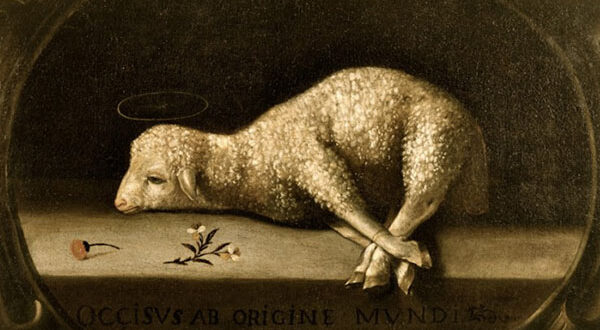
The Jews who heard John immediately understood the reference: the lamb was the sacrificial animal par excellence.
In the Temple of Jerusalem, lambs were sacrificed continually:
- for sin
- for atonement
- during religious feasts
- especially at Passover
Therefore, when John calls Jesus the Lamb of God, he is making a radical declaration:
Jesus is the definitive sacrifice who will take away the sin of the world.
2. The Origin of the Symbol: The Lambs of the Old Testament
To fully understand this phrase, we must go back many centuries.
The symbolism of the lamb appears repeatedly throughout the history of Israel.
The Lamb of Abraham
In the Book of Genesis, God asks Abraham to offer his son Isaac in sacrifice. At the last moment, God stops the sacrifice and a ram appears to take Isaac’s place.
Isaac had asked:
“Father… here are the fire and the wood, but where is the lamb for the sacrifice?”
(Genesis 22:7)
Abraham’s answer is prophetic:
“God Himself will provide the lamb for the sacrifice.”
The Fathers of the Church saw in this scene a figure of Christ.
The true Lamb would be provided by God Himself.
The Passover Lamb
But the symbol reaches its fullness in the Book of Exodus.
When the people of Israel were enslaved in Egypt, God commanded them to sacrifice a lamb without blemish and mark their doorposts with its blood.
“The blood shall be a sign for you on the houses where you are; when I see the blood, I will pass over you.”
(Exodus 12:13)
That night, Israel’s liberation took place.
The Passover lamb had three essential characteristics:
- it had to be without blemish
- its blood saved
- it had to be eaten in a ritual meal
This detail is fundamental.
The sacrifice did not end at the altar: the lamb had to be eaten.
Centuries later, Christ would celebrate the Passover… and give a completely new meaning to that meal.
3. Christ: The True Lamb of God
The entire Old Testament points toward Christ.
When Jesus Christ dies on the Cross, the Gospels emphasize remarkable details that connect Him with the Passover lamb:
- He dies on the eve of Passover
- none of His bones are broken
- His blood is poured out for salvation
Saint Paul states it clearly:
“Christ, our Passover, has been sacrificed.”
(1 Corinthians 5:7)
Christ is not merely a moral teacher.
Christ is the sacrificial victim offered for the redemption of the world.
For this reason, Catholic theology affirms that the Cross is:
- sacrifice
- expiation
- redemption
- reconciliation
And that sacrifice does not remain in the past.
It becomes present in the Eucharist.
4. The Lamb in the Holy Mass
Before Communion, the priest raises the consecrated Host and repeats the words of John the Baptist.
This is not a symbolic phrase.
It is a profession of faith.
The Church proclaims that in the Eucharist Christ is truly present:
- true God
- true man
- body, blood, soul, and divinity
The Host is not a symbol.
It is the Lamb who was slain and now glorified.
That is why the priest invites the faithful to Communion by saying:
“Blessed are those called to the supper of the Lamb.”
This is a direct reference to the heavenly banquet.
5. The Glorious Lamb of the Apocalypse
The Bible ends with a striking vision.
In the Book of Revelation, the figure of the Lamb appears repeatedly.
Saint John contemplates heaven and describes what he sees:
“I saw a Lamb standing, as though it had been slain.”
(Revelation 5:6)
This detail is deeply theological.
The Lamb is slain (sacrificed), yet standing (resurrected).
It is Christ:
- dead
- risen
- glorified
And all of heaven worships Him:
“Worthy is the Lamb who was slain to receive power and riches and wisdom and strength and honor and glory and blessing.”
(Revelation 5:12)
The liturgy of the Mass is a foretaste of that heavenly liturgy.
Every time we participate in the Eucharist we unite ourselves to the eternal worship of the Lamb.
6. “Who Takes Away the Sin of the World”: The Heart of the Gospel
The mission of the Lamb is clear: to take away sin.
Sin is the great tragedy of humanity.
It is not merely a moral fault.
It is a rupture with God.
Sin:
- destroys the soul
- breaks communion with God
- wounds others
- introduces death into the world
Christ came precisely to destroy that power.
As Saint John writes:
“The blood of Jesus His Son cleanses us from all sin.”
(1 John 1:7)
But there is an important nuance here.
Christ won redemption for all, but each person must freely accept it.
This is why the sacraments exist, especially:
- Baptism
- Confession
- The Eucharist
7. The Response of the Believer: “Lord, I Am Not Worthy…”
After hearing the proclamation of the Lamb, the faithful respond with humility:
“Lord, I am not worthy that you should enter under my roof, but only say the word and my soul shall be healed.”
These words come from the Gospel.
They were spoken by the Roman centurion before Jesus.
His faith deeply impressed the Lord.
The Church repeats them before Communion because they remind us of a fundamental truth:
no one deserves the Eucharist.
It is an immense gift of divine mercy.
For this reason, the Catholic tradition has always insisted that Holy Communion should be received:
- in a state of grace
- with spiritual preparation
- with profound reverence
8. What Does This Mean for Our Daily Life?
This phrase from the Mass is not merely liturgical.
It is a program for Christian living.
Contemplating the Lamb of God teaches us three fundamental attitudes.
1. Living in conversion
Christ takes away sin… but we must allow Him to act.
This means:
- examination of conscience
- frequent confession
- spiritual struggle
The Christian life is not spiritual comfort.
It is constant conversion.
2. Living with gratitude
Every Communion is a miracle.
The same Christ who died on the Cross comes into our heart.
This should transform the way we live the Mass.
We do not go to a social event.
We go to an encounter with the Lamb of God.
3. Living as lambs in the midst of the world
Jesus is not only the Lamb.
He also invites us to imitate His meekness.
In a world marked by:
- violence
- pride
- selfishness
Christians are called to live with:
- humility
- sacrifice
- love
9. The Lamb Who Transforms the World
Human history often seems dominated by force, power, and violence.
But Christianity proclaims something astonishing:
the world was saved by a Lamb.
Not by an army.
Not by an empire.
Not by an ideology.
But by a man who accepted being sacrificed out of love.
Every time we hear at Mass:
“Behold the Lamb of God…”
we are reminded of the deepest truth of the faith:
the salvation of the world did not come through power…
it came through the sacrifice of Christ.
10. A Personal Invitation
The next time you hear those words at Mass, try to pause for a moment.
Look toward the altar.
Contemplate the Lamb.
And remember:
- that Lamb died for you
- that Lamb conquered sin
- that Lamb desires to dwell in your heart
Because in the end, the entire Christian life can be summarized in a single attitude:
recognizing the Lamb of God and following Him.
As Scripture says:
“These are the ones who follow the Lamb wherever He goes.”
(Revelation 14:4)
And that, in the deepest sense, is the true path to holiness.