Related Articles


There are questions that make us uncomfortable… and this is one of them:
why did God, who is love, allow such a radical punishment as the Flood?
Doesn’t it seem contradictory? Isn’t it excessive?
And yet, when one goes deeper—not superficially—into the account in Genesis, something very different emerges: this is not the story of a cruel God, but of a patient God who, faced with the total corruption of man, acts to save what can still be saved.
This article seeks not only to answer that question, but to help you look at your own life in light of this event. Because the Flood is not just ancient history: it is a mirror of our time… and a deeply relevant warning.
1. The forgotten context: the world before the Flood
Many people judge the Flood without understanding its context. But Scripture is very clear:
“The Lord saw that the wickedness of man was great in the earth, and that every imagination of the thoughts of his heart was only evil continually.” (Genesis 6:5)
It does not say “some people were bad.”
It does not say “there were isolated sins.”
It says something chilling:
👉 evil had penetrated everything: thoughts, desires, structures, culture.
It was a humanity that was:
- Violent
- Corrupt
- Completely turned away from God
- Without repentance
The next verse summarizes it starkly:
“Now the earth was corrupt in God’s sight, and the earth was filled with violence.” (Genesis 6:11)
Here we find a key point:
this was not an arbitrary punishment… it was the consequence of total corruption.
2. Punishment or justice? The holiness of God in action
We live in a time where speaking about divine justice makes people uncomfortable. We prefer a “tolerant” god who never judges.
But that is not the true God.
God is love, yes…
but He is also just.
If God did not act in the face of evil:
- He would be indifferent to injustice
- He would abandon the innocent
- He would allow evil to triumph without limit
The Flood reveals something uncomfortable but necessary:
👉 God is not an accomplice to evil.
When humanity reaches a point where it:
- rejects all grace
- perverts everything that is good
- and destroys even the possibility of redemption
then God intervenes.
Not as a tyrant…
but as a just judge.
3. God’s patience: the detail many overlook
There is something that almost no one mentions:
👉 God did not act immediately.
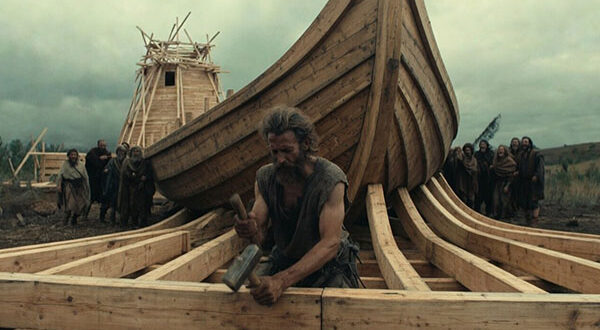
For years—according to tradition—Noah built the ark.
And that act was not only preparation… it was preaching.
Every blow of the hammer was a message:
“Repent, for judgment is coming.”
But no one listened.
Here we find a truth that runs throughout salvation history:
👉 God always warns before He judges.
He never punishes without first giving:
- time
- opportunities
- calls to conversion
The problem is not that God does not speak…
it is that man stops listening.
4. Noah: proof that God always preserves a faithful remnant
In the midst of a corrupt humanity, a key figure appears:
“But Noah found favor in the eyes of the Lord.” (Genesis 6:8)
Noah was not perfect, but he was righteous in his generation.
And here is a profound spiritual principle:
👉 God never destroys without preserving a faithful remnant.
This will be repeated throughout biblical history:
- in Israel
- in times of persecution
- in crises within the Church
There is always an “ark.”
And that ark is not just a boat…
it is a symbol:
- of salvation
- of obedience
- of refuge in the midst of chaos
For Christians, this image finds its full meaning in:
👉 the Church
5. The Flood as a figure of Baptism
Christian tradition has seen in the Flood something far deeper than punishment.
It is a prefiguration of Baptism.
The apostle Peter teaches this clearly:
“Baptism, which corresponds to this, now saves you.” (1 Peter 3:21)
What does this mean?
- The water destroys sin
- But it saves the righteous
- It marks a new beginning
The Flood is not only destruction…
it is also purification and rebirth.
God does not erase out of whim.
👉 God cleanses in order to begin again.
6. And today? The modern world in the mirror of the Flood
This is where the topic becomes uncomfortably relevant.
Look around you:
- moral relativism
- the trivialization of evil
- contempt for life
- cultural corruption
- rejection of God
Does it not sound familiar?
The problem is that today we no longer speak about sin.
We justify it, disguise it, even celebrate it.
But the spiritual logic does not change:
👉 when man radically distances himself from God, he self-destructs.
The Flood is not only a punishment of the past…
it is an ongoing warning:
without God, humanity sinks.
7. The great spiritual lesson: the true “flood” begins in the heart
Before thinking about global punishments, we must look within.
Because the real flood does not begin in the sky…
it begins in the soul.
Every time you:
- normalize sin
- silence your conscience
- stop striving for truth
you allow “the waters” to rise.
But there is also good news:
👉 you can build your own ark.
How?
- through daily prayer
- through the sacraments
- through a coherent moral life
- through fidelity in small things
Noah did not save the whole world…
but he saved what God entrusted to him.
And that is exactly what is asked of you.
8. God does not want to destroy: He wants to save
This is the key point you must never forget.
God does not delight in punishment.
In fact, the entire history of salvation culminates in the opposite of the Flood:
👉 not in water… but on a Cross.
In Jesus Christ, God does not destroy the sinner…
👉 He allows Himself to be destroyed in order to save him.
If the Flood shows the gravity of sin,
the Cross reveals the immensity of mercy.
9. Conclusion: an urgent and personal call
The Flood is not a story for children.
It is a serious call for adults.
It reminds us that:
- evil has consequences
- God is just
- but also infinitely patient
- and always offers a path to salvation
The question is not whether God will send another flood.
The real question is:
👉 which side are you on?
- With the world that mocks God?
- Or in the ark, even if it seems foolish to others?
Because in the end, the story of the Flood is not about water…
👉 it is about decisions.
And yours, today, matters more than you imagine.