Related Articles



Introduction: a phrase that is not just a memory
There are words that change history. But there are others that sustain it.
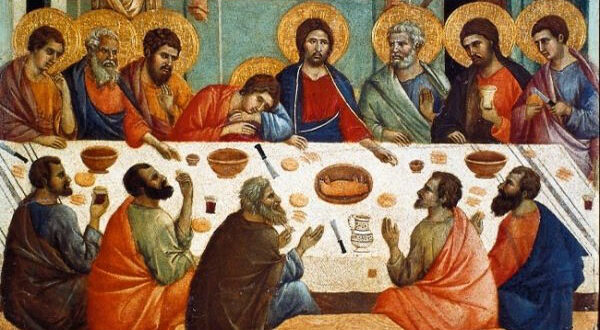
When Christ, at the Last Supper, says:
“Do this in memory of me” (Lk 22:19)
He is not simply giving a liturgical instruction or proposing a symbolic gesture. He is entrusting to the Church—and to all humanity—the very heart of His presence in the world: the Eucharist.
This mandate is not a psychological recollection, like recalling a photograph from the past. It is a living memorial, a real making-present of the redemptive sacrifice. In it is contained the mystery of faith, the continuity of the Church, and, in a profoundly real sense, the spiritual sustaining of the world.
Today, in a context marked by haste, superficiality, and forgetfulness of God, these words resonate with greater force than ever. To understand them is to rediscover the center of Christian life.
1. The historical root: the Last Supper and the New Covenant
To understand the depth of Christ’s mandate, we must place ourselves in its context: the Last Supper, celebrated within the framework of the Jewish Passover.
Passover: memory that makes present
For the people of Israel, Passover was not merely a remembrance of the Exodus. It was an effective memorial: each generation spiritually participated in the liberation from Egypt.
Christ takes this tradition and brings it to fulfillment.
The radical newness of Jesus
At the Supper, Jesus does not merely interpret the bread and wine:
- “This is my Body…”
- “This is my Blood…”
He does not say “this symbolizes,” but “this is.” Here the Sacrament is instituted.
And immediately He adds the mandate:
“Do this in memory of me”
That is to say:
👉 Make present this same sacrifice
👉 Repeat this gesture which is not repetition, but actualization
Here are born the ministerial priesthood, the Eucharistic liturgy, and the sacramental life of the Church.
2. “Memory” in the biblical sense: far more than remembering
In our modern culture, “memory” usually means mental recollection. But in the Bible, the term (Hebrew zikkaron, Greek anamnesis) has a much deeper meaning.
Memory as real presence
When God “remembers,” He acts. When the people “remember,” they participate.
Thus, in the Eucharist:
- We do not remember Christ as absent
- Christ becomes truly present
This is the heart of Catholic doctrine: the real presence.
3. The theological dimension: the sacrifice that sustains the world
Here we enter the core of the mystery.
The Eucharist is the same sacrifice of the Cross
The Church teaches that the Mass is not a repetition of Christ’s sacrifice, but its unbloody re-presentation.
- On Calvary: bloody sacrifice
- In the Mass: the same sacrifice, made present sacramentally
Therefore, every Mass has infinite value.
A world sustained by the Eucharist
From a profound theological perspective, we can affirm something astonishing:
👉 The world continues to exist because Christ continues to offer Himself to the Father.
The Eucharist is:
- A source of grace
- Reparation for sin
- Constant intercession
The saints understood this well. Many affirmed that if the Mass were to disappear, the world could not endure.
4. The ecclesial dimension: the Church is born and lives from the Eucharist
The Church is not an organization that celebrates the Eucharist.
👉 It is a reality that is born from it.
“The Church makes the Eucharist and the Eucharist makes the Church”
Every time the Mass is celebrated:
- Christ gathers His people
- He nourishes them with His Body
- He sends them into the world
Without the Eucharist:
- There is no full Christian life
- There is no real unity
- There is no fruitful mission
5. A contemporary crisis: the loss of the sense of mystery
We live in an age in which many have lost the sense of the sacred.
Present-day symptoms
- Superficial attendance at Mass
- Loss of awareness of the real presence
- Reduction of the liturgy to something emotional or merely social
And yet, Christ’s mandate remains in force. It has not lost its power.
On the contrary, today it is more urgent than ever.
6. Practical applications: living the mandate today
How can we respond today to “Do this in memory of me”?
1. Rediscover the Mass as the center of life
Not as an obligation, but as an encounter.
👉 Go to Sunday Mass with awareness:
- Prepare yourself interiorly
- Arrive with recollection
- Participate actively (not merely attend)
2. Adore the real presence
The Eucharist does not end with the Mass.
👉 Eucharistic adoration:
- Silence before God
- Transforming encounter
- School of prayer
In a noisy world, adoration is revolutionary.
3. Live eucharistically
To receive Christ implies imitating Him.
👉 A Eucharistic life is:
- Self-giving (like broken bread)
- Humble
- Sacrificial
- Loving
That is, becoming oneself an “offering.”
4. Make reparation and offer
Every Mass has infinite value.
We can:
- Offer it for our families
- For the deceased
- For the conversion of the world
This gives meaning even to suffering.
5. Educate in the mystery
Especially within the family.
👉 Teach children:
- Who is in the Tabernacle
- What it means to receive Communion
- How to behave in church
The transmission of faith passes through the Eucharist.
7. The spiritual dimension: the Eucharist as medicine for the soul
Christ does not remain in an idea. He remains as food.
The Eucharist:
- Strengthens against sin
- Heals interior wounds
- Gives deep peace
- Unites with God in an intimate way
For this reason, the saints called it:
👉 “Bread of the strong”
👉 “Medicine of immortality”
8. An urgent call: return to the center
The modern world seeks meaning in a thousand places: success, pleasure, ideologies. But the human heart still hungers for the infinite.
And Christ responds:
👉 “Take and eat”
It is not a discourse. It is a gift.
Conclusion: the mandate that remains alive
“Do this in memory of me” is not a phrase of the past.
It is a living, current, urgent command.
Every Mass is:
- Heaven touching earth
- Christ giving Himself anew
- Love made present
And every Christian is called to respond.
It is not enough to understand it.
It must be lived.
Because, in the end, this mandate does not only sustain the world…
👉 It is meant to sustain your life as well.