Related Articles

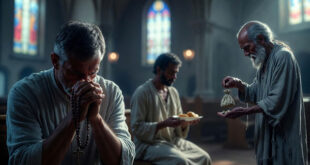
In a world saturated with noise—constant notifications, instant opinions, endless debates—silence has become a rare treasure. Paradoxically, in the Christian spiritual tradition, silence has never been emptiness; it is a place filled with presence. It is the space where God speaks to the heart.
Among all the saints, there is one who embodies this mystery with extraordinary depth: Saint Joseph. In the Gospels, not a single word spoken by him is recorded, yet his figure speaks with tremendous power. His silence is not absence; it is contemplation, obedience, listening, and active love.
Saint Joseph teaches us something that modern humanity desperately needs to rediscover: one can deeply contemplate God without saying a single word.
This article invites us to enter into that mystery: to understand the silence of Saint Joseph theologically, to discover its spiritual relevance, and to learn how to live today the art of sacred silence.
1. The Great Silence of Saint Joseph in the Gospels
The Gospels recount decisive moments in Saint Joseph’s life: his betrothal to Mary, his anguish over the inexplicable pregnancy, the flight into Egypt, the hidden life in Nazareth, and the episode of the Child Jesus lost in the temple.
Yet there is a striking detail: Joseph never speaks.
This is not accidental.
In Sacred Scripture, silence often indicates an attitude of deep listening before the mystery of God.
Saint Matthew describes one of the key moments:
“Joseph, son of David, do not fear to take Mary your wife into your home, for it is through the Holy Spirit that this child has been conceived in her.”
(Matthew 1:20)
Joseph does not respond to the angel with speeches. He does not argue. He does not demand explanations.
The Gospel simply says:
“When Joseph awoke, he did as the angel of the Lord had commanded him.”
(Matthew 1:24)
Joseph’s silence becomes obedience.
His faith does not need words because it is expressed through actions.
2. Silence as a Theological Attitude
From the perspective of spiritual theology, Saint Joseph’s silence can be understood in three fundamental dimensions.
1. Silence of Listening
Joseph lives in constant openness to God.
He does not act from impulsiveness but from interior listening.
The dreams in which God speaks to him reveal a heart that is available.
Interior silence allows something essential:
to discern the voice of God.
The prophet Elijah experienced the same when God did not manifest Himself in the earthquake or the fire, but in
“a still small voice.”
(1 Kings 19:12)
Silence is the space where that whisper can be heard.
2. Silence of Contemplation
Saint Joseph lived daily alongside two of the greatest mysteries in history:
- Jesus Christ, the Son of God made man
- Mary, full of grace
Let us imagine his daily life:
- working with wood
- eating with his family
- walking through the streets of Nazareth
- watching the child Jesus play
Every gesture was a mystery.
Saint Joseph learned something that great mystics would later describe centuries afterward:
contemplation can occur within the ordinary.
He did not need extraordinary visions.
He lived with God under the same roof.
3. Silence of Humility
Silence also reveals Joseph’s central virtue: humility.
He is the guardian of the Redeemer, yet he seeks no prominence.
The history of salvation moves forward thanks to his silent fidelity.
In the logic of the Kingdom of God, greatness is not measured by the noise we make but by invisible faithfulness.
Jesus Himself would later say:
“Your Father who sees in secret will repay you.”
(Matthew 6:6)
Joseph is the man of God’s hidden secret.
3. Saint Joseph: Master of Active Silence
It is important to clarify something essential:
Christian silence is not passivity.
Joseph’s silence is full of action.
Let us observe his decisions:
- he accepts Mary
- he protects the Child
- he flees to Egypt
- he returns to Israel
- he works to support the family
- he educates Jesus
Each action arises from deep listening to God.
We could say that Joseph lives what might be called:
the active silence of faith.
He does not need to speak much because his entire life is a response to God.
4. Silence in the Spiritual Tradition of the Church
Saint Joseph becomes a model for the entire Christian spiritual tradition.
Many saints understood that silence is a gateway to God.
For example:
Saint John of the Cross
The great Carmelite mystic said:
“The Father spoke one Word, which was His Son, and He always speaks it in eternal silence.”
Saint Teresa of Ávila
In contemplative prayer she discovered that:
God communicates beyond words.
The Desert Monks
The first Christian monks withdrew into the desert seeking silence in order to purify the heart.
For them, silence was a way to fight three interior enemies:
- distraction
- vanity
- superficiality
Saint Joseph anticipates this spirituality centuries earlier.
5. The Noise of the Modern World
Today we live in a culture radically opposed to silence.
We are surrounded by:
- screens
- news cycles
- constant debates
- social media
- perpetual music
- visual stimuli
This excess of noise creates something deep:
an inability to listen to God.
Many Christians say:
“God does not speak to me.”
But perhaps the problem is not that God is silent.
Perhaps we are the ones who do not leave space to hear Him.
Saint Joseph invites us to rediscover silence as a spiritual discipline.
6. How to Practice Sacred Silence Today
The example of Saint Joseph can be translated into concrete practices.
Here are some powerful ones.
1. Create Real Moments of Silence
Dedicate each day 10 or 15 minutes without stimuli:
- no phone
- no music
- no conversation
Only presence.
This can be done:
- before the Blessed Sacrament
- by slowly reading the Gospel
- simply by remaining in quiet stillness
This small habit opens the heart.
2. Practice Listening Before Speaking
Saint Joseph teaches a wisdom that is greatly needed today:
listen first.
Before responding in a conversation:
- pause
- understand
- reflect
Silence also improves our relationships.
3. Rediscover Contemplative Prayer
Not every prayer requires many words.
Christian tradition knows contemplative prayer:
simply being with God.
Like a child resting in the presence of his father.
Saint Joseph surely lived this form of prayer in Nazareth.
4. Value Everyday Life
Nazareth was a small, hidden, and seemingly irrelevant place.
Yet there the greatest spiritual revolution in history unfolded.
This reminds us of something essential:
God acts in the ordinary.
In work.
In family life.
In daily routine.
If we live with interior attentiveness, every moment can become a place of encounter with God.
7. Silence as a Path Toward Holiness
Saint Joseph demonstrates that great speeches are not necessary to become a saint.
His path was simple:
- listen
- obey
- work
- love
- protect
- trust in God
Silence purifies the heart because it forces us to confront ourselves.
And there, in that interior space, God begins to act.
8. Saint Joseph, Patron of the Interior Life
For this reason the Church has recognized him as:
- Patron of the Universal Church
- Model for fathers
- Protector of families
- Guide of the interior life
But we could also call him:
Patron of contemplative silence.
In a world full of words, Saint Joseph reminds us that the relationship with God does not depend on religious noise, but on silent fidelity.
Conclusion: Learning to Gaze at God in Silence
The life of Saint Joseph teaches us a profound truth:
not everything important needs to be spoken.
There are realities so great that they can only be contemplated.
Joseph contemplated:
- the mystery of the Incarnation
- the growth of the Son of God
- the holiness of Mary
- the mysterious plan of God for humanity
All of this without a single recorded word in the Gospels.
His silence was not empty.
It was lived adoration.
Perhaps today more than ever we need to rediscover this art.
Turn off the noise.
Enter into silence.
And discover that, in the deepest part of the heart, God is still speaking.
As happened with Saint Joseph, it is enough to listen… and then do what He asks.