Related Articles
A testimony of Christian love lived to its ultimate consequences
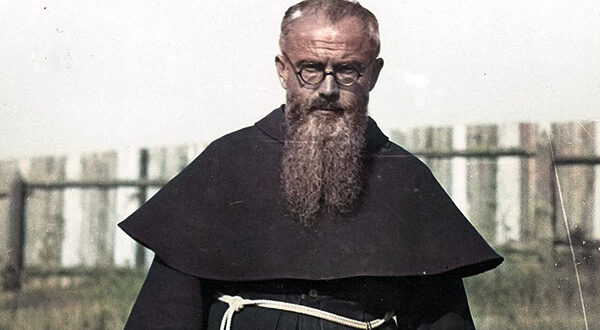
In the history of Christianity there are figures who not only teach with words, but preach with the totality of their lives. Among them stands out Saint Maximilian Mary Kolbe, a Franciscan priest who, in the midst of one of the darkest episodes of the twentieth century—the Nazi concentration camps—lived the Gospel with such radicality that his name became synonymous with heroic charity.
His story is not simply a moving account from the past. It is a profoundly relevant spiritual lesson for a world that often seems dominated by individualism, fear, and the pursuit of self-interest. Kolbe reminds us that Christian love, when lived fully, has the power to transform even places most marked by hatred.
His gesture—offering his life to save that of a father condemned to die in Auschwitz—constitutes one of the most luminous testimonies of contemporary Catholic faith.
But to understand the depth of that act, it is necessary to know his life, his spirituality, and the theological meaning of his sacrifice.
A Child Marked by a Spiritual Vision
Maximilian Kolbe was born January 8, 1894, in Poland, with the name Raymund Kolbe. His family was deeply Christian and lived the faith in a simple yet intense way.
When he was about twelve years old, an episode occurred that would mark his entire spiritual life. Kolbe himself recounted that he had a vision of the Virgin Mary, who offered him two crowns:
- a white one, symbol of purity
- a red one, symbol of martyrdom
The Virgin asked him which one he accepted. The young Raymund responded:
“I accept both.”
This experience was not simply an emotional moment. From a theological and spiritual perspective, it represents an interior consecration that would shape his priestly vocation and his total surrender to God.
Christianity teaches that holiness does not arise from improvisation, but from a free response to the love of God. In Kolbe’s case, that response began very early.
Franciscan Vocation and Missionary Passion
Raymund entered the Order of the Conventual Franciscans, where he adopted the name Maximilian Mary, reflecting his deep devotion to the Virgin.
He was ordained a priest in 1918, in Rome.
But his priesthood would not be conventional.
Saint Maximilian understood that the twentieth century was entering an era marked by anti-Christian ideologies, secularization, and a profound spiritual crisis. In response, he decided to confront it not with violence, but with the means of the Gospel.
He founded a spiritual movement called:
The Militia of the Immaculate (Militia Immaculatae)
Its goal was simple yet radical:
- to bring souls to Christ
- to consecrate them to the Virgin Mary
- to combat evil through love, prayer, and evangelization
Kolbe used modern means for his time: printing presses, magazines, mass publications, and radio. He eventually founded a large Franciscan community called Niepokalanów, which became one of the largest evangelizing centers in the world.
His vision was clear:
Evangelization must reach every corner of the world.
The Theological Heart of His Spirituality: Consecration to Mary
To understand Saint Maximilian Kolbe, it is necessary to understand his Marian spirituality.
He saw the Virgin Mary as the surest path to Christ.
But this was not a superficial devotion. His Marian theology was deeply profound. Kolbe reflected extensively on the mystery of Mary as the creature totally united to the Holy Spirit, even referring to her in his writings as:
“The created Immaculate Conception.”
His central idea was that the Christian, by consecrating himself to Mary, becomes an instrument completely available to God.
In other words:
- Mary forms Christ within the soul
- the Christian becomes a missionary of God’s love
This vision continues to influence Catholic spirituality today.
The World Enters War
In 1939, Germany invaded Poland and the Second World War began.
Kolbe’s monastery was closed by the Nazis. Nevertheless, the Franciscans continued helping refugees, including persecuted Jews.
In 1941, Kolbe was arrested by the Gestapo.
His destination: the Auschwitz concentration camp.
There he received the number 16670.
In the Nazi camps, the intention was not only to destroy the body but also human dignity itself. Yet testimonies from prisoners reveal that Kolbe acted as a true pastor even in the hell of Auschwitz:
- he heard confessions
- he shared his food
- he comforted prisoners
- he prayed with them secretly
His faith became a source of hope in a place designed to eliminate all hope.
The Moment That Changed History
In July 1941 an event occurred that would forever mark the memory of the world.
A prisoner escaped from the camp.
As punishment, the Nazis decided to select ten men at random to die of starvation in an underground bunker.
Among those condemned was a man named Franciszek Gajowniczek, a father of a family.
When he heard his sentence, he cried out in despair:
“My wife! My children!”
Then something unexpected happened.
Father Kolbe stepped out of the line.
He walked toward the Nazi officer.
And he said:
“I am a Catholic priest. I want to die in place of that man.”
Amazingly, the officer accepted.
Gajowniczek was spared.
Kolbe entered the bunker of death.
The Bunker of Death: A Church in the Midst of Horror
For days, the prisoners in the bunker heard something incredible.
Instead of screams of despair, they heard prayers and hymns.
Kolbe led the rosary and encouraged the other condemned men.
The guards testified that the bunker seemed like a chapel.
After two weeks, only Kolbe was still alive.
Finally, he was executed with a lethal injection of carbolic acid on August 14, 1941.
He died peacefully.
His act became one of the most extraordinary examples of love in the twentieth century.
The Theological Meaning of His Sacrifice
The Church considers Kolbe a martyr of charity.
His death literally embodies the words of Christ:
“Greater love has no one than this: to lay down one’s life for one’s friends.”
(John 15:13)
This verse is key to understanding the theology of Christian sacrifice.
Christ did not only preach love—He lived it to the point of the Cross.
The saints imitate this logic of the Gospel.
Kolbe did not die merely out of human altruism.
He died out of Christian love, which has concrete characteristics:
- it is free
- it is sacrificial
- it seeks the good of the other before one’s own
His act reflects what theology calls imitatio Christi (imitation of Christ).
In Auschwitz, Kolbe lived a small personal “cross” that reflected the great Cross of Christ.
An Urgent Message for the Modern World
The story of Saint Maximilian Kolbe does not belong only to the past.
We live in an era marked by:
- social polarization
- a culture of discard
- individualism
- fear of sacrifice
Kolbe’s gesture confronts us with an essential question:
How far are we willing to love?
Holiness does not necessarily consist in heroic gestures like his. But it does involve living Christian love in everyday life.
How to Apply the Example of Saint Maximilian Kolbe Today
1. Rediscover the Value of Sacrifice
Our culture avoids suffering at all costs. Yet Christianity teaches that true love involves sacrifice.
This can be lived in simple things:
- giving time to someone in need
- forgiving an offense
- helping without expecting a reward
2. Live a Deep Marian Spirituality
Kolbe reminds us that the Virgin Mary is not a decorative element of faith, but a spiritual guide.
To consecrate oneself to Mary means asking her to:
- transform our hearts
- bring us closer to Christ
- teach us how to love as she loves
3. Defend Human Dignity
Kolbe saw in every person the image of God.
In a world where many are discarded—the elderly, the poor, migrants, the sick—his example invites us to protect the dignity of every human being.
4. Be Light Even in Difficult Environments
Kolbe did not preach in a full church.
He preached in Auschwitz.
This teaches us that Christians are called to live their faith:
- at work
- at university
- in the family
- in society
Even when the environment is not favorable.
A Legacy That Still Lives
In 1982, Pope John Paul II canonized Maximilian Kolbe and called him:
“A martyr of charity.”
At the ceremony was present the man whose life he had saved.
Franciszek Gajowniczek lived until 1995, able to see his family grow thanks to the sacrifice of the priest.
This fact reminds us that true love generates life even after death.
Conclusion: The Love That Conquers Hatred
Saint Maximilian Kolbe had no political power.
He had no weapons.
He had no military influence.
But he possessed something stronger:
a heart transformed by the Gospel.
In the place where hatred seemed to triumph, he chose to love.
In the place where everyone struggled to survive, he chose to give himself.
And in the place where death reigned, he left an eternal message:
The love of Christ is stronger than any darkness.
Today every Christian is called to continue that legacy—not necessarily by dying for another, but by living each day for others.
Because in the end, the true greatness of the Christian life is measured by one single question:
How much have we loved?